pastel
#
portrait
#
portrait drawing
#
genre-painting
#
pastel
#
rococo
Dimensions: height 59.2 cm, width 46.2 cm, weight 5.2 kg, height 67.6 cm, width 54.3 cm, thickness 3 cm
Copyright: Rijks Museum: Open Domain
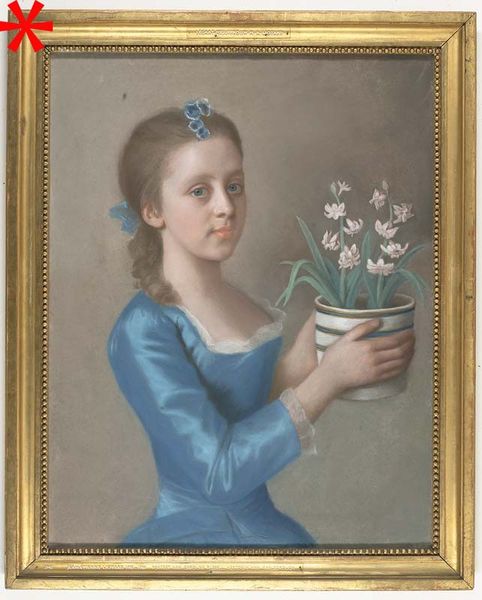
Editor: This is "Young Girl Holding a Pot of Hyacinths," a pastel portrait by Jean-Étienne Liotard, dating from around 1750 to 1755. I'm struck by the delicate colors and the girl's somewhat self-conscious expression. What kind of statement was Liotard making? Curator: A fascinating piece! It operates within the Rococo period's fascination with innocence, but it simultaneously showcases the emerging role of art as a display of social status. The young girl, undoubtedly from a privileged background due to her dress and the leisure activity depicted, is framed holding hyacinths. Editor: The flowers seem so…fragile. Curator: Precisely! Hyacinths, newly fashionable at the time, were cultivated in elaborate, costly Delftware pots. Their inclusion points not only to the family's wealth, displayed with these fashionable and seasonal blooms, but to an awareness of botanical science, something increasingly associated with enlightenment ideals. Editor: So, it’s not just a pretty picture, but also a representation of power and cultural capital? Curator: Exactly. Portraits like these actively participated in constructing a public image of the sitter's family. Think about where such portraits would have been hung, and for whom. Were they designed primarily to impress other members of their social class? How does it shape your viewing knowing these sorts of dynamics were at play? Editor: I never considered how much these domestic objects are involved with social signaling in artwork like this. This makes me see the portrait in a completely new way, with a sharper awareness of the subtle displays of status woven into something that seems, at first glance, just delicate. Curator: The politics of imagery often hide behind seemingly simple subjects! Paying attention to how social contexts intertwine with art broadens our appreciation, even for these seemingly innocent depictions of the wealthy.
Comments

rijksmuseum over 2 years ago
⋮
It is difficult to be certain whether this pastel was intended as a portrait or a genre piece. In Liotard’s family it was known as a portrait of the Duchess of Marlborough, but that is improbable. More freely conceived than his more formal portraits, and with a softer, more melting use of pastel, it should perhaps be classified with La Liseuse as a generalised evocation of youthfulness.


Join the conversation
Join millions of artists and users on Artera today and experience the ultimate creative platform.
 Collect
More like this