drawing, ornament, coloured-pencil, watercolor
drawing
neoclacissism
ornament
coloured-pencil
watercolor
coloured pencil
decorative-art
Dimensions: height 220 mm, width 178 mm
Copyright: Rijks Museum: Open Domain
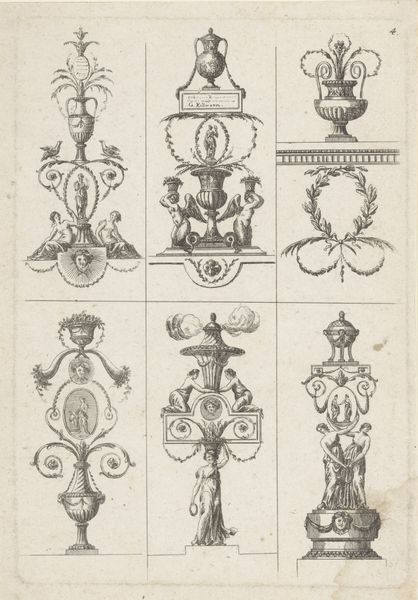
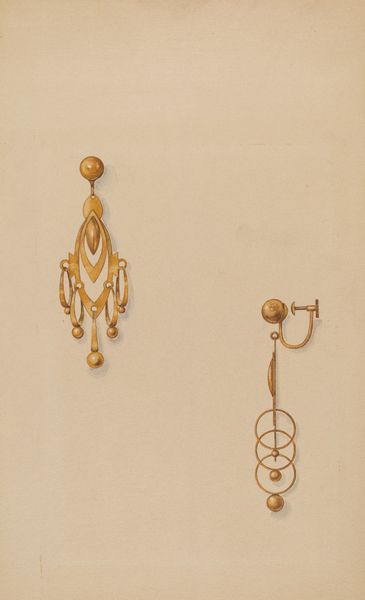
Curator: Well, aren't these little designs precious! They almost feel like golden sketches from a fairy tale. Editor: They are quite charming, yes. We’re looking at "Negen ontwerpen van hangers," or Nine Designs for Pendants, attributed to Carl Friedrich Bärthel, dating from around 1800 to 1810. Bärthel was working during the rise of Neoclassicism, so his clean, elegant designs, rendered in colored pencil and watercolor, certainly reflect that aesthetic. Curator: Neoclassical, right! It's so orderly, like jewelry envisioned by an architect, almost devoid of ornamentation. I feel there is also a theatrical almost stage-like dimension about the display of these individual pieces, all lined up like performers awaiting their cue to come on! Editor: Indeed. There’s an interesting tension here. Neoclassicism often linked back to antiquity. The simplicity might have also served a social purpose: distancing from the opulent styles of the aristocracy during a period marked by the rise of Napoleon and emerging ideas about the place of artwork. It's interesting to note that Bärthel would've been involved in a socio-political dynamic around luxury! Curator: Oh! And those colors— such subtlety. The hues feel so muted, so whispery. It reminds me of old love letters with gold lettering fading on parchment. The details and shading create a soft warmth against the plain background which enhances this warm tonality and invites you closer in. Editor: That restrained palette also points to shifts in what was considered desirable or appropriate in public-facing items. Think about the rising merchant class. Their aesthetic choices were certainly changing expectations and values during the Napoleonic Era, influencing not only visual culture but potentially access to these refined and meticulously detailed works of art. Curator: I see, yes, you do make me think about where a pendant sits within the context of what to make public and private with regards to expression. Thinking about wearing your heart on a hanger instead of your sleeve now makes more sense... It makes you wonder whether the wearer wants this on display as jewelry for all to see! Editor: Absolutely, it raises intriguing points around the meaning of adornment, a cultural pivot we are now a little more attuned to thanks to historical understanding. What do you think? Shall we continue? Curator: It's always so much fun going into a jewelry box together!
Comments
No comments
Be the first to comment and join the conversation on the ultimate creative platform.
 React
React Comment