Dimensions: Overall: 6 1/8 in. (15.5 cm)
Copyright: Public Domain
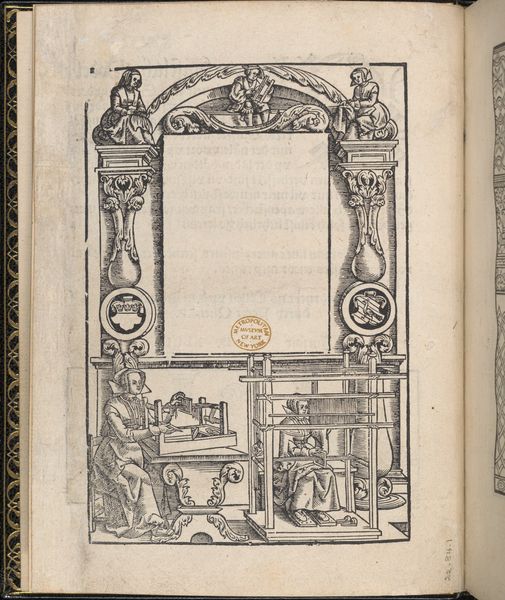
Curator: The image before us is an engraving from 1543 entitled "Orus Apollo de Aegypte," attributed to Jacques Kerver, currently housed in the Metropolitan Museum of Art. The medium is a rather crisp engraving. Editor: Stark. The high contrast creates a somewhat austere impression, like sunlight piercing through heavy drapes. The composition leads my eye right to the center—a flame. Curator: Indeed, note how the engraving technique emphasizes light and shadow. The radiant lines emanating from the flame dominate the visual space. It employs line texture to describe form. Tell me, what effect does that linear density and directional movement impart? Editor: It lends a certain visual vibration. Energetic, even. But tell me, the scene seems almost staged. What narrative context do you see here? Curator: It’s tied to Renaissance humanism's fascination with classical and Egyptian knowledge. “Orus Apollo,” is an exploration of hieroglyphic symbolism and thought. Figures and creatures represented particular concepts—like the serpent that indicates time and celestial change. Consider the politics of knowledge inherent here—who had access to such esoteric information and how this could reflect the religious power structures? Editor: A visual argument rooted in symbol, mediated by artistic expression. Interesting how it attempts to give graphic form to knowledge systems, even imposing a European perspective. This is certainly very interesting when viewed within the culture of period book printing at the time! Curator: Precisely. The image itself is less about empirical depiction, and more about conveying complex associations that would only be readable to those trained. It's a fascinating insight into medieval methods of translating imagery and symbolic vocabularies. Editor: Reflecting on the semiotic and compositional qualities here, one finds this piece interesting given it attempts to graphically create and project not merely record an understanding, making visible an interpretative code. It stands, an artifact mediating power and artistic intention through this fascinating dance between visual expression, Renaissance inquiry and systems of thought. Curator: The very act of encoding is an act of selecting meaning, then reflecting that intention, mediated by visual expression, a statement about the historical moment.
Comments
No comments
Be the first to comment and join the conversation on the ultimate creative platform.
 Collect
 React
React Comment
More like this