oil-paint
#
figurative
#
narrative-art
#
oil-paint
#
figuration
#
oil painting
#
ancient-mediterranean
#
history-painting
Copyright: Public Domain: Artvee
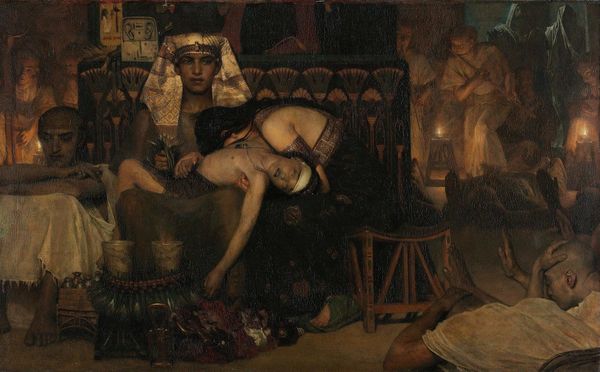
Editor: Here we have Lawrence Alma-Tadema's "The Egyptian Widow," painted in 1872. The oil paint lends a striking realism to the scene, but the subject matter feels quite heavy and sorrowful. What historical context shaped a piece like this? Curator: Absolutely. Tadema wasn't just depicting a scene; he was interpreting Victorian sensibilities around mourning, using ancient Egypt as a mirror. How does seeing it this way shift your understanding? It critiques imperialism through sentimentality. Editor: I hadn't thought of it as critiquing imperialism. How so? Curator: Think about the Victorian fascination with Egypt: objects looted and displayed in museums stripped of cultural meanings. By focusing on personal grief within that context, the painting subtly highlights that loss and the West’s appropriation. What kind of agency, if any, does the woman possess in this carefully crafted representation of widowhood? Editor: It seems as though her grief is on display rather than deeply felt. There is a sense of staging, even exploitation. I didn't pick that up at first. Curator: Precisely! Tadema stages it all in that exotic backdrop to underscore the West’s distorted image of Egypt. Consider how that depiction also reinforced a hierarchy, where the colonizer gazes upon the colonized, even in mourning. Editor: That’s a lot to unpack, especially when you first just see a pretty, historical scene. I am struck how looking closer through social, gender and political frames reveals deeper critiques that I would not have known without context. Curator: Right? It demonstrates art’s fascinating ability to operate on multiple layers! Looking at pieces such as this makes the museum experience richer, if not troubling.
Comments

rijksmuseum over 2 years ago
⋮
The Frisian artist Alma-Tadema was a great success in England, where he was even knighted. His representations of ancient Egyptian, Greek and Roman scenes made him one of the most popular 19th-century painters. In this picture, full of archaeological details, a woman is mourning beside the inner mummy case containing the body of her husband. His sarcophagus stands at left, while priests and singers lament the departed.


Join the conversation
Join millions of artists and users on Artera today and experience the ultimate creative platform.
 Collect
More like this