mixed-media
#
neoclacissism
#
mixed-media
#
landscape
#
handmade artwork painting
#
genre-painting
#
miniature
Dimensions: height 57.5 cm, width 155.5 cm, depth 25 cm, height 45 cm, width 150 cm, depth 30 cm
Copyright: Rijks Museum: Open Domain
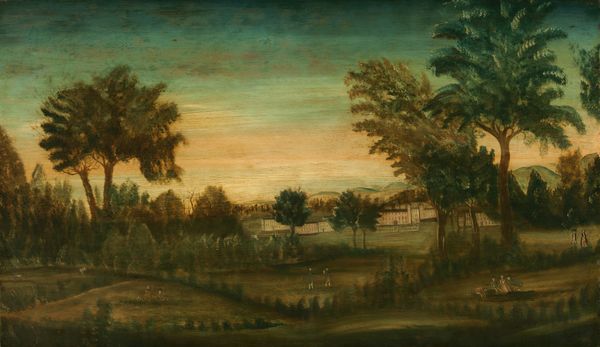
Curator: The "Diorama of the Zeezigt Coffee and Cotton Plantation" by Gerrit Schouten, dating from about 1815 to 1821, offers a glimpse into the world of early 19th-century Suriname. Schouten, known for his meticulously detailed mixed-media dioramas, presents us with a striking vision of colonial life. Editor: It's so meticulously constructed! There's something unsettling, almost dreamlike about it. The perspective seems deliberately flattened, creating a sense of both intimacy and distance. It is romantic, almost idyllic, until you consider the system supporting this fantasy. Curator: Absolutely. Schouten’s work gives us an important opportunity to confront the legacy of Dutch colonialism in Suriname. While aesthetically pleasing, it also exposes the visual language through which colonial powers constructed their dominance, concealing the exploitation and forced labor upon which plantations relied. The commission of such idyllic depictions reflects the values of a very particular patron class, seeking to legitimize and perhaps even beautify their role in this system. Editor: The landscape feels performative. Look at the symbols here; the neoclassical architecture speaks to the aspirations of the colonizers. And the water—it isn't just part of the scene, is it? As a visual cue, water symbolizes both passage and power—the passage to riches and resources that was forcefully seized. But it also suggests separation, the vast distance between colonizer and colonized. What would an image look like if rendered through the eyes of a native person at this time? Curator: Precisely. While Schouten was not himself European, but rather of mixed European and Asian descent, the patronage and social context certainly shaped the artwork’s intended meaning. He depicts the coffee and cotton plants almost lovingly, highlighting their economic importance. I notice a conspicuous absence in rendering details for enslaved people working the plantation: their individual identities are flattened to support the central narrative of a thriving, organized system, thus exposing how class distinctions defined access to the production of cultural material at that moment. Editor: Right, which is why it's so important to unpack these depictions. The diorama isn't just a landscape; it's a curated narrative, one that participated in perpetuating particular economic and power dynamics, even while ostensibly just reflecting them. I come away with more questions about what the diorama hides than satisfaction for what it overtly represents. Curator: And that questioning, that engagement with the undercurrents of history and representation, is precisely the goal when encountering artwork of this nature. We understand more about the world, then and now, by considering Schouten's diorama.
Comments

rijksmuseum over 2 years ago
⋮
In the mid-19th century, almost 800 men, women and children held in slavery worked on the Zeezigt coffee and cotton plantation. Yet only a few of them are to be seen in the diorama. They sweep the coffee-drying floor, spread the cotton in the sun and work in the carpentry workshop. Schouten also depicted an overseer on horseback taking a fugitive man back to the plantation.


Join the conversation
Join millions of artists and users on Artera today and experience the ultimate creative platform.
 Collect
More like this