
Curatorial notes
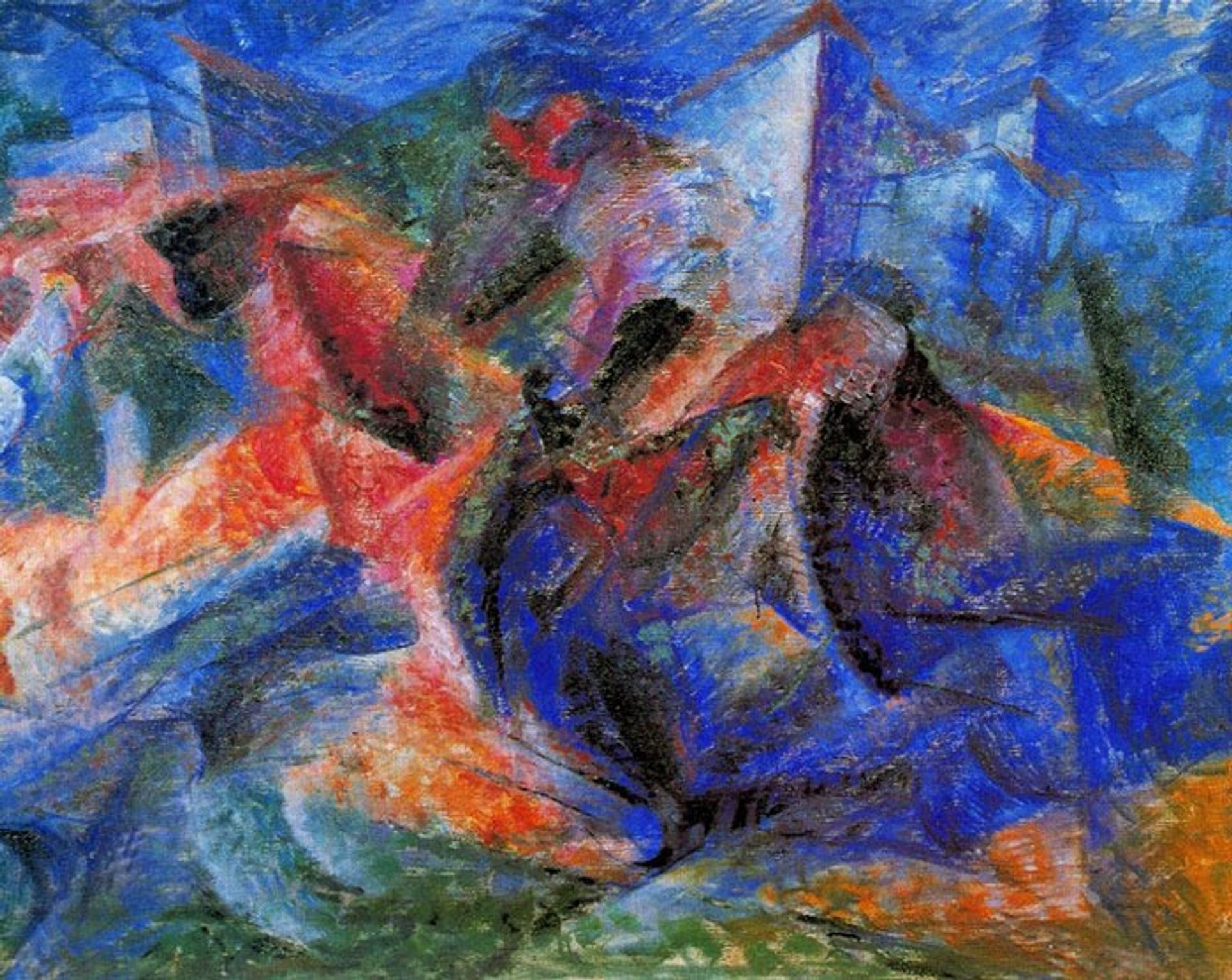
Curator: At first glance, Umberto Boccioni's "Horse+Rider+Houses," painted in 1914 with oil paint, feels like an explosion contained on canvas. It’s wonderfully chaotic! Editor: Chaotic, yet evocative of a very particular feeling...speed! Boccioni clearly intends to capture not just the appearance, but the sensation of movement, a horse and rider almost dissolving into the urban landscape. Curator: Absolutely. The horse, traditionally a symbol of power and forward motion, practically blends into these geometric, fragmented buildings, wouldn't you say? What meaning does that evoke? Editor: It signifies humanity’s relentless pursuit of progress. The buildings, rendered as angular shards, are emblematic of the modern city—ever-changing, ever-rushing towards the future. Even the colors—blues and oranges colliding—seem charged with an almost anxious energy. Curator: I do love your perception there. Boccioni, and Futurism in general, obsessed over this dynamic between humans, animals, and technology. You can almost feel their giddy anticipation of a world transformed by speed and industry. Editor: Giddy and yet also anxious, that's true. This fragmented style could symbolize a loss of the pastoral. I sense, a subtle lament for a world being overtaken by mechanical forces. The rider seems barely in control, doesn't he? Curator: It's an incredible balancing act, isn't it? He yearns for the future, yet mourns a world he remembers slipping away, like a half-remembered dream. Editor: Precisely. And perhaps that's the key. "Horse+Rider+Houses" is not just a painting, but a powerful emotional landscape rendered in visual form, using symbols to express very real ambivalences and anxieties. Curator: And what better way to freeze-frame a feeling than on the cusp of total transformation? A horse frozen mid-gallop as if wondering when it became engulfed in its world. Editor: What better image indeed? Even now the work acts like a powerful symbolic echo that we have clearly been running toward for a long time, while glancing over our shoulder and wondering whether this is where we are truly meant to be.