1797
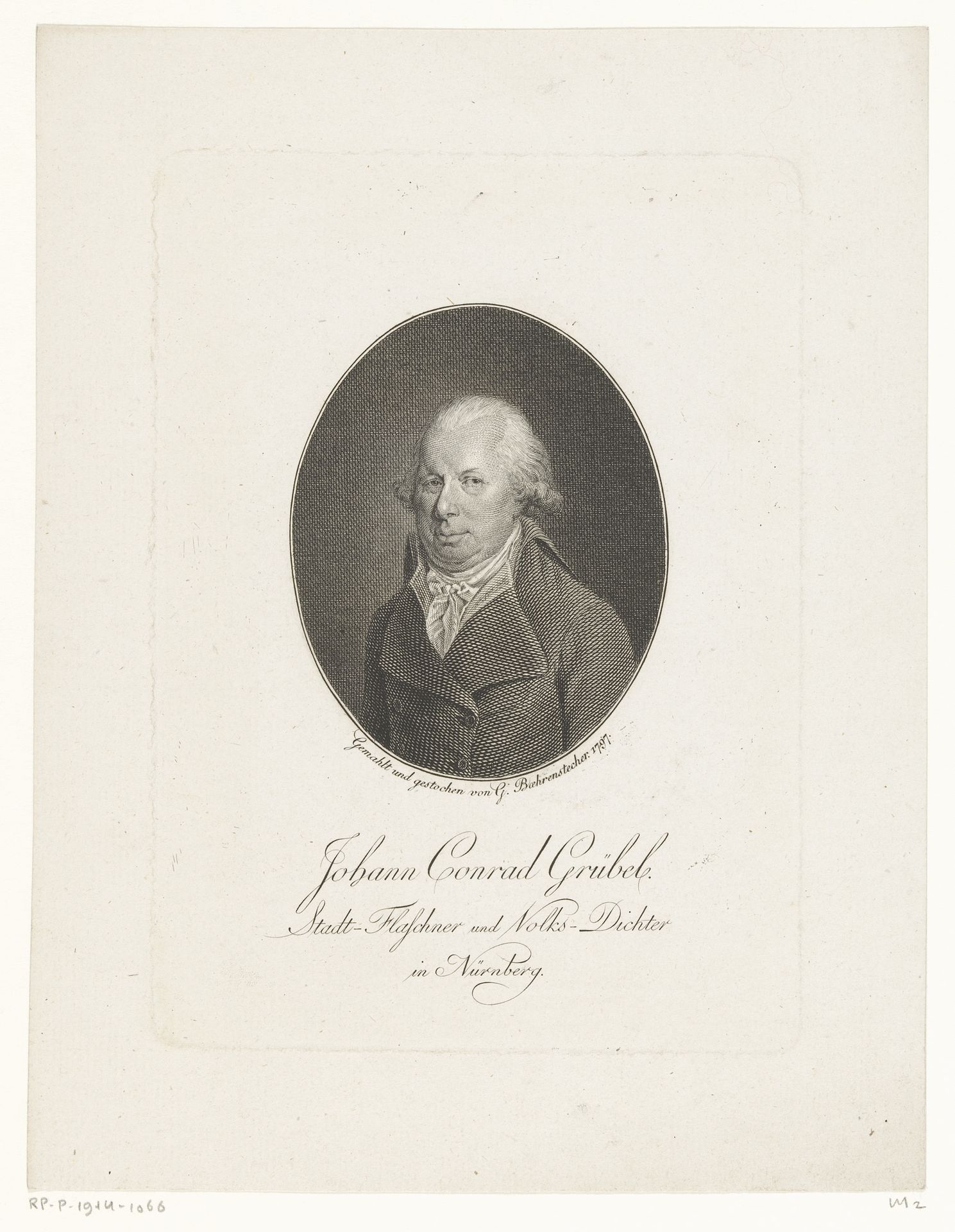
Portret van Johann Conrad Grübel

Listen to curator's interpretation
Curatorial notes
Curator: Here we have a work created in 1797 entitled "Portret van Johann Conrad Grübel", executed by Johann Gottlieb Baerenstecher. It’s an engraving. Editor: Right. My first impression is...contained. Like someone trying to sit very still for a very long time. A kind of restrained dignity, all in monochrome. It has something charming in this classical shape and fine lines. Curator: Precisely. Engravings like this served an important function in the late 18th century. Consider that portraiture, before photography, was a key method for disseminating images of prominent individuals. Baerenstecher's print gives us a glimpse into the visual culture surrounding figures like Johann Conrad Grübel. Editor: So, it’s part PR, part historical document, huh? Is there an almost cookie-cutter aspect in making similar pieces that served for other influential figures? The way he is neatly positioned into this ellipse does makes him seem like an official figure! I wonder what it meant to Grübel to have his portrait disseminated that way. Did he have any say in it? Curator: It's definitely worth asking what Grübel thought about the process. In terms of broader trends, this image fits neatly into the Neoclassical movement, which favored order, reason, and references to classical antiquity. Prints were a very effective tool for spreading Neoclassical taste, far beyond paintings or sculptures displayed in wealthy people's houses. It would be intresting to explore at that time to what extent this genre can have also affected the way that society appreciated art and expressed political ideas. Editor: Right, the efficient dissemination. Which always impacts content, no matter what. Now that you mention it, his stern facial expression looks definitely in agreement with that neoclassic spirit! The more I stare at him the more I'm curious about this guy: how much control artists and figures such as Grübel could exert, if at all, in dictating the tone for portraying them, their "image". Curator: The extent to which the artist or subject had control over their image in printed portraits is complex. By analyzing the surviving correspondence and patronage records, one could potentially trace these collaborative decisions... In essence, what this portrait of Johann Conrad Grübel captures for us is not only a likeness but also a network of cultural meanings. Editor: Networks indeed. Art is just made of it! The very fine strokes are particularly eloquent of this, if you ask me. Anyway, quite the contained and yet rich world hiding inside this classical shape. I will make sure to dig deeper!