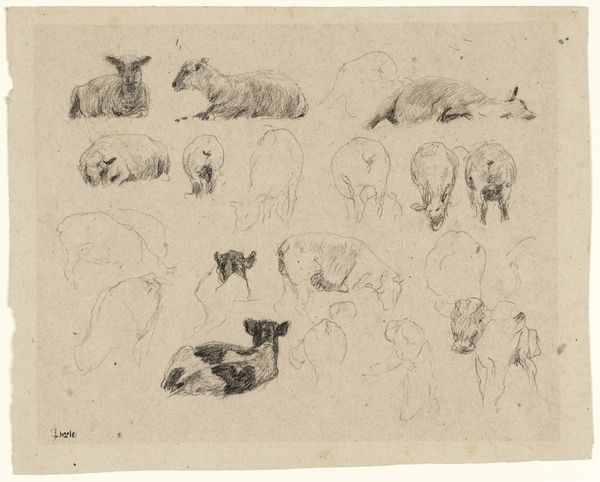
drawing, paper, charcoal
#
drawing
#
animal
#
dutch-golden-age
#
incomplete sketchy
#
landscape
#
paper
#
genre-painting
#
charcoal
#
watercolor
#
realism
Dimensions: height 193 mm, width 300 mm
Copyright: Rijks Museum: Open Domain
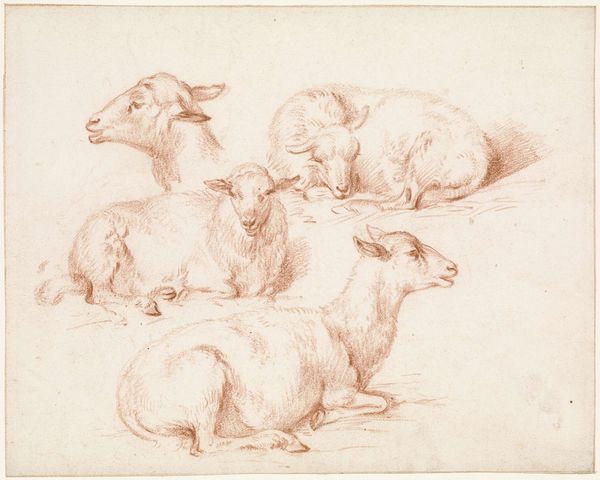
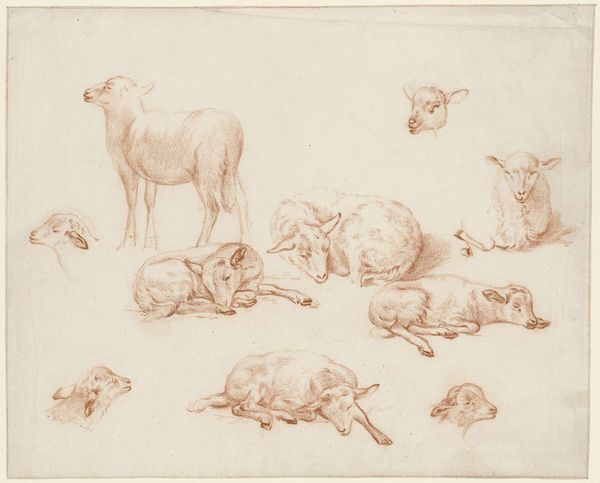
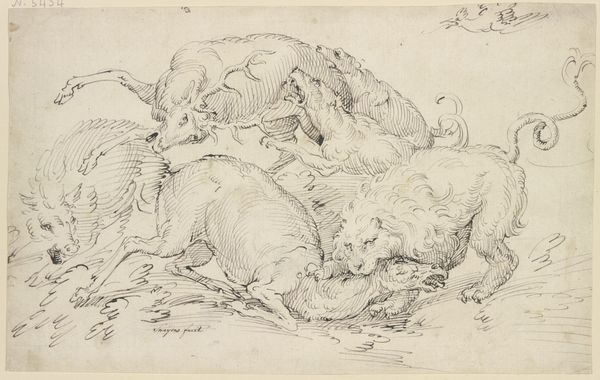
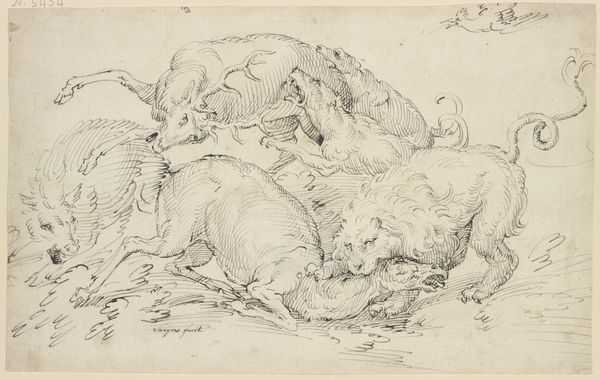
Editor: We’re looking at “Studies van lammetjes,” or “Studies of Lambs,” a drawing by Jan van Ravenswaay from 1821. It's rendered in what appears to be charcoal on paper. I’m immediately drawn to the sketch-like quality. The composition feels like a page from a naturalist's notebook, almost as if he caught these lambs mid-nap. What strikes you when you look at this work? Curator: The means of production here is incredibly telling. Van Ravenswaay employs drawing – a readily available and relatively inexpensive medium – to depict these animals. We must consider who had access to these materials and how such accessibility shaped artistic output. The sketchiness, as you mentioned, isn't just stylistic; it suggests a practical engagement with recording the realities of animal husbandry, which was of growing economic importance in the 19th century. The drawing is not an end in itself, but part of a larger production process of rural life. What would have been the impact of industry? Editor: I see your point. So the art isn’t about pure aesthetics, but it reflects larger systems? Did it influence how people understood farming practices? Curator: Exactly. Think about the role of imagery in shaping perceptions. These lambs are rendered with a certain tenderness, which contrasts with their economic function as livestock. Were the economic functions softened for a more sensitive consumer? Also, notice the multiple studies. It’s as though Ravenswaay is refining a prototype, linking artmaking with industrial processes of trial, error and reiteration that define artistic production. Editor: That’s a completely different perspective than I initially had! I hadn't considered the impact of production this deeply. Curator: It’s about interrogating what constitutes art. This wasn't necessarily destined for a gallery; it might have been a preliminary study for a larger work, a teaching tool, or even a commercial pattern. Considering these potential uses redefines our understanding of artistic labor. Editor: I'm definitely going to look at art with an eye toward material conditions from now on. It changes the whole way you understand its place in the world.
Comments
No comments
Be the first to comment and join the conversation on the ultimate creative platform.
 Collect
 React
React Comment
More like this