About this artwork
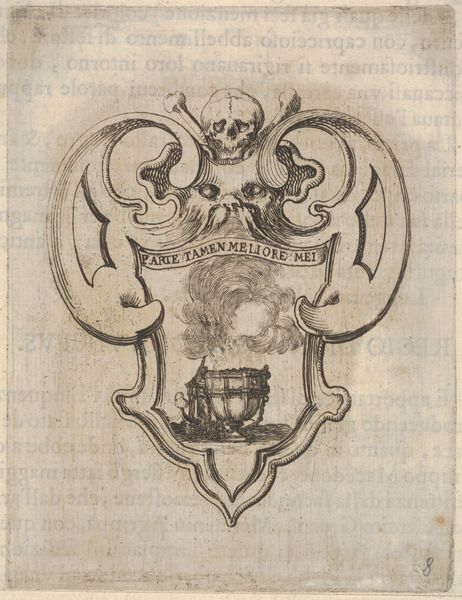
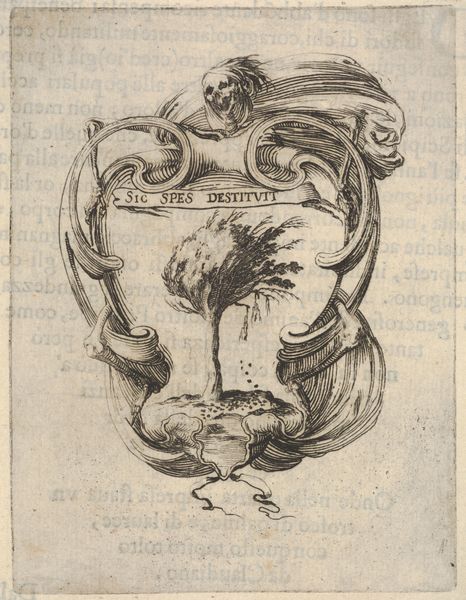
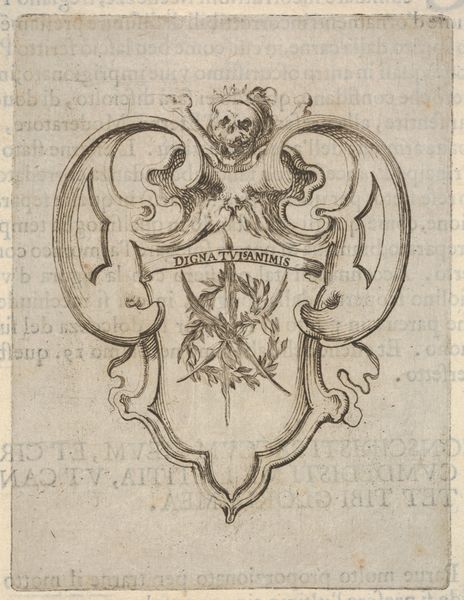
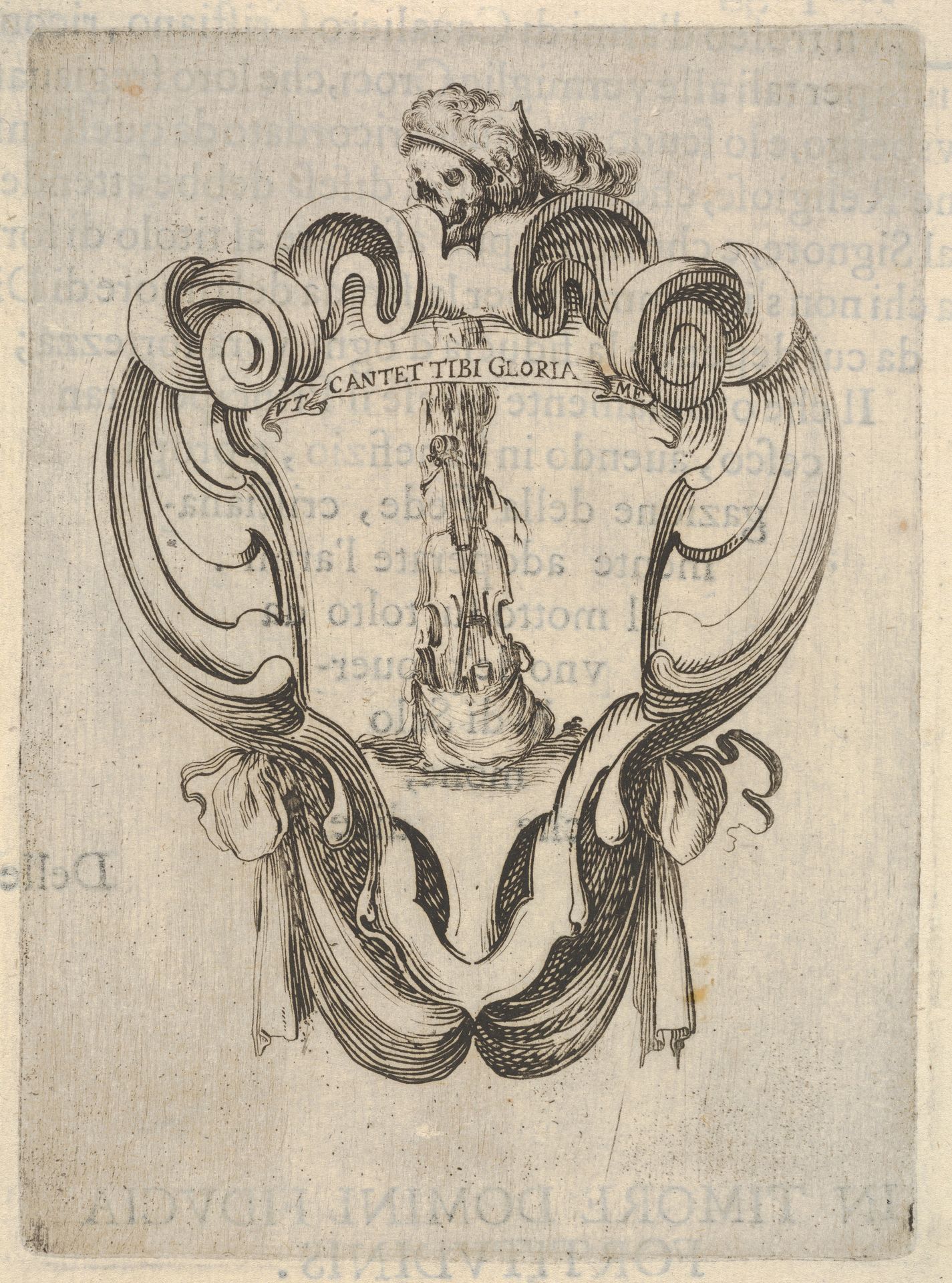
Curator: Let’s turn our attention to this etching by Stefano della Bella, dating back to the mid-17th century. The piece is titled "A cartouche with a violin coming out of its case, a skull with a helmet with feathers at top, from 'Eight Emblems for the Funeral of Francesco de Medici.'" Quite a mouthful, I know. Editor: Woah. My first thought? Melancholy hits a high note! I mean, a violin emerging from a case juxtaposed with a skull—it’s like a serenade to mortality. Stark, ornate, baroque…it’s all whispering "remember you must die." Curator: Precisely. The imagery speaks volumes, doesn't it? The cartouche itself is lavish, but the inclusion of the skull suggests a 'vanitas' theme, a reflection on the transience of life. The violin, poised to play, perhaps symbolizes the fleeting beauty and brevity of earthly pleasures. Editor: Right? You almost hear a ghostly melody about to fade. And that feathered helmet on the skull—it’s almost theatrical, like death is dressed up for a grand performance. Is the whole thing about reminding Prince Francesco what he’s leaving behind, all the finery of court? Curator: Perhaps. It was designed as one of a series of emblems for his funeral, and so the work almost certainly comments on his place as a member of the Medici. This print acts as a structured symbolic exercise rather than merely a somber portrayal of mortality. Look how Bella organizes symbolic images within its very formal and decorative framework to convey the significance of this death to Medici political power. Editor: The text swirling above the violin, can’t quite make it out… it almost sings a praise to what has passed, “Cantet tibi Gloria”—“Glory to thee.” What are we to learn about glory and the things we leave behind, beyond artful lament? Curator: A complex idea, but certainly this work prompts introspection, doesn't it? Bella masterfully interweaves artistic flair with reminders of our mortality. Editor: It's Baroque memento mori with a dash of operatic flair. A somber tune to which time marches to! I think this piece teaches that facing death isn't just morbid; it is also an exercise of accepting all facets of the life that was, both triumphs and fleeting pleasures.
A cartouche with a violin coming out of its case, a skull with a helmet with feathers at top, from 'Eight Emblems for the Funeral of Francesco de Medici' (Huit emblèmes pour les funérailles du prince François de Médicis)
1640 - 1660

Stefano della Bella
1610 - 1664
The Metropolitan Museum of Art
Metropolitan Museum of Art, New York, NYArtwork details
- Medium
- drawing, print, etching, engraving
- Dimensions
- sheet: 8 9/16 x 5 1/2 in. (21.7 x 14 cm) mount: 10 3/8 x 7 3/16 in. (26.3 x 18.3 cm)
- Location
- Metropolitan Museum of Art, New York, NY
- Copyright
- Public Domain
Tags
Comments
Share your thoughts
About this artwork
Curator: Let’s turn our attention to this etching by Stefano della Bella, dating back to the mid-17th century. The piece is titled "A cartouche with a violin coming out of its case, a skull with a helmet with feathers at top, from 'Eight Emblems for the Funeral of Francesco de Medici.'" Quite a mouthful, I know. Editor: Woah. My first thought? Melancholy hits a high note! I mean, a violin emerging from a case juxtaposed with a skull—it’s like a serenade to mortality. Stark, ornate, baroque…it’s all whispering "remember you must die." Curator: Precisely. The imagery speaks volumes, doesn't it? The cartouche itself is lavish, but the inclusion of the skull suggests a 'vanitas' theme, a reflection on the transience of life. The violin, poised to play, perhaps symbolizes the fleeting beauty and brevity of earthly pleasures. Editor: Right? You almost hear a ghostly melody about to fade. And that feathered helmet on the skull—it’s almost theatrical, like death is dressed up for a grand performance. Is the whole thing about reminding Prince Francesco what he’s leaving behind, all the finery of court? Curator: Perhaps. It was designed as one of a series of emblems for his funeral, and so the work almost certainly comments on his place as a member of the Medici. This print acts as a structured symbolic exercise rather than merely a somber portrayal of mortality. Look how Bella organizes symbolic images within its very formal and decorative framework to convey the significance of this death to Medici political power. Editor: The text swirling above the violin, can’t quite make it out… it almost sings a praise to what has passed, “Cantet tibi Gloria”—“Glory to thee.” What are we to learn about glory and the things we leave behind, beyond artful lament? Curator: A complex idea, but certainly this work prompts introspection, doesn't it? Bella masterfully interweaves artistic flair with reminders of our mortality. Editor: It's Baroque memento mori with a dash of operatic flair. A somber tune to which time marches to! I think this piece teaches that facing death isn't just morbid; it is also an exercise of accepting all facets of the life that was, both triumphs and fleeting pleasures.
Comments
Share your thoughts