

1923 - 1925
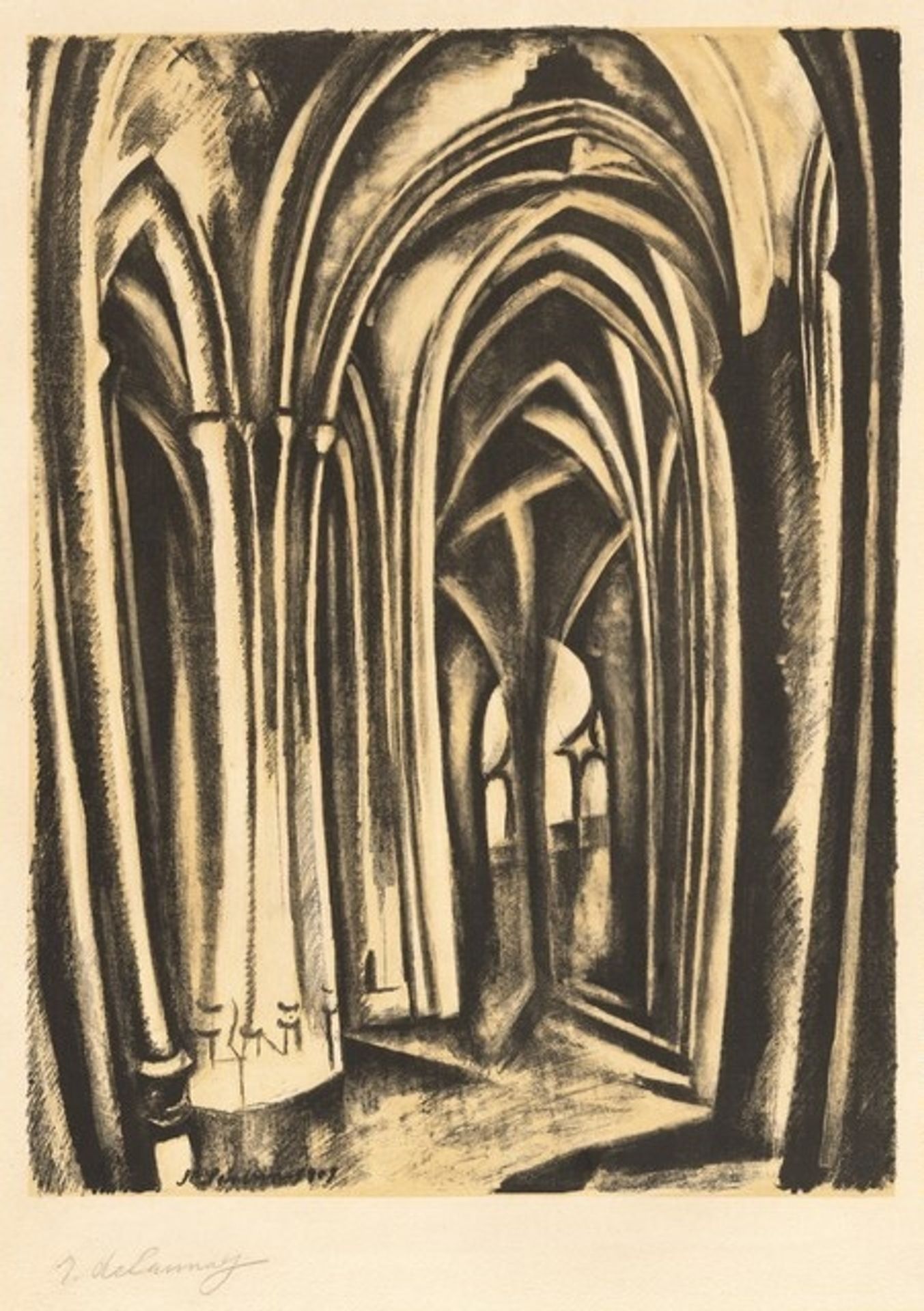
Saint-Séverin


Listen to curator's interpretation
Curatorial notes
Editor: Here we have Robert Delaunay’s "Saint-Séverin," a print, an etching from between 1923 and 1925. The lines are so bold, creating an intense architectural space that feels both familiar and strangely abstract. What captures your attention in this work? Curator: The dance of light and shadow, darling! Delaunay hasn't just drawn a church; he's bottled the very *feeling* of standing in a cathedral, craning your neck at those impossibly high arches. It's almost like a fever dream of geometry, isn't it? Do you feel that Vertigo of space and time collapsing? Editor: I do! It's dizzying, and I see some cubist elements in it. How does the architectural theme intertwine with abstraction here? Curator: Delaunay, bless his heart, was always chasing the essence of things. Here, he's stripping Saint-Séverin down to its bones – the repeating arches, the play of light. But those stark lines, that deliberate flattening of space? That’s where the abstraction comes in. It's not about *realistically* depicting the church; it’s about capturing its *soul*. It becomes a study in pure form. Do you see the way the arches almost seem to vibrate? Editor: I do, now that you mention it. They really do. So he’s showing the emotional reality more than the physical. Curator: Precisely! It is about how light, architecture, and geometric abstraction create a total sensory, even spiritual, experience. This piece is like a visual hymn! Editor: This has reshaped my view entirely! Now I can almost *hear* the organ music echoing through those abstracted arches. Curator: Ah, music to my ears too.