

1862 - 1863
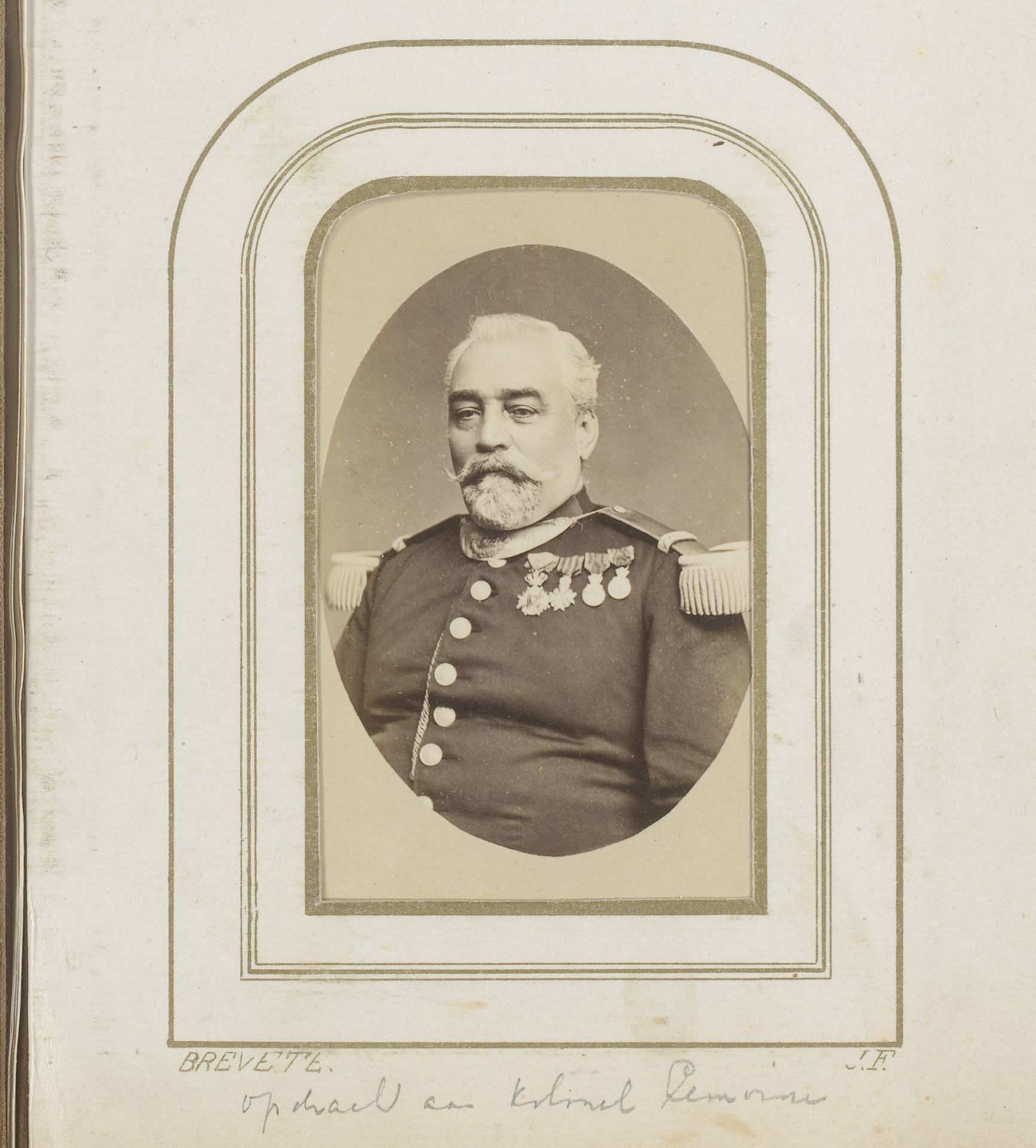
Portret van een man in uniform, staand bij een stoel met hoed

Listen to curator's interpretation
Curatorial notes
Curator: Here we see a portrait, captured between 1862 and 1863 by Maes & Michaux. It's a gelatin-silver print, titled "Portret van een man in uniform, staand bij een stoel met hoed," or, in English, "Portrait of a Man in Uniform, Standing by a Chair with Hat". Editor: Oh, he’s a striking fellow. There’s a solemn weight to him, don’t you think? Like he’s carrying the burden of something unspoken. Those medals, clustered on his chest, hint at a life of service, perhaps sacrifice. The sepia tones just add to that sense of gravitas. Curator: Absolutely. And that specific use of the gelatin-silver process allowed for finer detail, capturing not just the likeness, but also the texture of his uniform, the glint of those medals. Think of the cultural context: photography was becoming increasingly accessible, but studio portraits like these still held a certain status. It was about memorializing oneself and solidifying social standing. Editor: And yet, even within the constraints of a formal portrait, you catch glimpses of humanity. There’s a slight vulnerability in his eyes, almost as if he’s caught between duty and… something else entirely. Maybe that's just my imagination, reading into a historical document. The fact that the image captures every fine line and facial crease is a sign of a photographer focused on depicting reality instead of creating a perfect image, as some contemporaries preferred. Curator: Precisely. And when we analyze the materiality, consider the labor involved: preparing the gelatin emulsion, meticulously printing, and finishing the image. Photography in this era wasn’t a simple click; it involved skill and technical mastery. Editor: It’s amazing to think that such a small image could contain so many layers of history. I can't help but stare and imagine all the possibilities and events that had shaped him, made him who he was at that time. Curator: A convergence of chemistry, labor, and individual representation—quite remarkable. Editor: Makes you think, doesn’t it? Even portraits of soldiers, when done right, show them at their most human.