

Possibly 1887 - 1896
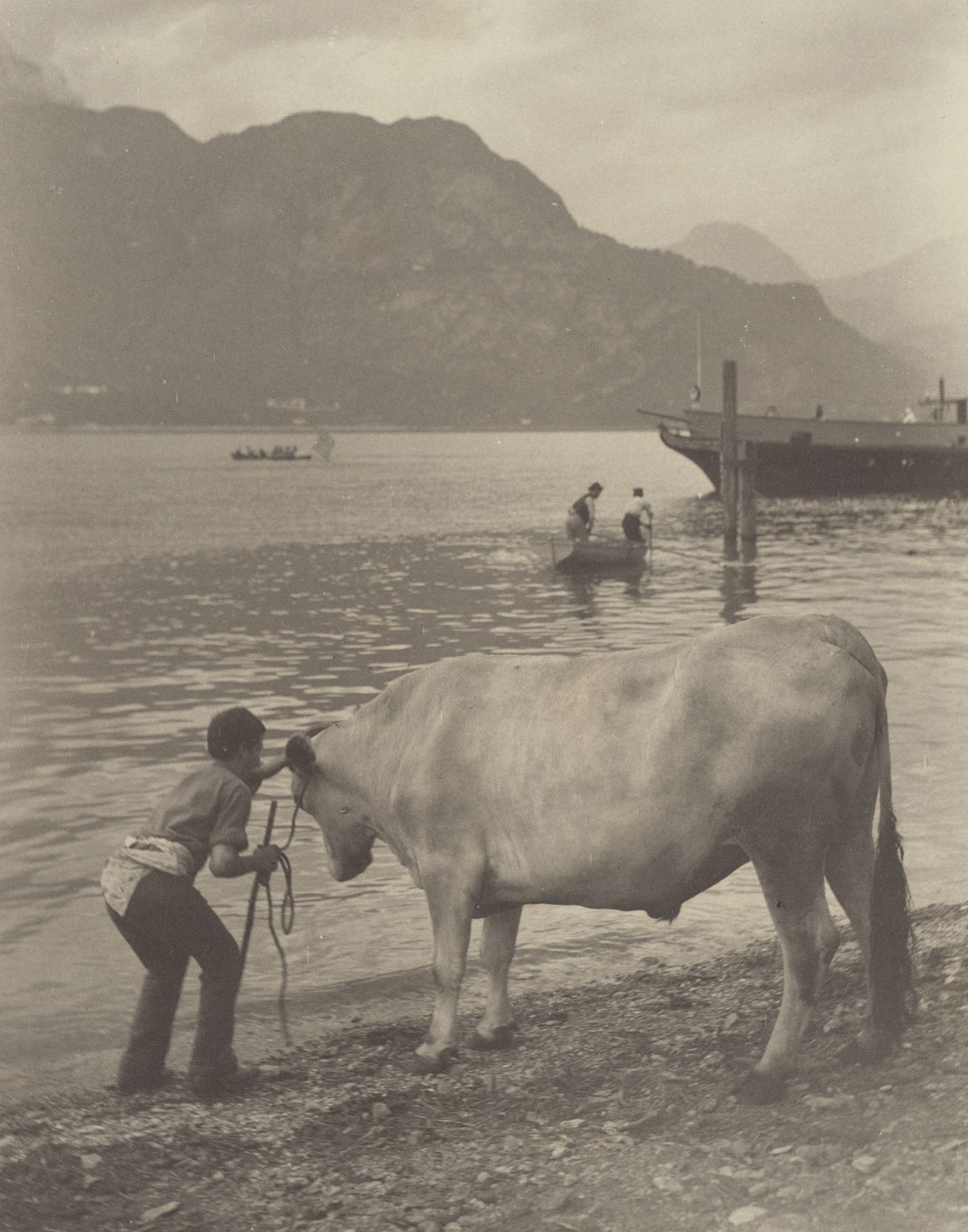
The Unwilling Bath


Listen to curator's interpretation
Curatorial notes
Curator: Let’s take a moment to consider Alfred Stieglitz’s photograph, "The Unwilling Bath," likely taken between 1887 and 1896. It's a gelatin-silver print depicting a scene by a lake. Editor: It strikes me as both pastoral and melancholic. The subdued tones lend it a sense of timelessness, yet the subdued mood hints at some underlying tension or resistance. Curator: Absolutely. The composition is quite striking. Note the clear horizontal division: the subdued reflections on the still water lead to mountainous background. The overall tonality ranges through grayscale. Editor: That tonality, so essential to its emotional weight. Think of the power dynamics at play: the boy's small stature versus the massive bulk of the animal. Consider how this image resonates with broader narratives of humans' domination over animals and perhaps how this dynamic shapes societal norms. The idea of a bath brings up other things to consider: the ritual of cleanliness versus an imposition upon another living being. Curator: A compelling interpretation. Focusing on the image's formal aspects, there's also a sense of realism conveyed by the unidealized portrayal of the animal, every line and form captured without romantic embellishment. Editor: Which invites scrutiny. Is this realism or naturalism? Because of its focus on everyday life, you must account for class. This looks to me as something a rural working-class boy would be charged to do; such quotidian interactions raise broader questions. Stieglitz was documenting a very specific lived experience. Curator: Indeed, those aspects, too, play a role. Editor: So as you examine Stieglitz’s "The Unwilling Bath", let the piece instigate thought: what does a bath entail in human and animal experience? Curator: An invitation to closely observe both its form and resonate with its socio-historical dimensions.