About this artwork
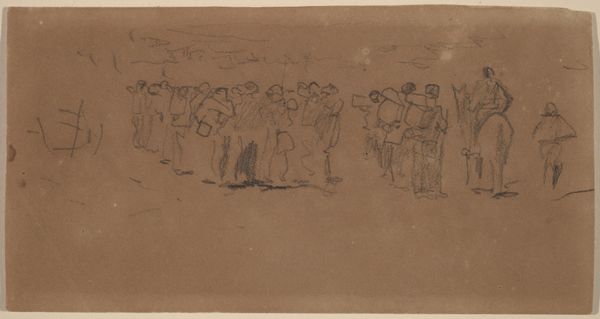
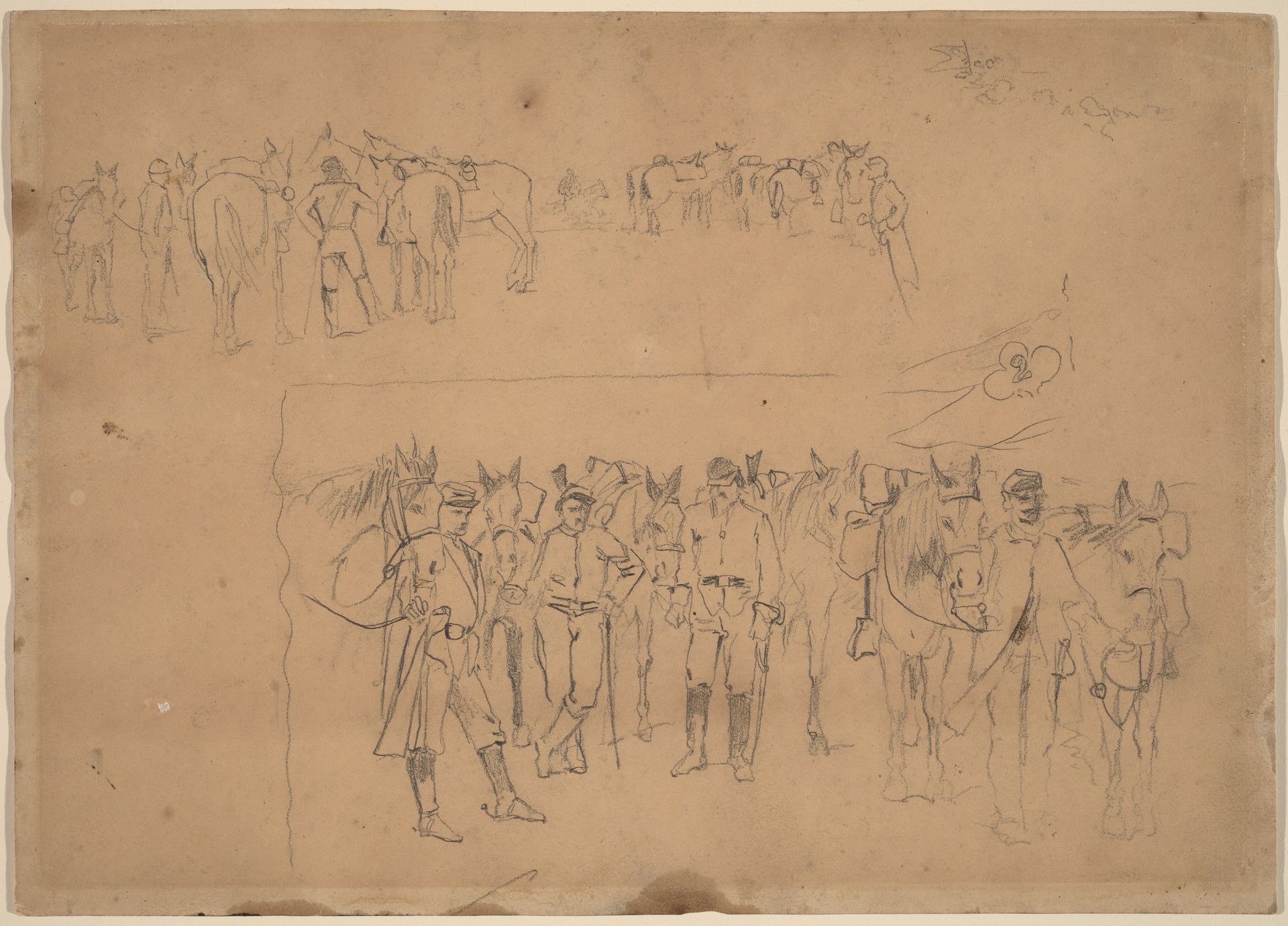
Winslow Homer rendered "Officers and Horses at Rest" with graphite on paper. Notice how Homer uses delicate lines to define the forms of soldiers and their horses. The composition is divided into two distinct registers, each presenting a different arrangement of figures. Homer uses line and form to capture a sense of quietude amidst the potential chaos of military life. The sketch-like quality destabilizes the traditional heroic depictions of war, offering a more intimate, human perspective. The absence of dramatic action shifts our focus to the subtle interactions between the officers and their mounts. The linear quality of the work invites us to consider the structured relationships between the figures and their environment. This piece functions not only as a visual record but also as a commentary on the psychological space of men at war, subtly conveyed through the structural elements of line and composition.
Officers and Horses at Rest
1864


Artwork details
- Medium
- drawing, pencil
- Dimensions
- sheet: 25.2 x 35.2 cm (9 15/16 x 13 7/8 in.)
- Copyright
- National Gallery of Art: CC0 1.0
Tags
Comments
Share your thoughts
About this artwork
Winslow Homer rendered "Officers and Horses at Rest" with graphite on paper. Notice how Homer uses delicate lines to define the forms of soldiers and their horses. The composition is divided into two distinct registers, each presenting a different arrangement of figures. Homer uses line and form to capture a sense of quietude amidst the potential chaos of military life. The sketch-like quality destabilizes the traditional heroic depictions of war, offering a more intimate, human perspective. The absence of dramatic action shifts our focus to the subtle interactions between the officers and their mounts. The linear quality of the work invites us to consider the structured relationships between the figures and their environment. This piece functions not only as a visual record but also as a commentary on the psychological space of men at war, subtly conveyed through the structural elements of line and composition.
Comments
Share your thoughts