

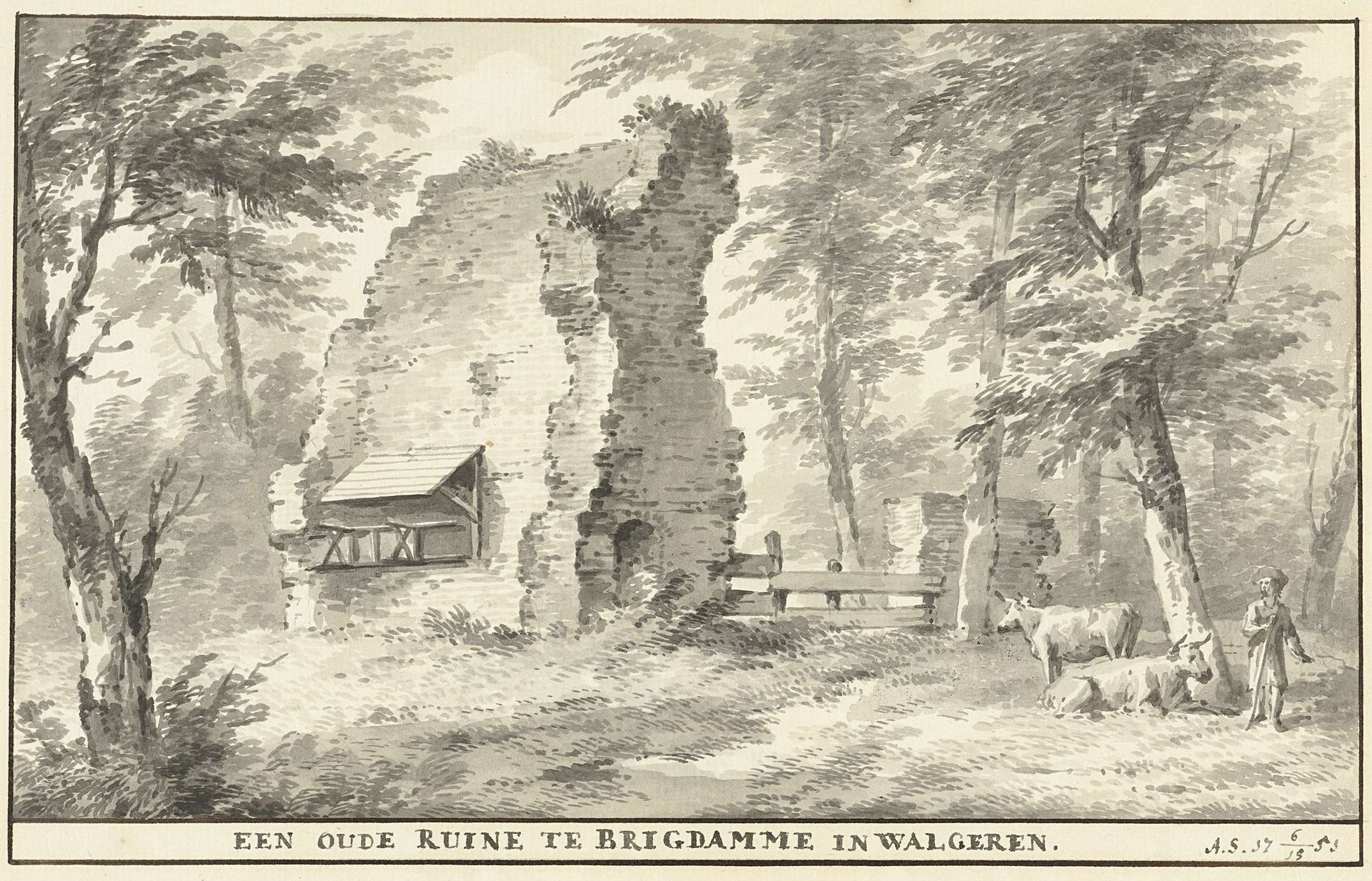
Possibly 1753 - 1756
Ruïne te Brigdamme op Walcheren

Aert Schouman
1710 - 1792Location
RijksmuseumListen to curator's interpretation
Curatorial notes
Editor: So, this etching by Aert Schouman, "Ruïne te Brigdamme op Walcheren," was likely made between 1753 and 1756. It depicts a crumbling ruin surrounded by trees and grazing cows. There's something hauntingly peaceful about it. What symbols or underlying narratives do you find particularly striking? Curator: The ruin itself speaks volumes. It's not merely a depiction of decay but a powerful symbol of transience, isn't it? Think about the Dutch Republic in that period. Prosperity, yes, but also anxieties about decline, about the passing of an era. Do you notice how nature reclaims the stone, softening its harshness? Editor: Yes, the trees seem to embrace it, almost protectively. Curator: Precisely. The image evokes a cultural memory. Ruins were potent symbols in the 18th century – a reminder of mortality, of the ephemeral nature of human achievement. Consider the cows. Are they just livestock? Or do they symbolize a return to a simpler, agrarian existence after a period of mercantile power? What's your sense? Editor: That’s fascinating! I hadn't considered the cows beyond just pastoral scenery, but that adds a whole layer of meaning to their presence. It makes me think about the cycle of growth and decay and the relationship between humanity and nature. Curator: The interplay between shadow and light adds another dimension. It's a very deliberate contrast. Think of light as enlightenment, perhaps, juxtaposed against the shadows of the past and potential oblivion. It raises questions rather than giving easy answers. Editor: This has completely changed how I see this piece. It's more than just a landscape etching; it’s a meditation on time, change, and the enduring power of nature and memory. Curator: Exactly. And by exploring these layers of meaning, we keep the conversation going. The image endures, evolving along with our interpretations.