1925
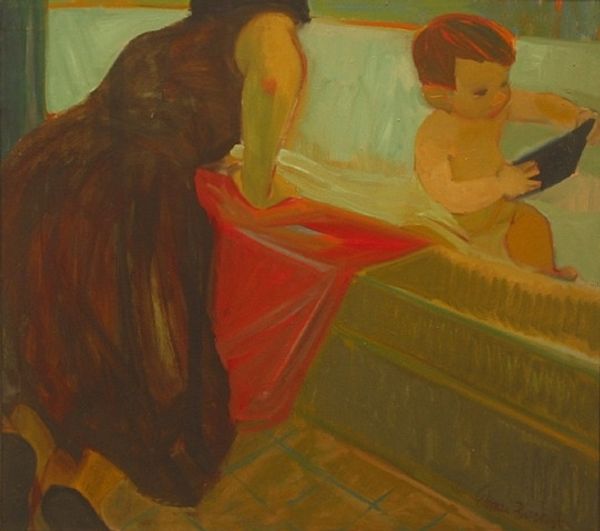
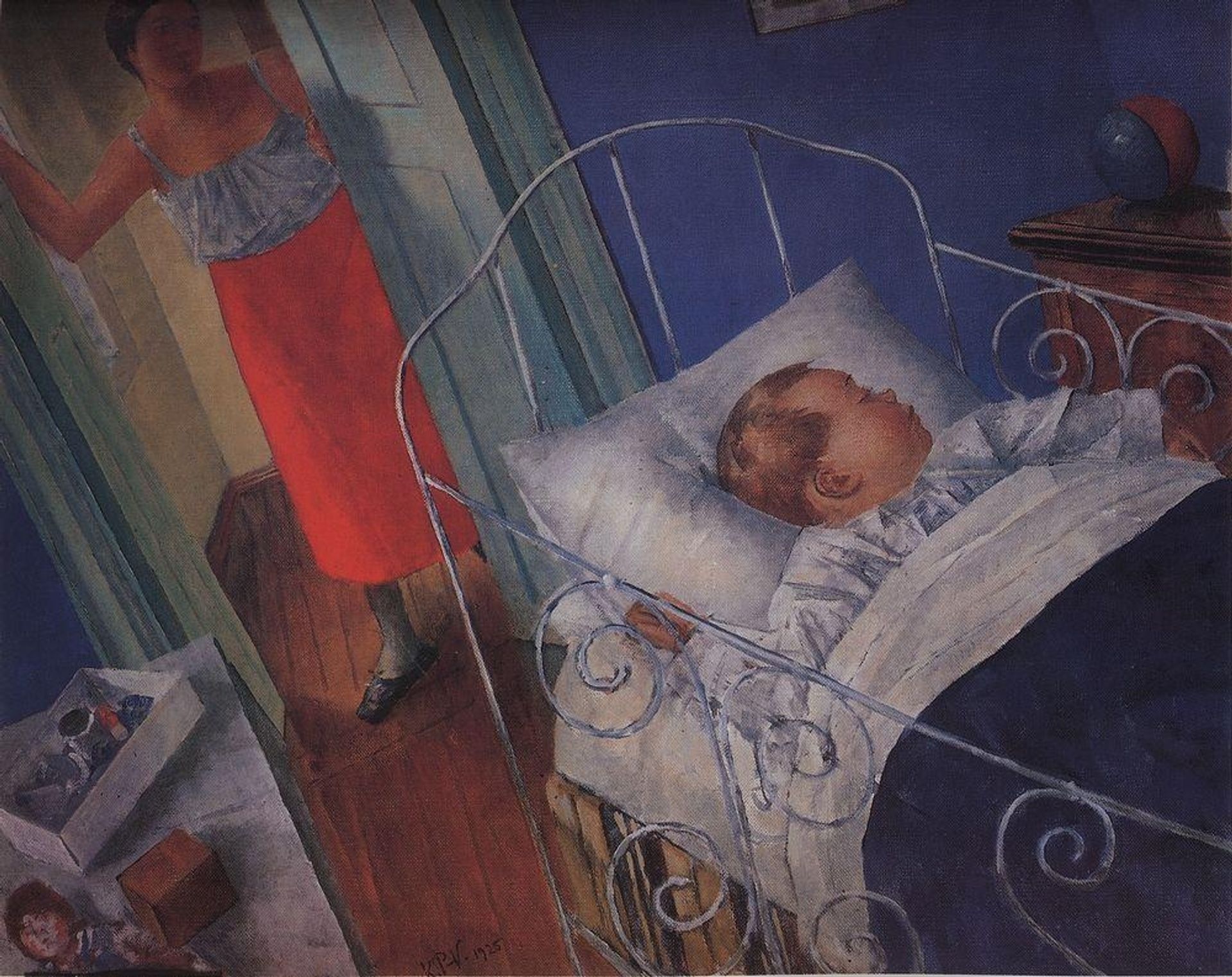
In the children's chamber

Listen to curator's interpretation
Curatorial notes
Editor: This is Kuzma Petrov-Vodkin's "In the children's chamber," created around 1925, using watercolor and oil. There’s an unusual angle, almost a tilted perspective, and the color palette is so calming, yet slightly melancholic. How do you interpret this work? Curator: The tilted perspective certainly grabs the eye, doesn't it? It speaks to a kind of destabilization, a world seen perhaps through the eyes of a child or someone not entirely grounded. Notice the color choices – muted blues and reds. What do those colors evoke for you in relation to childhood? Editor: Well, the blue is peaceful, definitely suggesting sleep, but the red of the mother’s dress, maybe a subdued energy? Curator: Exactly. Red often signifies life force, passion, even revolution, but here it’s toned down, domesticated, if you will. It’s a protective force, softened for the child’s sake. Think about the cultural context too, this is post-revolutionary Russia. What visual clues tie it to its time? Editor: The sparseness, perhaps? The bare room, the simple toys in the box… It feels intimate, but also maybe a bit stark. Curator: Precisely! There's a conscious move away from opulent portrayals of childhood that were common before. Here, childhood is simple, domestic, watched over – even guarded. That tilted perspective suggests the world itself is not quite stable, yet there is care, and continuity, a symbol for the next generation in uncertain times. What do you make of that gaze –the Mother is both present and absent? Editor: That’s an interesting question! The ambiguity almost makes her feel like a guardian angel… watchful, protective… a constant presence in the child's world, but also someone who holds their own counsel about everything that lies ahead in Russia… thank you, I see that so much more clearly now! Curator: It's a poignant commentary, isn't it? Full of cultural echoes of an era of vast shifts. The visual image is full of memory.