

1816
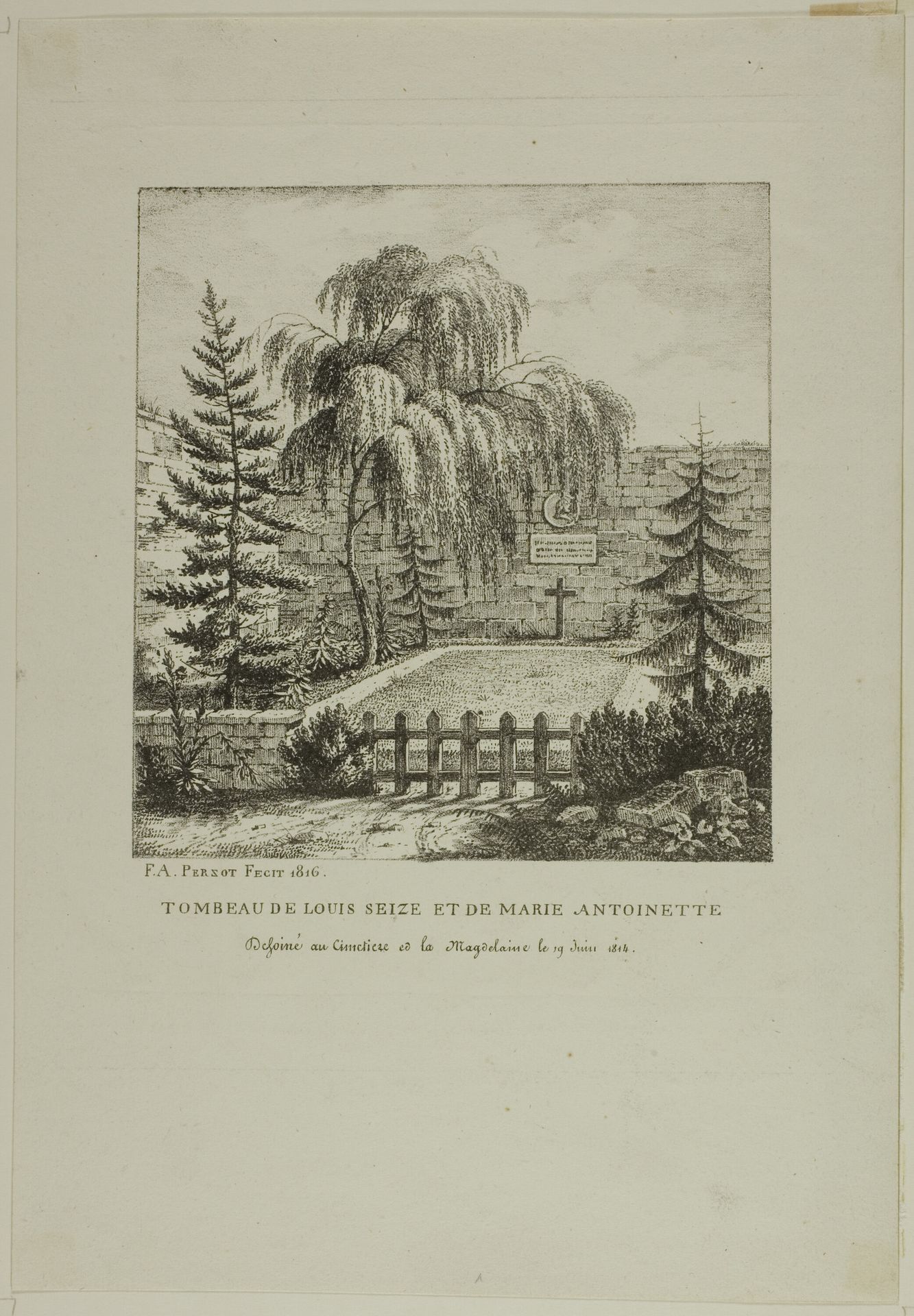
Tomb of Louis XVI


Listen to curator's interpretation
Curatorial notes
Curator: Here we have François Alexandre Pernot's "Tomb of Louis XVI," a lithograph and engraving from 1816. Editor: My immediate response is somber. The scene is muted, softened by the printmaking technique. The weeping willow, in particular, contributes a heavy feeling of grief. Curator: Indeed. The composition is rather deliberate, isn’t it? Notice the strategic placement of the trees. The weeping willow drapes almost centrally, while the evergreens punctuate either side—structuring the scene within the frame. And look at how the line work, through its careful application, guides your eye towards the tomb itself. Editor: I’d say the Romantic style further reinforces this heavy, emotional landscape, one directly informed by the French Revolution and the subsequent execution of Louis XVI and Marie Antoinette. We are viewing not just a tomb but a potent symbol of the revolution's complexities. Curator: An intriguing intersection, where formal elements mirror historical unease. The engraving captures a historical painting approach. Editor: The artist, Pernot, has embedded more than a gravesite. This is about a narrative steeped in gender, class, and power. The death of a king and queen invites a consideration of who gets remembered, how, and why. The fence appears somewhat out of place considering the presence of such a formal monument. Its meaning is not obvious at all! Curator: Certainly, Pernot is carefully navigating the intersection of aesthetics and historical memory, but in that crosshatching and shading, you can begin to analyze a tension that resonates still. Editor: Ultimately, this print invites us to reflect on how historical traumas continue to shape our present. Curator: An elegant marriage of line and loaded history. Editor: And of personal grief intersecting public narrative.