About this artwork
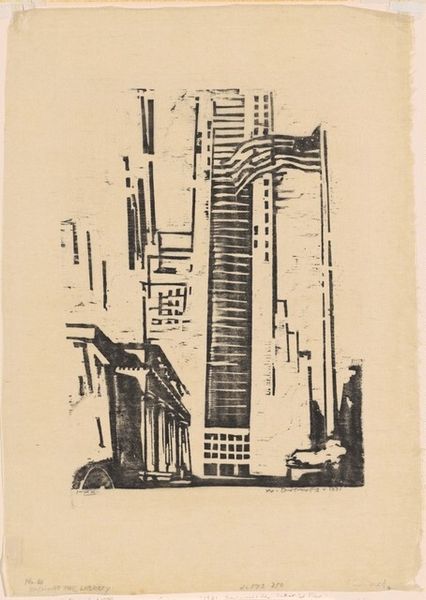
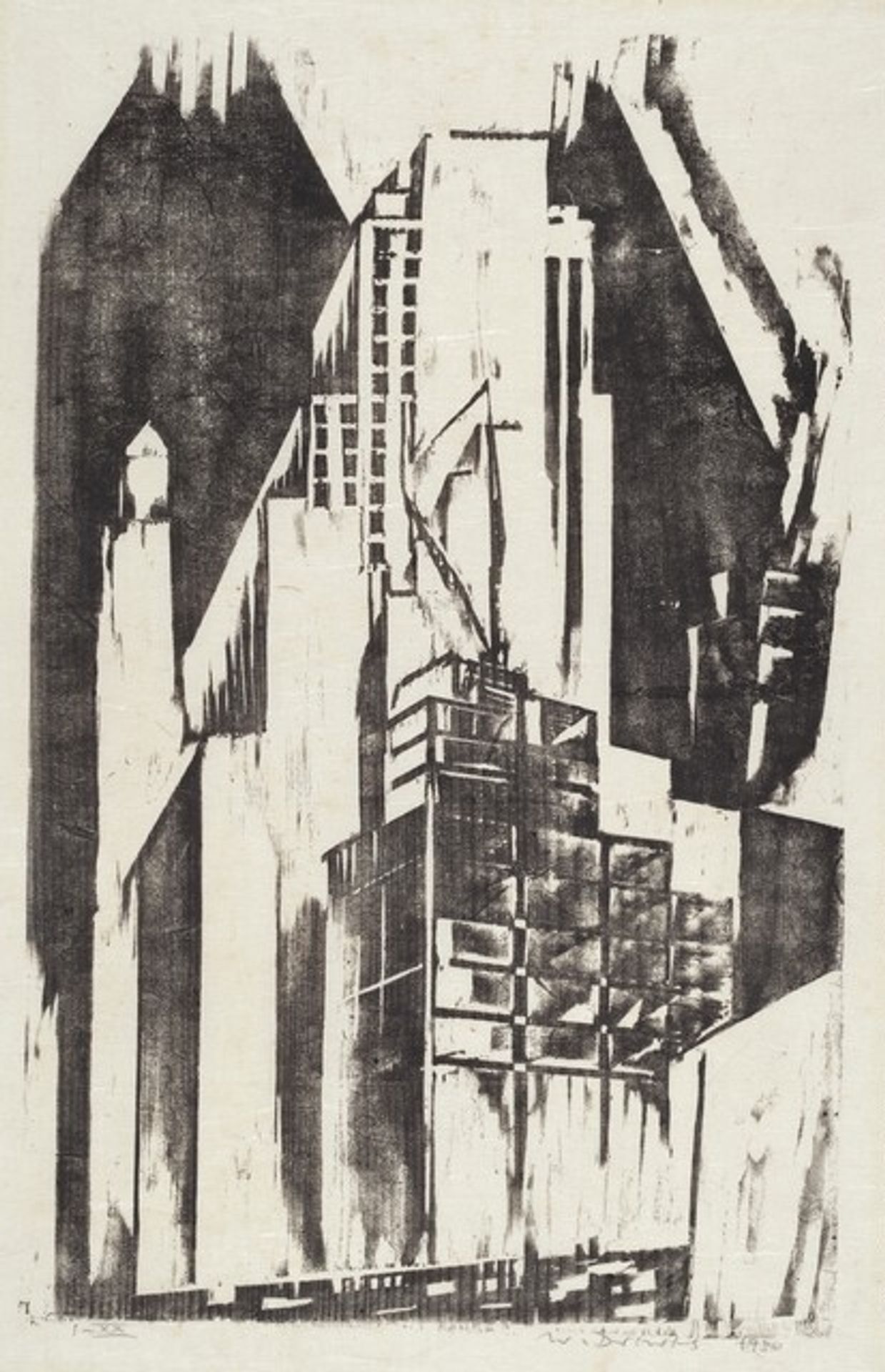
Werner Drewes made this woodcut print, "Corner Fifth Avenue 57th Street," using black ink on paper. Look at how he’s created this edgy, almost violent space, all with stark black and white contrasts. You can almost feel the saw cutting through the wood. What’s really striking is the way Drewes uses texture. There's a roughness that gives the image a raw, immediate feel, like you’re right there on the corner, dodging construction. Take, for example, the way the ink bleeds a little around the edges of the forms, creating a sense of depth and shadow. It's like he's capturing not just the buildings, but also the energy of the city, its noise and its constant state of flux. This print reminds me a little of the German Expressionists, those early 20th-century artists who weren't afraid to get a bit angsty in their work. But Drewes also has his own thing going on, a kind of optimistic take on the urban landscape. Art’s like that, an ongoing conversation between artists and ideas.
Corner Fifth Avenue 57th Street
1930


Artwork details
- Medium
- print, woodcut
- Dimensions
- image: 33.7 × 21.3 cm (13 1/4 × 8 3/8 in.) sheet: 49.1 × 35.3 cm (19 5/16 × 13 7/8 in.)
- Copyright
- National Gallery of Art: CC0 1.0
Tags
Comments
Share your thoughts
About this artwork
Werner Drewes made this woodcut print, "Corner Fifth Avenue 57th Street," using black ink on paper. Look at how he’s created this edgy, almost violent space, all with stark black and white contrasts. You can almost feel the saw cutting through the wood. What’s really striking is the way Drewes uses texture. There's a roughness that gives the image a raw, immediate feel, like you’re right there on the corner, dodging construction. Take, for example, the way the ink bleeds a little around the edges of the forms, creating a sense of depth and shadow. It's like he's capturing not just the buildings, but also the energy of the city, its noise and its constant state of flux. This print reminds me a little of the German Expressionists, those early 20th-century artists who weren't afraid to get a bit angsty in their work. But Drewes also has his own thing going on, a kind of optimistic take on the urban landscape. Art’s like that, an ongoing conversation between artists and ideas.
Comments
Share your thoughts