

1650 - 1685
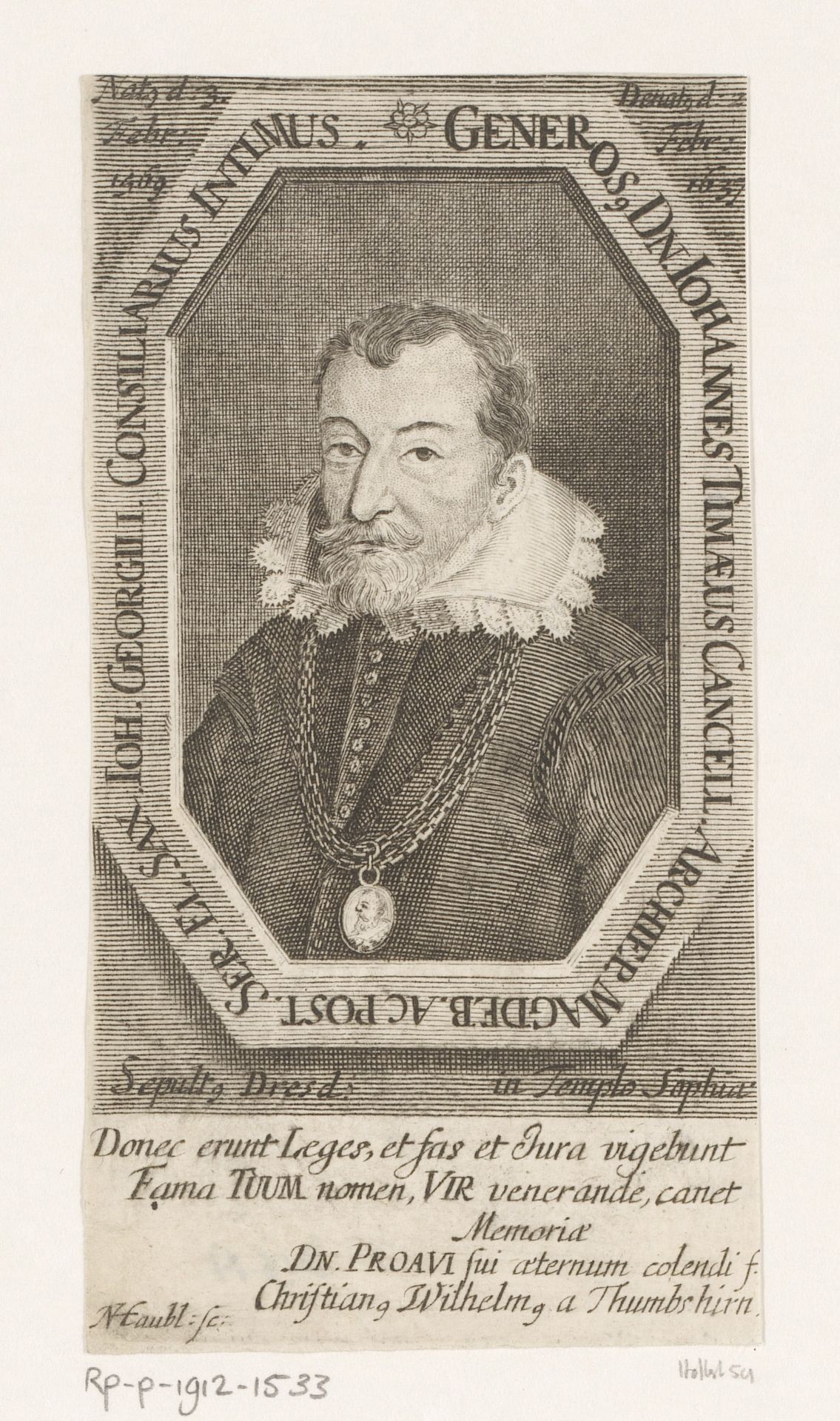
Portret van Johann Timaeus

Listen to curator's interpretation
Curatorial notes
Curator: Let's turn our attention to this intriguing print, a portrait of Johann Timaeus, created sometime between 1650 and 1685 by Nicolaus Häublin. Editor: Immediately, I'm struck by the formality. The meticulous detail suggests an individual of high standing, maybe even caught in a performative moment of power and legacy building. Curator: Häublin's engraving offers a glimpse into Baroque aesthetics and the conventions of 17th-century portraiture, immortalizing Timaeus with a certain weight of symbolism. Notice how the details aren't simply decorative; they're carefully considered emblems of his position and virtues. The octagonal frame bears a lengthy latin inscription which may have denoted the values of Johann Timaeus. Editor: Absolutely. The collar alone, stiff and elaborate, reads as a signifier of his elite status. But beyond that, consider the power dynamics at play in portraiture during this period. Who was allowed to be depicted, and how did these images reinforce existing social hierarchies? What we might see as a neutral representation of a powerful individual can actually act to buttress certain political regimes. Curator: A fine point, because images inherently project cultural memory as power and control. The intricate metalwork suggests luxury, the engraving hinting at timeless qualities in an attempt to elevate Timaeus beyond the mere temporal. And speaking of enduring memory, note the pendant suspended from his chain. It probably contained his insignia, signifying identity and ancestry to evoke notions of the sublime. Editor: And what kind of man was Johann Timaeus? Does this portrait offer insights, or simply a mask crafted to project authority? It almost feels staged. How would we, in contemporary society, engage with this imagery? Are we perpetuating past powers and cultural dynamics, or critically examining them to imagine alternative, future identities? Curator: He probably embraced these images as signs that could consolidate an aspirational future, so in that respect he and contemporary portrait subjects might have shared more aims than you imagine. Regardless, the symbolic vocabulary serves to transmit these concepts forward, even if viewed with a different cultural framework. Editor: Food for thought, indeed. Thinking critically, these types of visual symbols help highlight the role power dynamics play, encouraging viewers to ask insightful questions, instead of merely consuming aesthetics. Curator: Precisely. Through historical objects like this, the symbols prompt dialogues, creating ongoing exchanges that shape how we engage with ourselves and our culture today.