About this artwork
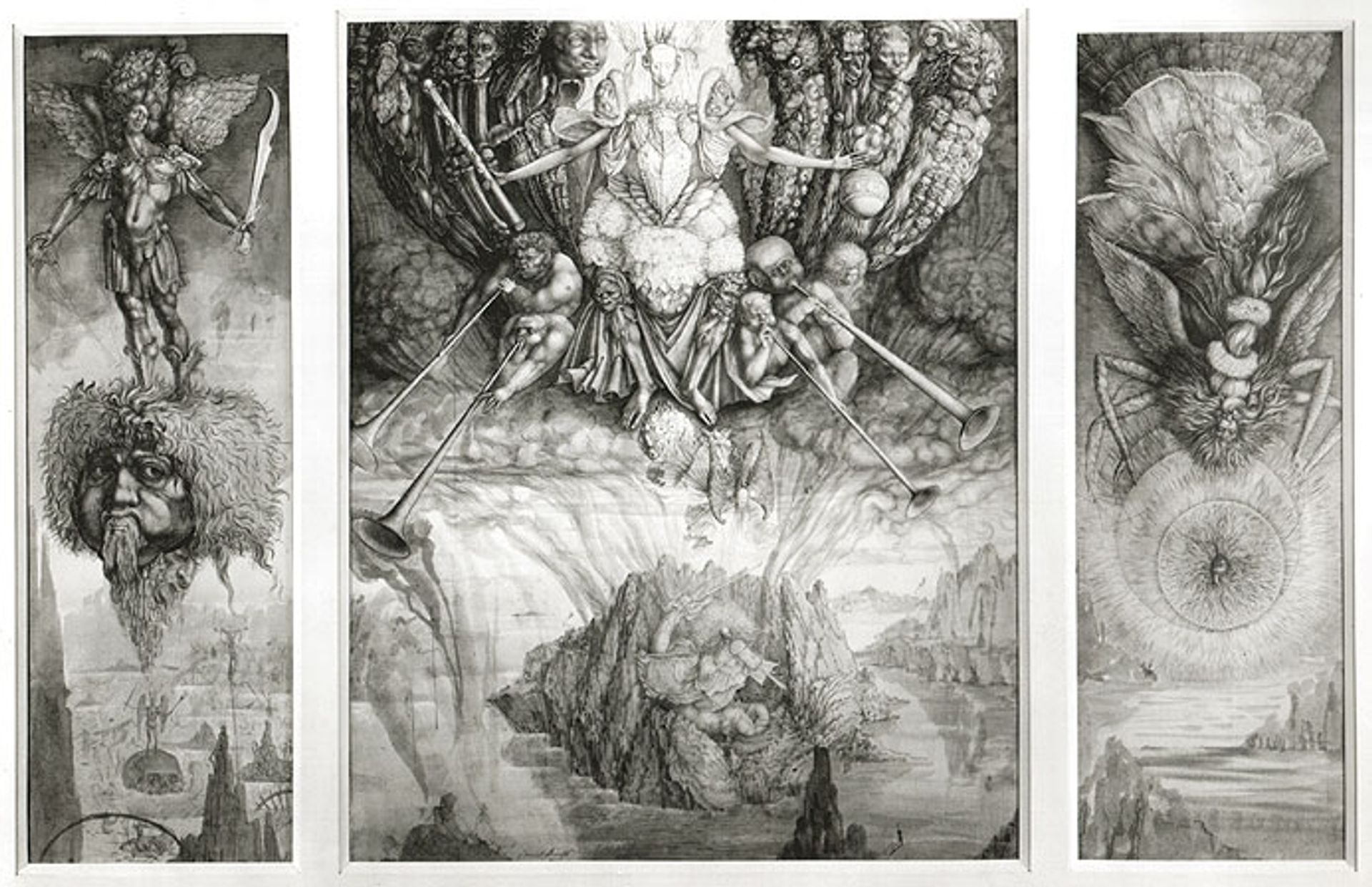
Curator: Wow, what an intense and sprawling composition. It feels like I’m looking at a charcoal dream—a really dark one. Editor: It certainly is evocative! This is Ernst Fuchs’s "SATAN'S HEAVEN," created in 1954. It’s a charcoal drawing, and it displays much of the fantastical symbolism characteristic of his work and the Vienna School of Fantastic Realism to which he belonged. The neo-expressionist handling makes it very striking. Curator: Neo-expressionism definitely. There’s something almost deliberately grotesque about the figures, the way they seem crammed into the frame, those bulging eyes, distended faces… is that meant to be, you know, heaven? Editor: Well, that’s where the title gets provocative, doesn't it? I think Fuchs uses the visual language of religious art – the triptych form, the hierarchy of figures, the landscapes – to question power structures. He’s inviting us to consider what is typically held as divine in the frame of oppressive figures looming at the top, using the bodies of people below them as instruments, as horns blowing into an already scorched and bleak landscape. The almost caricatured presentation invites the viewer to see that something is rotten in the supposed seat of power. Curator: The gender dynamics also stand out. There is a queen figure centrally posed in an extremely intricate robe while surrounded by figures in robes or largely nude. Given your explanation about how oppressive forces appear in the piece, I can’t help but interpret this in relation to larger conversations in feminist theory around powerful women’s exploitation and abuse. Editor: It could very well speak to this! I mean, the Black Arts Movement influence can’t be overlooked either. "Satan’s Heaven"— the phrase itself has a defiant, almost revolutionary ring, don’t you think? Maybe it's a critique of the promises made and broken, the "heaven" offered that turns out to be another form of hell. Curator: Absolutely. There's a potent symbolism that challenges Western art historical notions of paradise, flipping expectations on their head. Thanks for your insight! Editor: And thank you. It is quite sobering to have these themes explored from multiple vantage points. It’s a drawing that lingers.

Artwork details
- Copyright
- Ernst Fuchs,Fair Use
Comments
No comments
About this artwork
Curator: Wow, what an intense and sprawling composition. It feels like I’m looking at a charcoal dream—a really dark one. Editor: It certainly is evocative! This is Ernst Fuchs’s "SATAN'S HEAVEN," created in 1954. It’s a charcoal drawing, and it displays much of the fantastical symbolism characteristic of his work and the Vienna School of Fantastic Realism to which he belonged. The neo-expressionist handling makes it very striking. Curator: Neo-expressionism definitely. There’s something almost deliberately grotesque about the figures, the way they seem crammed into the frame, those bulging eyes, distended faces… is that meant to be, you know, heaven? Editor: Well, that’s where the title gets provocative, doesn't it? I think Fuchs uses the visual language of religious art – the triptych form, the hierarchy of figures, the landscapes – to question power structures. He’s inviting us to consider what is typically held as divine in the frame of oppressive figures looming at the top, using the bodies of people below them as instruments, as horns blowing into an already scorched and bleak landscape. The almost caricatured presentation invites the viewer to see that something is rotten in the supposed seat of power. Curator: The gender dynamics also stand out. There is a queen figure centrally posed in an extremely intricate robe while surrounded by figures in robes or largely nude. Given your explanation about how oppressive forces appear in the piece, I can’t help but interpret this in relation to larger conversations in feminist theory around powerful women’s exploitation and abuse. Editor: It could very well speak to this! I mean, the Black Arts Movement influence can’t be overlooked either. "Satan’s Heaven"— the phrase itself has a defiant, almost revolutionary ring, don’t you think? Maybe it's a critique of the promises made and broken, the "heaven" offered that turns out to be another form of hell. Curator: Absolutely. There's a potent symbolism that challenges Western art historical notions of paradise, flipping expectations on their head. Thanks for your insight! Editor: And thank you. It is quite sobering to have these themes explored from multiple vantage points. It’s a drawing that lingers.
Comments
No comments