painting, oil-paint
portrait
narrative-art
painting
oil-paint
figuration
oil painting
france
mythology
genre-painting
history-painting
academic-art
portrait art
fine art portrait
realism
Copyright: Public domain
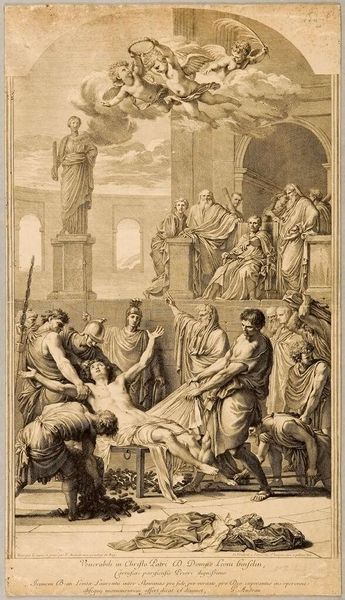
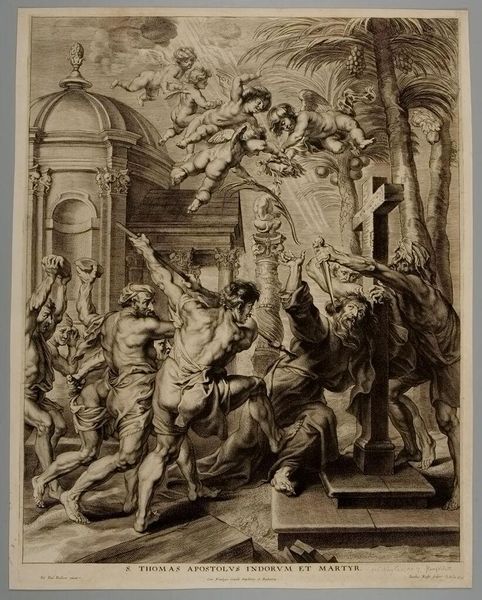
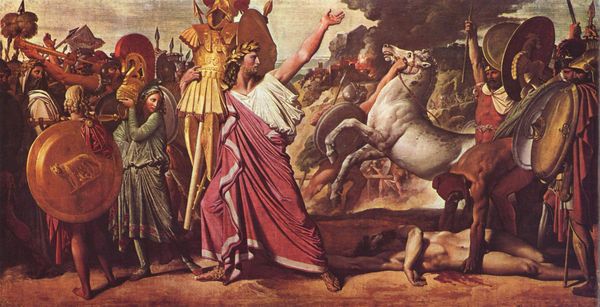
Editor: This is Léon Bonnat's "Martyrdom of St. Denis," painted in 1886. It's a really graphic depiction of the Saint's execution, very dramatic. The overall impression is unsettling, quite violent. How do you interpret this work in terms of its historical context and the messages it might be conveying about power and faith? Curator: Well, it’s vital to acknowledge that depictions of martyrdom, like this one, are never just straightforward narratives. They’re often politically charged, particularly when considering Bonnat’s context in late 19th century France, a nation grappling with secularism after the revolution. How might this scene reinforce or challenge existing power structures? Editor: I guess it could be seen as reinforcing the power of the church by portraying St. Denis as a hero, but the brutality also seems like a criticism of religious extremism. Curator: Precisely. We need to dissect whose interests this serves and at what cost. Is it meant to inspire faith, or does it, perhaps unintentionally, expose the violence inherent in certain religious doctrines? Consider also the portrayal of the executioner, almost idealized in his physique. What does this tell us about the societal attitudes toward violence and masculinity? Editor: That's interesting. He's not really presented as a monstrous figure. He’s just… there. Curator: Exactly. Bonnat, likely unconsciously, unveils uncomfortable truths about the normalization of violence within societal structures. Looking at it from a contemporary perspective, we need to ask: what does it mean to display such explicit violence, and who gets to control that narrative? Is this art contributing to a dangerous acceptance of violence? Editor: This has completely changed how I view the painting. It's much more complex than just a historical scene. Curator: Indeed. Art, particularly historical pieces, become active participants in contemporary discussions, reflecting our current values and anxieties. It's a constant dialogue.
Comments
No comments
Be the first to comment and join the conversation on the ultimate creative platform.
 React
React Comment