painting, oil-paint
#
painting
#
oil-paint
#
oil painting
#
expressionism
#
expressionist
Copyright: Public Domain: Artvee
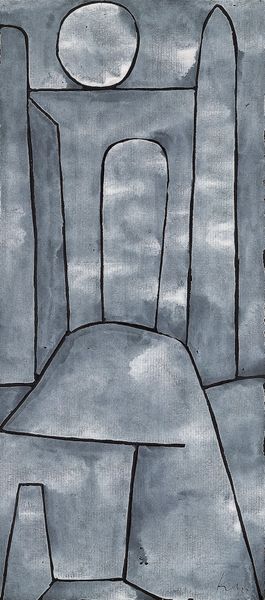
Curator: Marsden Hartley's "Mushrooms on a Blue Background," painted in 1926. It presents a simple, almost stark, arrangement of fungi. What do you make of it? Editor: It feels… unsettling. The blue background is surprisingly vibrant, almost artificial. It really makes the pallid mushrooms pop, but it gives the entire piece a somewhat melancholic feel to me. The facture gives the work its character; Hartley captures the textures—the sleek cap of the mushroom in contrast to its segmented stem, the ridges around the base. It really looks as if they’ve been simply gathered on an enamel surface or perhaps are scattered on a patterned oilcloth. Curator: Hartley was deeply invested in the idea of American identity and often sought to represent its spirit through unassuming, often overlooked subjects. The mushrooms might seem mundane, but could they also be symbolic, perhaps representing growth or decay in the American landscape following the first world war? Given Hartley's complex and at times contradictory attitude towards the commodification of natural imagery. Editor: Interesting… Certainly, the focus on such ordinary objects emphasizes the raw materials readily available to the artist in an America developing rapidly via industrial means at that time, and thus might seem an odd choice considering Hartley’s involvement in distinctly European movements such as Der Blaue Reiter or Parisian Cubism and Fauvism, or the role Stieglitz played in fostering his style. To really delve deeper into the artwork and into how the medium conveys a narrative about societal factors might well also require the exploration of how the pigments that formulate those “melancholic” effects were concocted by artists—or not as was so often the case with the average artist’s work– during that particular time. Curator: Exactly, we should acknowledge that some saw Hartley as actively challenging the status quo, while others have pointed to instances of reinforcing societal hierarchies through his selective depictions of labor and landscape. Can you see the mushrooms arranged on an unseen support system, an undergirding of support—perhaps even exploitation? We really must see this as a work where so many threads are being played out simultaneously to appreciate that dynamism. Editor: Right! To acknowledge these mushrooms' life cycles, what processes were needed to prepare them for consumption or use as dyes? Were the source communities ever acknowledged as being participants of labor involved, or was that always rendered opaque? Food is not always apolitical, but can the act of observation alter that, transform our reading of an image? So fascinating, still. Curator: A very astute way of seeing it. Thanks for your perspectives! Editor: A pleasure.
Comments
No comments
Be the first to comment and join the conversation on the ultimate creative platform.
 Collect
 React
React Comment
More like this