drawing, ink
#
night
#
drawing
#
sky
#
dark design
#
landscape
#
form
#
ink
#
water
#
line
#
cityscape
#
natural form
Dimensions: 55 x 61 cm
Copyright: Creative Commons NonCommercial
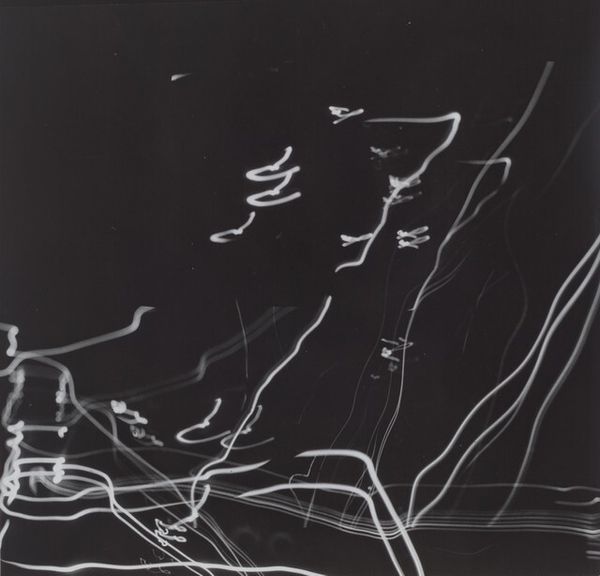
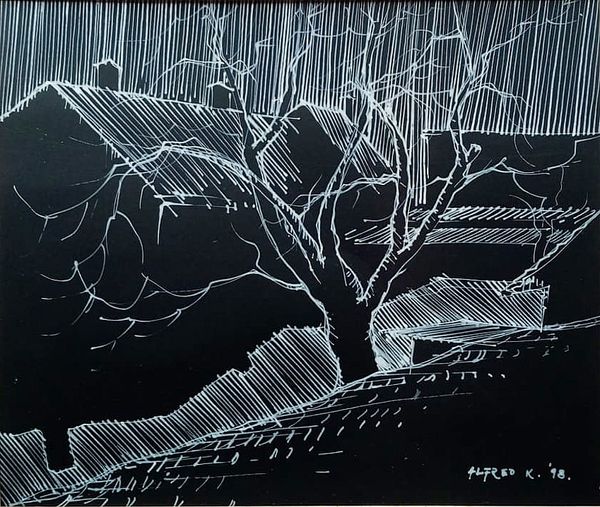
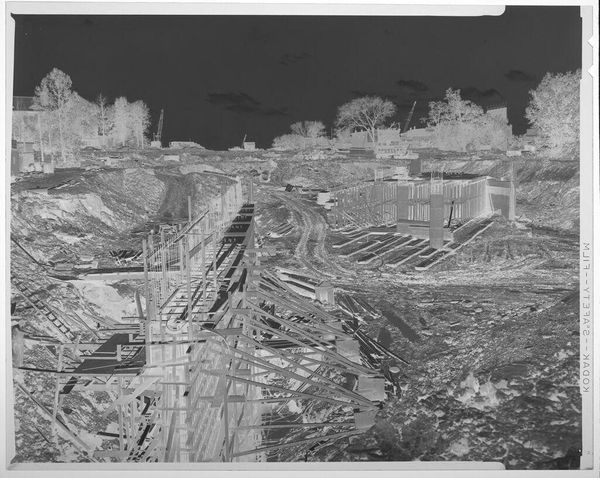
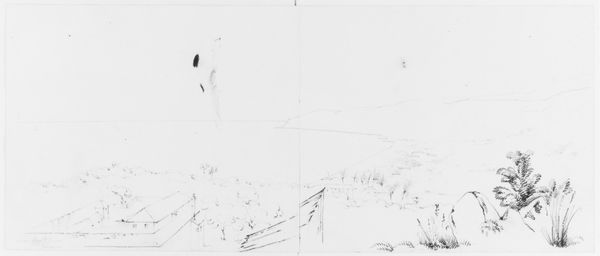
Editor: This is "Karlovac at night. A view from the Kupa river," a 2007 ink drawing by Alfred Freddy Krupa. It’s a strikingly simple composition; just white lines on a black background. I’m curious about your perspective, what do you see in this piece? Curator: This work prompts us to consider the very essence of drawing and its place in contemporary art. Krupa’s choice of ink, applied so minimally, challenges the traditional hierarchy that often privileges painting. The black support is not merely background, but a critical material agent, its mass playing against the fragile lines describing the cityscape. What labor is being expressed here? Is it about observation or representation? Editor: It’s interesting how you focus on the materials. It makes me think about the act of drawing itself. Like, why ink, why these minimal lines? Curator: Precisely! Consider the social context. Krupa’s practice embraces what some might dismiss as simple or preliminary— a sketch. By elevating this, he critiques the commodification of art. He's showcasing the labor of seeing and recording, not just the finished product. What is lost, and what is gained, in such starkness? Editor: I hadn't really considered the ‘labor of seeing.’ The roughness of the lines actually makes me focus more on the atmosphere, that particular stillness you get at night. Do you think the limited materials affect our interpretation of the place? Curator: Absolutely. The artist purposefully utilizes humble means. Is this an exercise in democratic image-making? Is it an invitation to observe beyond conventional beauty, pushing us to value the immediacy of experience and the bare bones of artistic creation? Editor: Thinking about the labor involved and the commentary on art itself really deepens my understanding of what’s at play here beyond just the depiction of a cityscape at night. Curator: Yes, considering the materials, their application, and the implicit commentary woven into their use reveals the artist's complex dialogue with artistic production. It underscores art not as a detached object, but as embedded within economic and social structures.
Comments
No comments
Be the first to comment and join the conversation on the ultimate creative platform.
 Collect
 React
React Comment
More like this