

1644
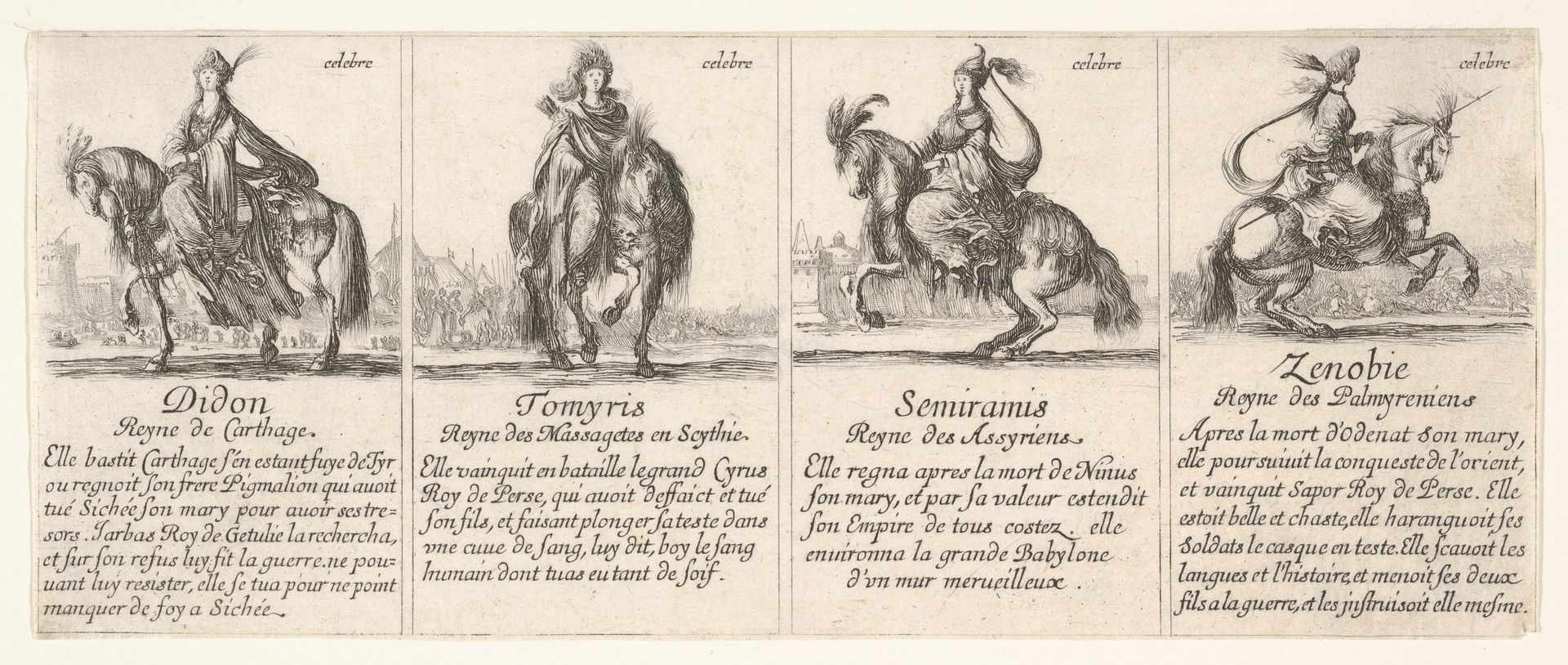
Didon, Tomyris, Semiramis, and Zenobie, from 'The game of queens' (Le jeu des Reines renommées)

Stefano della Bella
1610 - 1664The Metropolitan Museum of Art
Metropolitan Museum of Art, New York, NYListen to curator's interpretation
Curatorial notes
Curator: My first thought looking at this is "power"—pure, unadulterated female power rendered in exquisitely fine lines. There's a coolness to it as well, almost an aristocratic detachment, don’t you think? Editor: It’s rather imposing, certainly. We're looking at a print from 1644 called “Didon, Tomyris, Semiramis, and Zenobie, from 'The game of queens',” made by Stefano della Bella. He used etching and engraving on paper to depict these four queens from antiquity. Curator: Etching, yes! It gives the figures this shimmering, almost ethereal quality. Look at the details in their clothing and on the horses. They're dressed to the nines. Are they off to war or a fancy ball? What do you make of these heroic equestrian figures? Editor: Bella focused intently on their composition within the frame. He masterfully contrasts light and shadow, guiding the viewer's gaze strategically. Each queen occupies her own panel, which enhances both their autonomy and a comparative analysis across their representations. Notice the posture, adornment and symbolic artifacts assigned to each, meant to subtly imply character and authority through an intricate play of visual symbols. Curator: Interesting… Each figure is almost clinically distinct, which could reflect Bella's attitude, right? Was he maybe trying to turn these queens into trading cards? Because I wonder about the whole enterprise; why single out only these female monarchs and put them in what amounts to a deck of playing cards. Editor: The series presents a fascinating commentary on feminine power during a period of patriarchal authority. By displaying these women from Carthage, Scythia, Assyria, and Palmyra, it transcends specific biographical details, functioning on a symbolic level that subtly interrogates normative expectations for women in leadership. Curator: It makes me question what exactly makes a queen, what qualities do the patriarchy think are “acceptable”. All are on horses. Are the horses metaphors, somehow? Like, untamable female "nature"? Editor: The choice of equine depictions serves not merely as decorative accessory, but integral communicative component underscoring themes of sovereignty and controlled vigor under the reins of strategic mind and will. The etching style further supports that sense, yes. Curator: These women have been reduced and celebrated by male interpretations of their rule! A clever critique packaged as courtly fashion. Anyway, thank you for helping me decode that—it's an uncomfortable thing to look at on the one hand, but visually fascinating nonetheless. Editor: Yes, it's an image of complex power relations that prompt one to rethink legacy through critical lenses—a potent effect achieved by stark formal means.