About this artwork
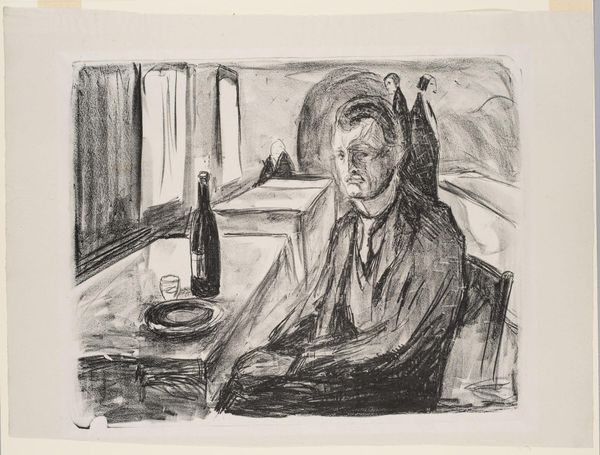
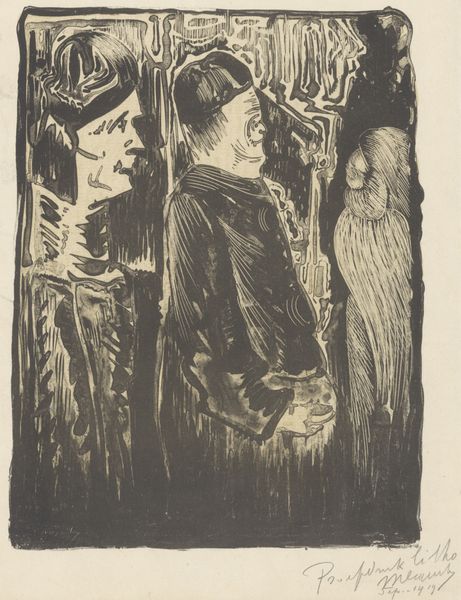
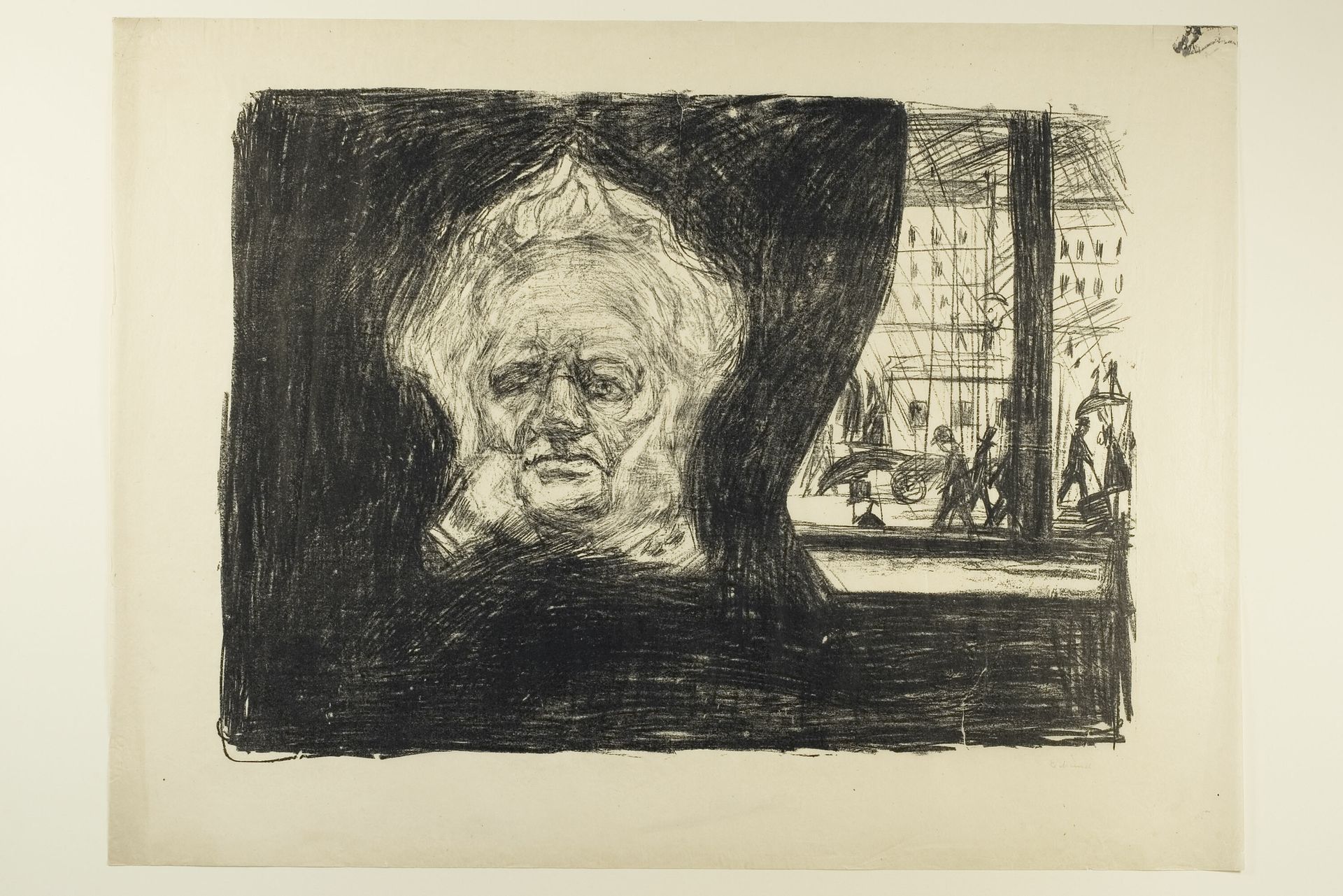
Editor: This is "Henrik Ibsen at the Grand Café," a lithograph on paper made in 1902 by Edvard Munch. It's such a striking image. Ibsen's face seems to float in this dark, smoky space. What do you make of this print? Curator: What fascinates me is the lithographic process itself. Consider the materials: the grease crayon on the limestone, the acid etching away what wasn't covered. How does that process, inherently about reproduction and distribution, affect our understanding of Ibsen's image and legacy? Editor: That's an interesting point. How the medium changes our understanding of Ibsen... Curator: Exactly. And let’s not forget the "Grand Café," a significant location for artists and intellectuals at the time. Munch captures Ibsen framed between the exterior street and the darkened cafe in what appears to be a kind of portrait or display. How does placing Ibsen there, in that locus of social and intellectual labor, shape the way we view him? Editor: I see what you mean. It connects him to the working world and the conversations of the time, not just some removed genius. The café as part of his "making." Curator: Precisely! This isn’t just about Munch's genius either, but the industrial processes that allow for such an image to proliferate, embedding Ibsen within the burgeoning print culture of the early 20th century. Editor: So, understanding the context—the materials, the location, and the reproductive nature of the print—helps us appreciate the piece more fully, beyond just seeing it as a portrait? Curator: Absolutely. It shifts our focus from the romantic idea of artistic genius to the mechanics of image-making and cultural production. Editor: This really changed my perspective on how to view a portrait! Curator: Mine too.
Henrik Ibsen at the Grand Café 1902


Artwork details
- Dimensions
- 440 × 594 mm (image); 545 × 726 mm (sheet)
- Location
- The Art Institute of Chicago
- Copyright
- Public Domain
Comments
No comments
About this artwork
Editor: This is "Henrik Ibsen at the Grand Café," a lithograph on paper made in 1902 by Edvard Munch. It's such a striking image. Ibsen's face seems to float in this dark, smoky space. What do you make of this print? Curator: What fascinates me is the lithographic process itself. Consider the materials: the grease crayon on the limestone, the acid etching away what wasn't covered. How does that process, inherently about reproduction and distribution, affect our understanding of Ibsen's image and legacy? Editor: That's an interesting point. How the medium changes our understanding of Ibsen... Curator: Exactly. And let’s not forget the "Grand Café," a significant location for artists and intellectuals at the time. Munch captures Ibsen framed between the exterior street and the darkened cafe in what appears to be a kind of portrait or display. How does placing Ibsen there, in that locus of social and intellectual labor, shape the way we view him? Editor: I see what you mean. It connects him to the working world and the conversations of the time, not just some removed genius. The café as part of his "making." Curator: Precisely! This isn’t just about Munch's genius either, but the industrial processes that allow for such an image to proliferate, embedding Ibsen within the burgeoning print culture of the early 20th century. Editor: So, understanding the context—the materials, the location, and the reproductive nature of the print—helps us appreciate the piece more fully, beyond just seeing it as a portrait? Curator: Absolutely. It shifts our focus from the romantic idea of artistic genius to the mechanics of image-making and cultural production. Editor: This really changed my perspective on how to view a portrait! Curator: Mine too.
Comments
No comments