

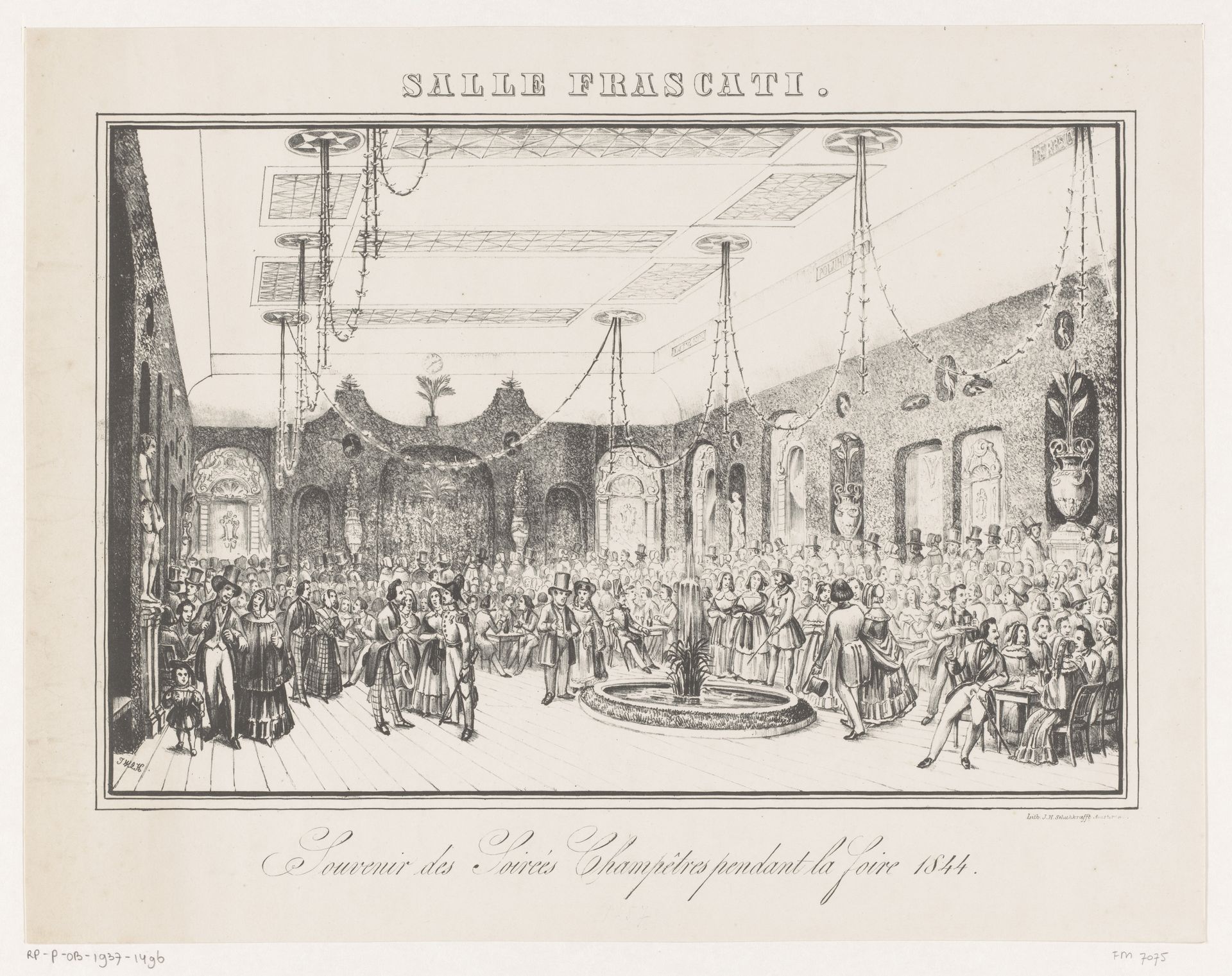
after 1844
Interieur van Frascati in Amsterdam tijdens een soiree in 1844

Listen to curator's interpretation
Curatorial notes
Editor: This is "Interior of Frascati in Amsterdam during a soiree in 1844," an etching made after 1844 by Jacobus Wilhelmus Adrianus Hilverdink. It has a hushed, observational quality, like we're peering into a moment of 19th-century Amsterdam society. What social dynamics are at play here, and how might this image speak to broader themes of class and leisure? Curator: Absolutely. Think about Frascati as a stage. Who has access to this space? What behaviors are being performed? Look at the distribution of figures; are there unspoken hierarchies at work? These spaces weren't neutral. They mirrored and reinforced social divisions, often excluding marginalized groups based on gender, race, or class. What power dynamics might this seemingly innocuous scene conceal? Editor: It's interesting to consider Frascati as a carefully curated performance space rather than just a place for leisure. Does the artwork give us clues about the role of women at these events? I'm noticing their attire, how they are grouped together. Curator: Precisely. Consider how women's roles were often confined to ornamentation or marital prospects within such social gatherings. How are their bodies represented? Are they active agents in this social theater, or are they largely passive figures, framed by the male gaze and societal expectations? This print provides a valuable glimpse into the controlled visibility and constraints placed on women within 19th-century bourgeois culture. Editor: Thinking about the work in this way opens up so many possibilities for understanding it! It's not just a historical document but a lens through which we can analyze social structures. Curator: Exactly. And remember, even seemingly historical documents like this etching have contemporary resonance. The negotiation of space, visibility, and social power are ongoing struggles. By unpacking the visual language of the past, we can better understand the present.