About this artwork
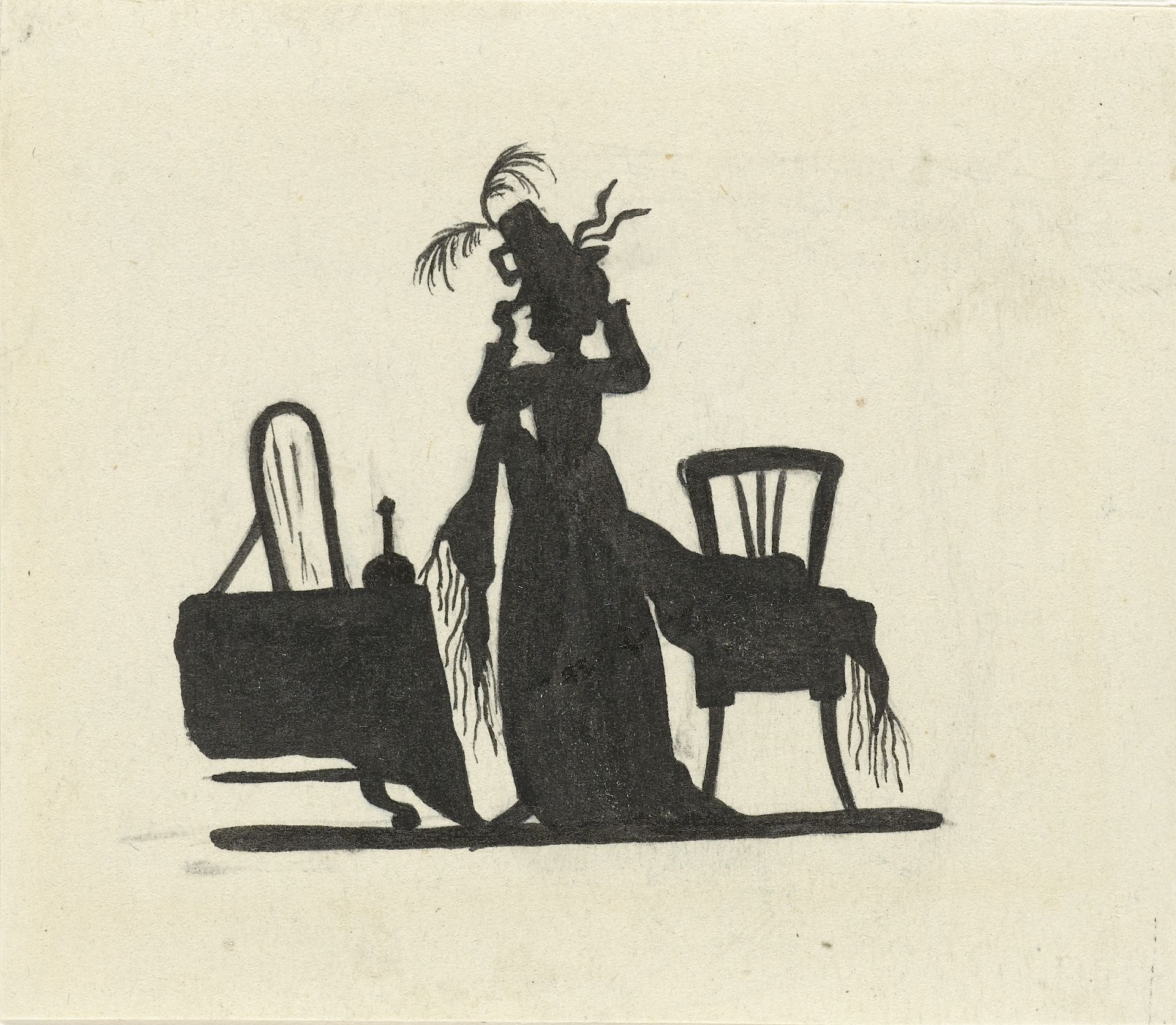
This is Nelly Bodenheim’s silhouette design for an illustration, most likely cut from black paper. The stark contrast between the black shapes and the white background immediately draws you into its world. The composition centers around a woman in silhouette, facing away as she adjusts a feathered hat while looking into a mirror. Bodenheim’s strategic use of solid black shapes renders the scene with incredible economy. Note the shapes of the furniture; a dressing table, a mirror, and chair. Each object is defined not by internal detail but by its outline, demanding that we read the image as a collection of signs within a domestic setting. The woman’s attire, the hat, and the mirror all suggest a particular class and gender performance. Consider how Bodenheim reduces complex forms into simple, readable shapes. This flattening effect emphasizes the two-dimensionality of the image. What we see is not merely a depiction of a scene, but a conscious arrangement of shapes that invite us to decode the cultural meanings embedded within these forms.
Ontwerp voor illustratie voor In Holland staat een huis: silhouet van de vrouw voor de spiegel
1884 - 1917

Nelly Bodenheim
1874 - 1951Location
RijksmuseumArtwork details
- Medium
- drawing, ink
- Dimensions
- height 62 mm, width 72 mm
- Location
- Rijksmuseum
- Copyright
- Rijks Museum: Open Domain
Tags
Comments
Share your thoughts
About this artwork
This is Nelly Bodenheim’s silhouette design for an illustration, most likely cut from black paper. The stark contrast between the black shapes and the white background immediately draws you into its world. The composition centers around a woman in silhouette, facing away as she adjusts a feathered hat while looking into a mirror. Bodenheim’s strategic use of solid black shapes renders the scene with incredible economy. Note the shapes of the furniture; a dressing table, a mirror, and chair. Each object is defined not by internal detail but by its outline, demanding that we read the image as a collection of signs within a domestic setting. The woman’s attire, the hat, and the mirror all suggest a particular class and gender performance. Consider how Bodenheim reduces complex forms into simple, readable shapes. This flattening effect emphasizes the two-dimensionality of the image. What we see is not merely a depiction of a scene, but a conscious arrangement of shapes that invite us to decode the cultural meanings embedded within these forms.
Comments
Share your thoughts