print, engraving
#
medieval
# print
#
landscape
#
figuration
#
genre-painting
#
northern-renaissance
#
engraving
#
realism
Dimensions: 4 1/2 x 6 1/8 in. (11.43 x 15.56 cm) (image)
Copyright: Public Domain
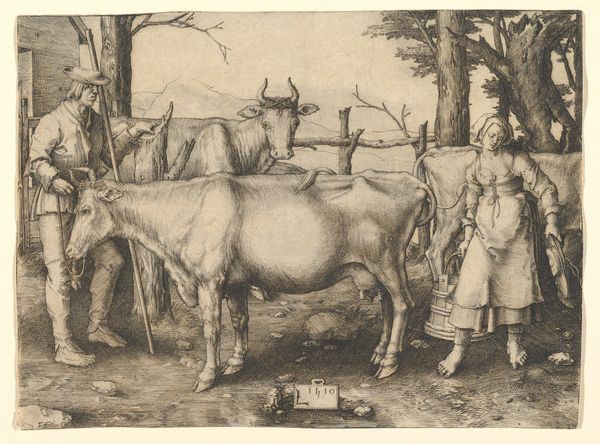
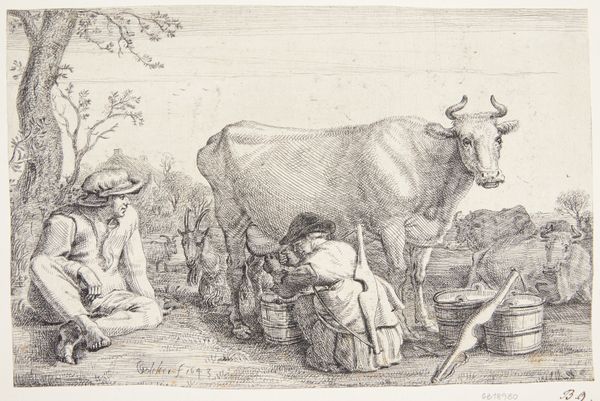
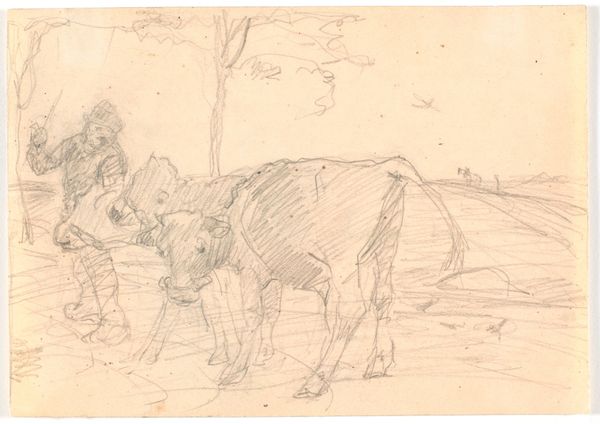
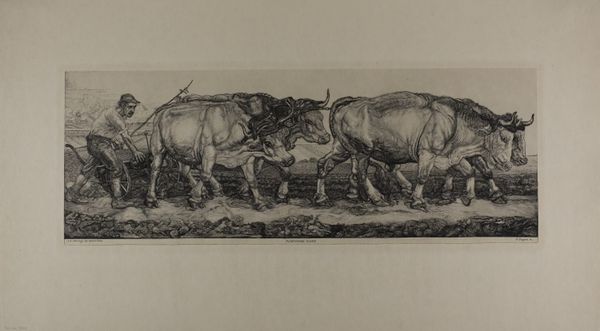
Editor: We're looking at "The Milkmaid," an engraving by Lucas van Leyden from 1510. It's a deceptively simple scene of rural life, but the level of detail is incredible for a print. It's got such a peaceful, almost pastoral feel to it, even though you can practically smell the farm. What do you make of it? Curator: You're right; there's something both serene and earthy about it. What strikes me is the artist’s almost tender observation of everyday life. There's a quiet dignity in these figures, isn't there? The woman, the farmer, even the cows. They aren't idealized, just…present. What stories do you think are contained within the image? Editor: Well, I see a slice of life. Maybe a comment on the dignity of labor? The bare feet suggest they might be poor. Curator: Ah, yes! I see that as well. And consider the medium: engraving. Prints allowed images and ideas to circulate widely during the Renaissance. Do you think the artist was deliberately choosing a common subject, like the milkmaid, so the image would resonate with more viewers? Perhaps reflecting on the common lives, rather than idealised aristocracy, don't you agree? Editor: That’s interesting; so maybe it’s more about democratizing art, making it accessible? Curator: Precisely! Lucas van Leyden could be said to be ahead of his time, and to really 'see' something in what could otherwise be considered every day life. So he captures what may become lost. It is an astute study of 'being', isn't it? Editor: I never thought of it that way, as this profound. I was too focused on the quaintness of it all. Curator: It's easy to miss that depth. But art, at its best, invites us to look closer and deeper, both into the image and ourselves. Now I find myself wondering what van Leyden might do, painting the scenes from my own mundane life... Editor: This makes me excited to look at everything with an interpretive mindset. To appreciate that so much lies below the surface.
Comments

minneapolisinstituteofart over 2 years ago
⋮
Traditionally, Lucas's The Milkmaid was hailed as one of the first pure, genre subjects in northern European art. Superficially, the shepherd and milkmaid are performing the mundane chores of rural, daily life. However, in subsequent scholarship, erotic overtones have been suggested --specifically, an allegory of lust and free will. The basis of this thesis is the word melkan (to milk) in 16th century Dutch connoted lokken (to lure). Lustful intent has been perceived in the poses and costumes of the figures, landscape details, and prominently placed cattle.


Join the conversation
Join millions of artists and users on Artera today and experience the ultimate creative platform.
 Collect
More like this