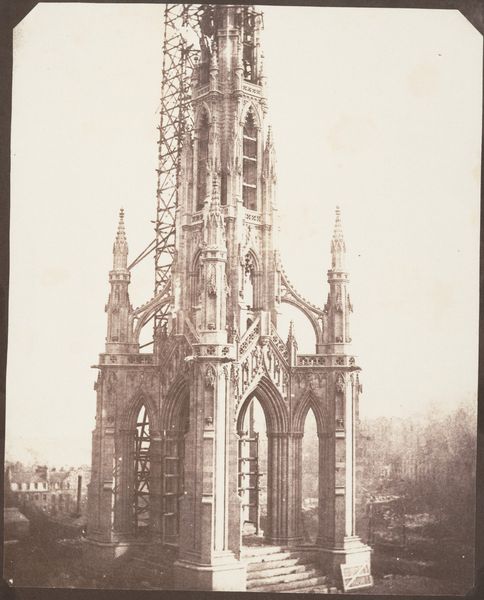
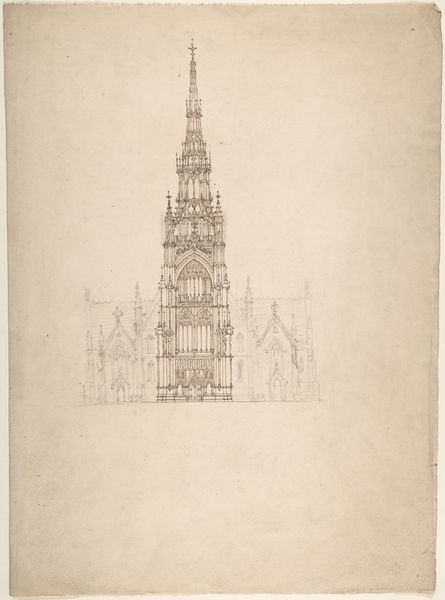
Sir Walter Scott's Monument, Edinburgh; as it appeared when nearly finished, in October 1844 1844


print, paper, photography, architecture
landscape
paper
photography
romanticism
cityscape
architecture
Dimensions: 19.6 × 15.5 cm (image/paper); 30.5 × 24.1 cm (page/mount)
Copyright: Public Domain
This is William Henry Fox Talbot’s 1844 photograph of the Sir Walter Scott Monument in Edinburgh, captured using his pioneering calotype process. Talbot, a man of science and privilege, was deeply embedded in the Victorian era’s celebration of progress. Yet, this image also reveals the era’s fixation on commemorating its cultural heroes. Sir Walter Scott, the celebrated novelist, is memorialized here in an almost ghostly, gothic form, not quite complete, yet looming large. Consider what it means to erect such a monument. It speaks to identity, both national and personal. Scott’s novels helped shape Scotland’s cultural identity, and this monument serves as a reminder of the narratives we choose to immortalize. The scaffolding, caught in Talbot’s lens, is a poignant reminder that identity, like any construction, is always in process, always being built. What stories are still missing from our monuments and collective memory?
Comments
No comments
Be the first to comment and join the conversation on the ultimate creative platform.
 React
React Comment