


Curatorial notes
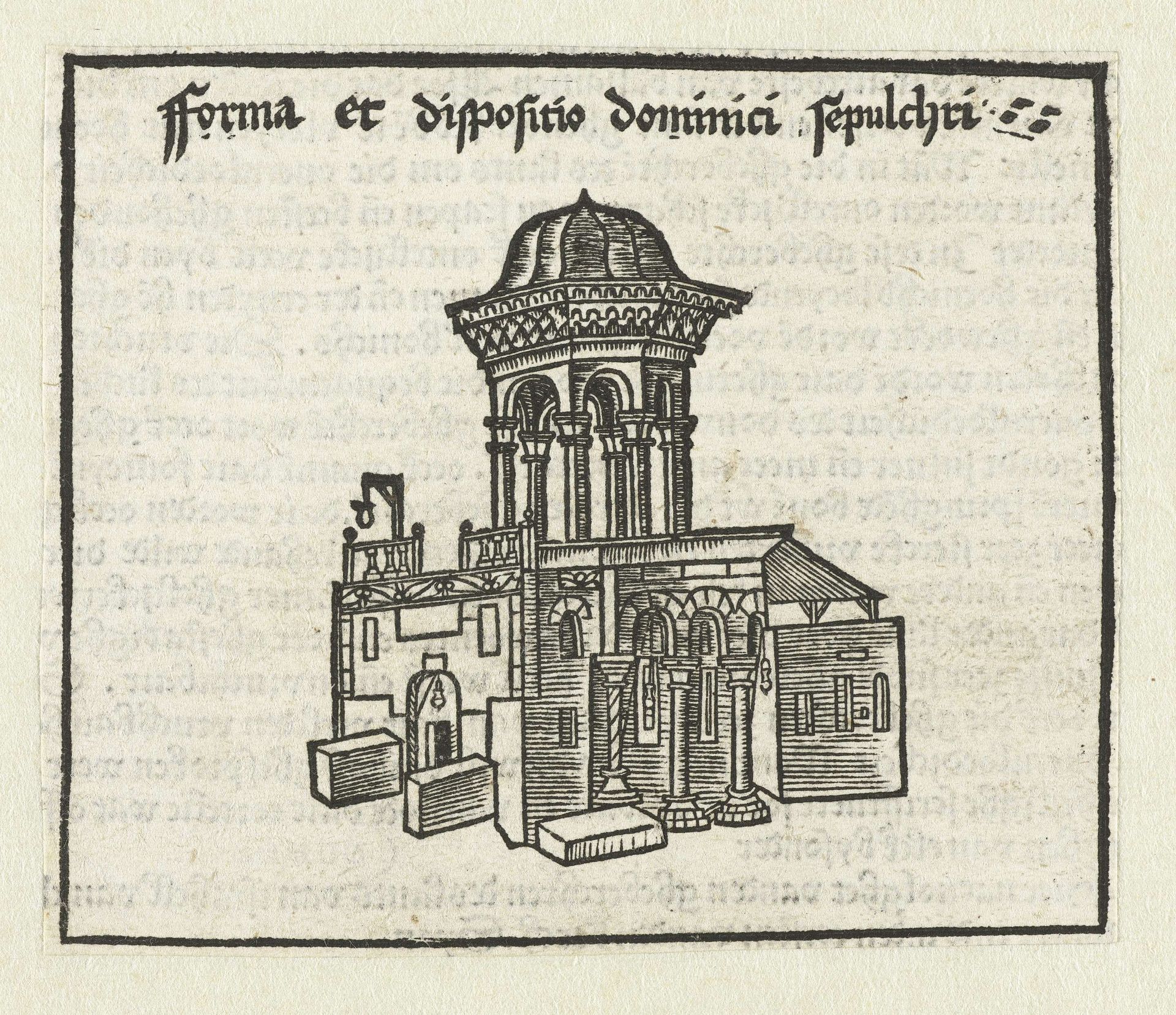
Curator: Here we have Erhard Reuwich's "Heilige graf", or "Holy Sepulchre," a woodcut print created between 1486 and 1488. Editor: My initial impression is a feeling of stark geometry. The contrast of black lines on the pale paper gives it a very immediate and imposing presence, despite its small scale. There’s a sense of reverence conveyed through those precise lines, but also perhaps, constraint? Curator: That’s interesting. Let’s consider the historical context. Reuwich was commissioned to create these images for Bernhard von Breydenbach's pilgrimage account. This print isn't just a depiction; it's a visual record intended to validate the pilgrim’s journey and the holy sites they visited, reinforcing a very specific socio-religious power structure. The printing press played a crucial role in disseminating these "official" versions of reality. Editor: Precisely. So, this wasn't simply about illustrating a scene. It was about constructing and solidifying religious and social hierarchies. Thinking about that framework, I see how the geometric precision might symbolize an attempt to contain the messy, human realities of faith within an ordered system. Who exactly did this serve? Curator: That's the question, isn’t it? These pilgrimage accounts were targeted towards wealthy elites. Owning such a book validated their status as learned and pious individuals. Reuwich's print, therefore, served as both a devotional aid and a status symbol. The clear lines and architectural details offered a seemingly objective truth, bolstering the Church's authority. Editor: And that constructed "truth" would inevitably exclude or marginalize other interpretations, particularly those of marginalized communities. Was there ever room for alternative stories within these representations, or did it force its viewers to confront a pre-designed, monolithic point of view, so characteristic of institutions, even until this day? Curator: Reuwich’s image, despite its limitations, is still a testament to the enduring human desire to connect with the sacred. The very act of attempting to capture a holy site reflects a belief in its power, even within the confines of a powerful system. Editor: Perhaps the print now encourages us to reflect on the role of art as an act of power: as means to challenge, resist, or consolidate existing hierarchies? The rigid architecture depicted in it can only remind me of today’s political structures and institutions, which are long overdue for renovations, perhaps an entire demolition.