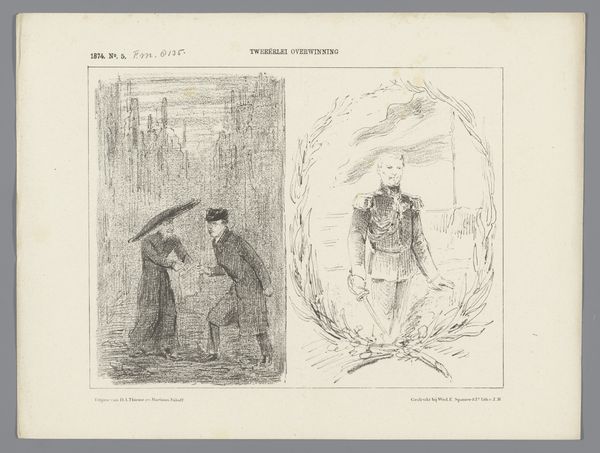
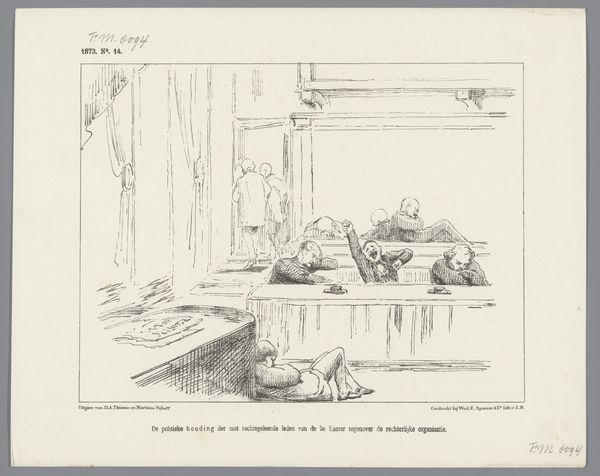
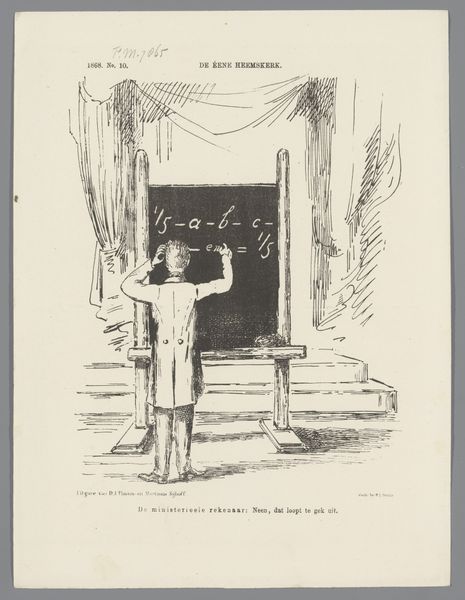
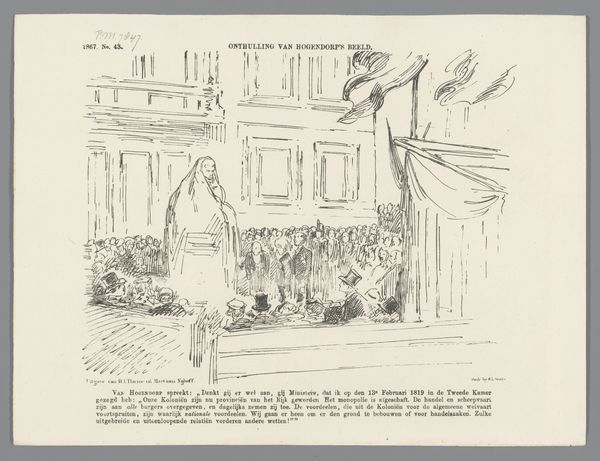
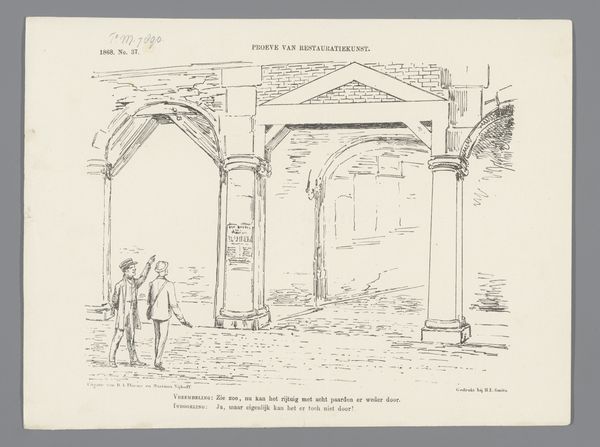
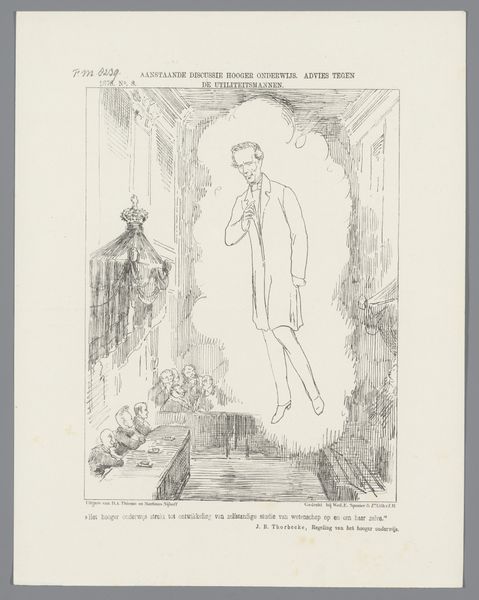
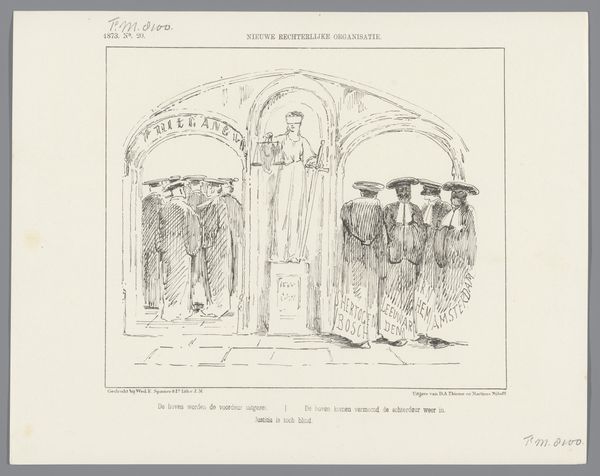
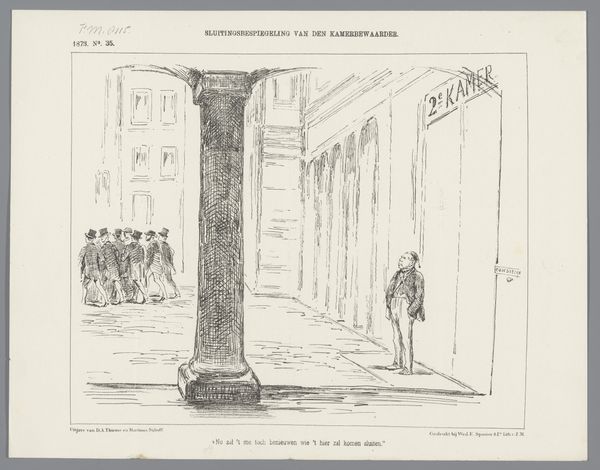
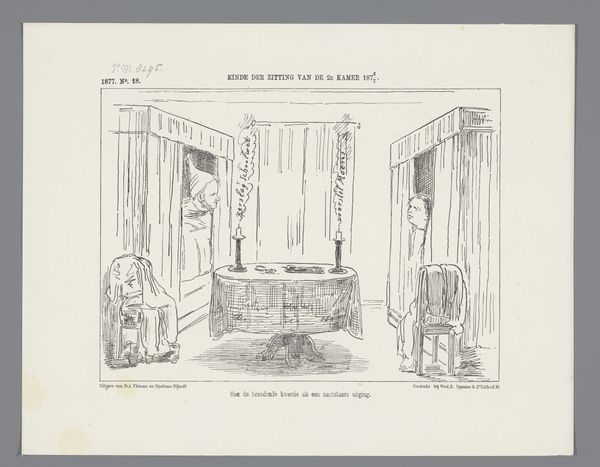
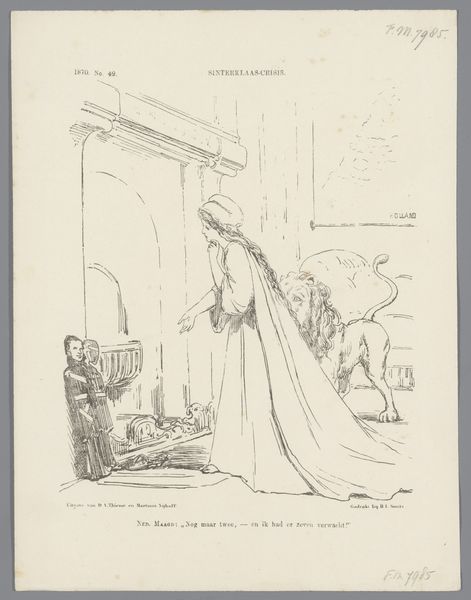
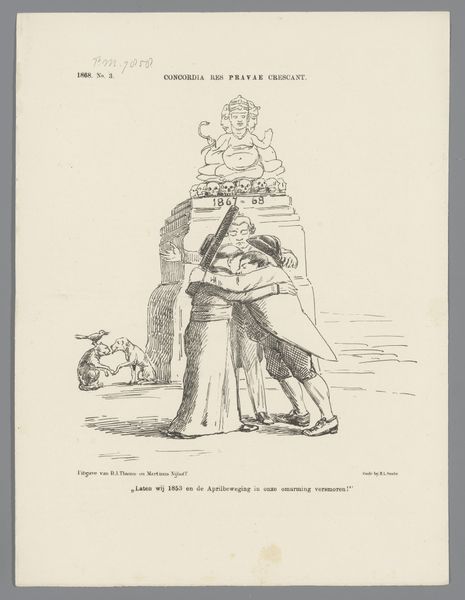
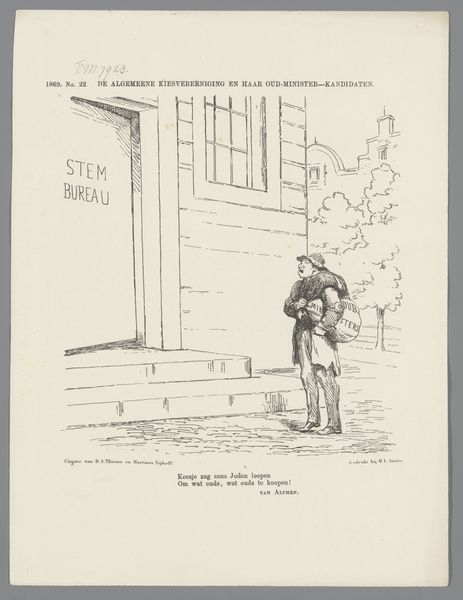
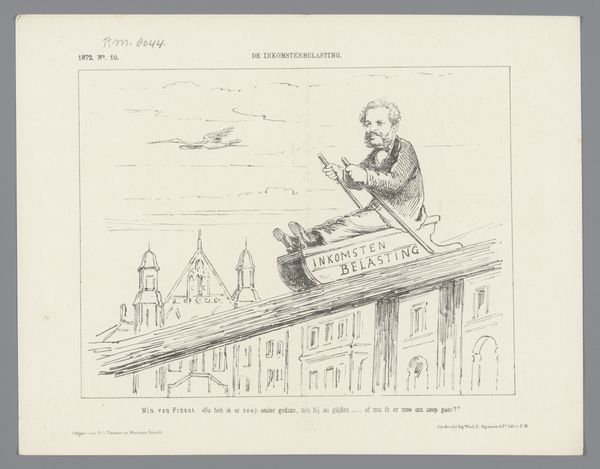
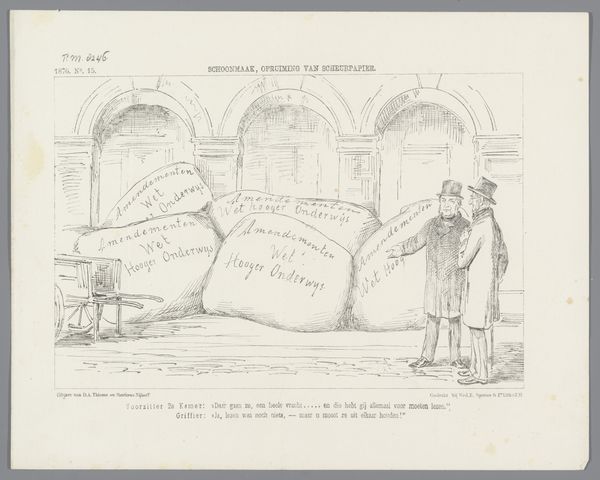
Spotprent op de benoeming van Heemskerk tot lid van het college van de Hoge Raad, 1873 1873
0:00
0:00

drawing, print
#
portrait
#
drawing
#
historical design
#
comic strip sketch
#
aged paper
#
pale palette
#
dutch-golden-age
# print
#
caricature
#
sketch book
#
personal journal design
#
personal sketchbook
#
sketchwork
#
sketchbook drawing
#
storyboard and sketchbook work
#
realism
Dimensions: height 215 mm, width 275 mm
Copyright: Rijks Museum: Open Domain
Editor: So, this is a print from 1873, titled "Spotprent op de benoeming van Heemskerk tot lid van het college van de Hoge Raad," attributed to Johan Michaël Schmidt Crans. It depicts a figure on what appears to be a stage. There's a slightly melancholic feeling, with the lone figure and the empty stage. What can you tell me about it from a historical viewpoint? Curator: This work operates as political commentary, using visual metaphor. The 'theatre' setting and the figure, Heemskerk, suggest a deliberate performance of power and justice. Considering that museums and the art world are deeply embedded within political structures, ask yourself who would be the intended audience for such a caricature, and what message it tries to send to that demographic? Editor: That's interesting. So, is the idea that Heemskerk's appointment to the Supreme Court is seen as a staged event, a pre-determined performance rather than a just outcome? Curator: Precisely! Look at the starkness of the stage design and ask yourself how the lack of ornamentation affects your reception of the scene. This caricature is more than a portrait; it's a critique of the political institutions of the time. It draws attention to how those institutions operate in the public eye. How do you feel the 'performance' and reception of justice may be subtly manipulated? Editor: It's fascinating how much social commentary can be packed into a single image. I didn't initially pick up on the performative aspect. Curator: These visual tools were, and remain, a common tactic to affect public perception. So understanding them enhances one's interpretation. What are your final thoughts regarding its enduring qualities? Editor: Now, I am more aware of art’s power to shape public perception, a key reminder about being a responsible viewer and that visual artworks carry deeper meaning. Curator: Exactly! And that understanding transforms our reading of visual art, regardless of age, medium or origin.
Comments
No comments
Be the first to comment and join the conversation on the ultimate creative platform.
 Collect
 React
React Comment
More like this