Copyright: Public domain
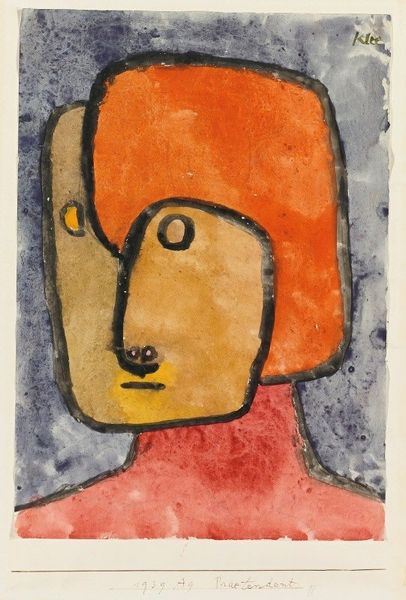
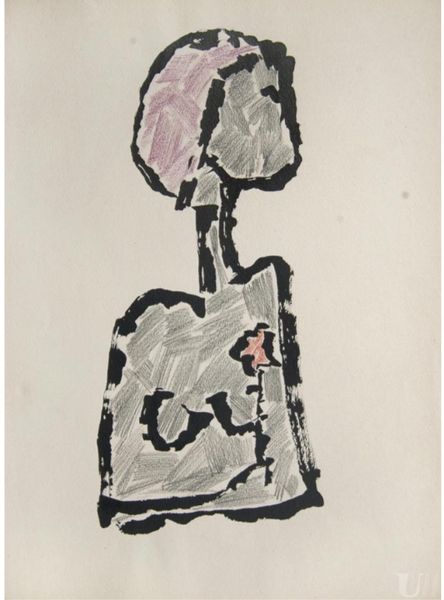
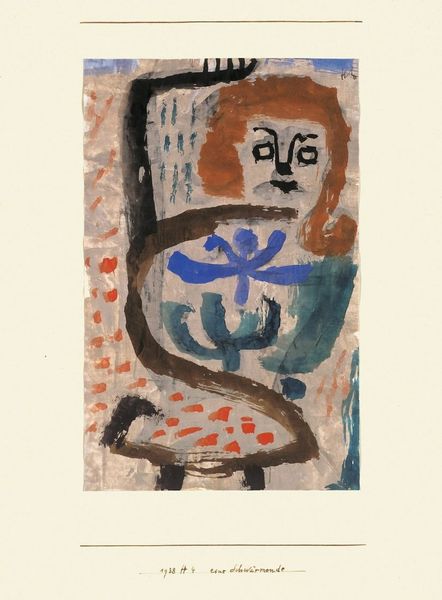
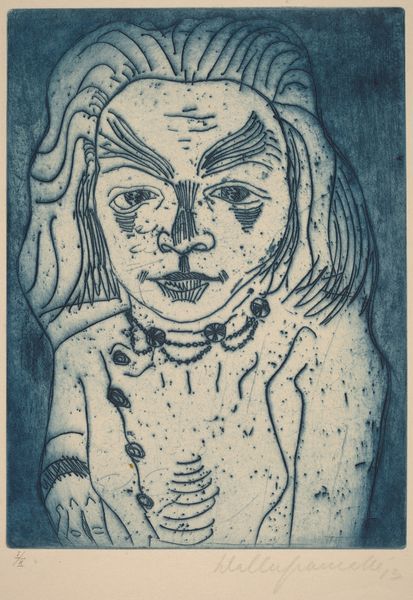
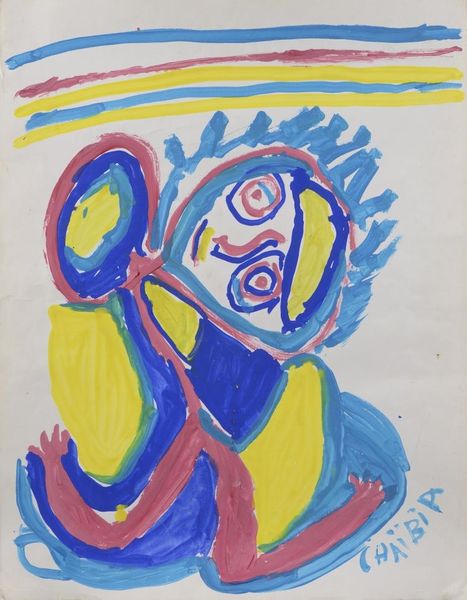
Curator: Welcome! We're standing before Paul Klee's "Head of a Child," a watercolor piece created in 1939. Editor: The color palette hits me first. That lavender background coupled with the peachy skin tone… there's a deliberate, almost unsettling juxtaposition there. The black outlines give the composition a structured feel. Curator: Klee created this watercolor in a period overshadowed by political turmoil in Europe. Reflecting upon its context, do you think this representation carries symbolic weight about the vulnerability of innocence amid rising oppression? Editor: I see your point about the sociopolitical factors of that era. But I'm drawn more to the geometric construction of the face itself. Those flattened planes and almost diagrammatic eyes remind me of early Cubist explorations of form. It's a face reduced to its essential visual components. Curator: Yes, I see the basic forms as well, and there is a child's innocence in Klee's simplified portrayal, even a caricature. In 1933 Klee was dismissed from his teaching position due to Nazi pressure and his art was labeled 'degenerate,' a painful attack. His experience shaped his artistic trajectory, his 'degenerate' and "primitive" drawings were his visual rebellion. Editor: Rebellious or not, the starkness achieves a curious effect. And I am curious about the lines of the shoulders, creating two sharp angles that frame a curious geometric pattern; like letters maybe, they could be elements borrowed from the world of script and code. What about the way he defines those lines, too? Is it dry brush? There's almost no blending, adding to the rawness of the work. Curator: Yes, Klee explores this, doesn’t he? The tension he evokes reflects how Germany treated his art. Klee was exiled from Germany in December 1933, just six years before he created this haunting portrayal. Editor: Hmm… "haunting." Yes, maybe now I can see that sense of…unease. But it’s subtler, born more from the calculated composition, not necessarily a literal depiction of emotions. Curator: Art provides endless insights into our history; hopefully this inspires reflection! Editor: I agree. Whether you are observing the technique or social narratives, these perspectives enhance each other.
Comments
No comments
Be the first to comment and join the conversation on the ultimate creative platform.
 Collect
 React
React Comment
More like this