

Possibly 1786
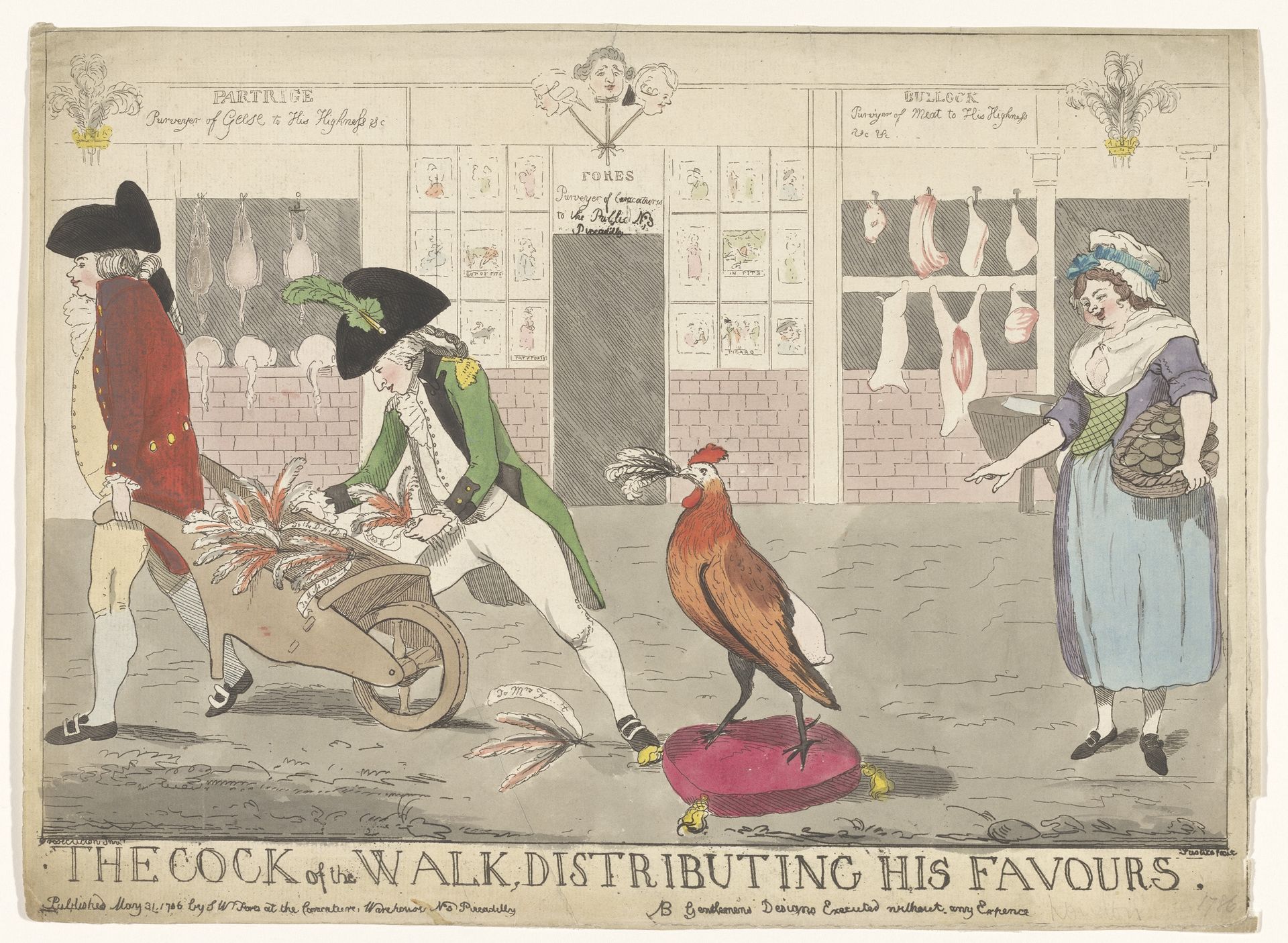
Haan deelt veren uit voor de prenthandel van Samuel W. Fores te Londen

Anonymous
@anonymousLocation
RijksmuseumListen to curator's interpretation
Curatorial notes
Curator: So, here we have a satirical print titled "Haan deelt veren uit voor de prenthandel van Samuel W. Fores te Londen," or roughly, "The Cock of the Walk, Distributing His Favours," possibly from 1786, and attributed to an anonymous artist. It combines drawing, ink, engraving, and watercolour. What strikes you about it? Editor: I'm immediately drawn to the central figure—a literal rooster perched on a cushion! It's quite absurd. And those gentlemen handing out feathers… It seems very critical, but about what? What should I make of this composition? Curator: Focus on the production itself. This wasn't simply 'art'; it was manufactured imagery intended for a specific market. The print refers directly to Samuel Fores, a London print seller, connecting artistic creation to the commercial world. This suggests a comment on the mass dissemination and consumption of images. Notice the contrast: hand-drawn, unique artistic labor, translated into reproducible prints, sold for profit. It blurs the boundaries between high art and commodity. Editor: So, the rooster is like... an emblem of the whole commercial operation? Distributing "favours," which are really mass-produced items. Are the feathers symbols of vanity or perhaps frivolous consumption? Curator: Possibly both! The feathers point to the material reality of adornment and display. Think about the labour involved in creating and distributing those prints. Whose hands touched this image, and for what purpose? What class consumed these images, and what kind of cultural capital did owning such an object represent? It questions the very process through which value is assigned to art. Editor: I hadn't considered the labour aspect so directly before. It's easy to forget that art, even satire like this, involves production and economic exchange. I also like that you point out the connection with labor, challenging the definition of ‘art’ as divorced from work or mass distribution. Curator: Exactly. It urges us to view art not in isolation, but as enmeshed within material networks and systems of power. Editor: This perspective really changes how I see it. Thanks, I now have some good angles to follow here.