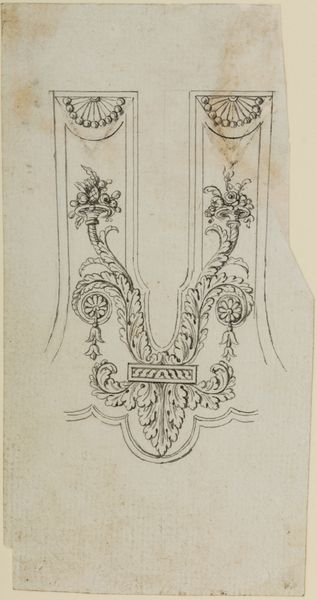
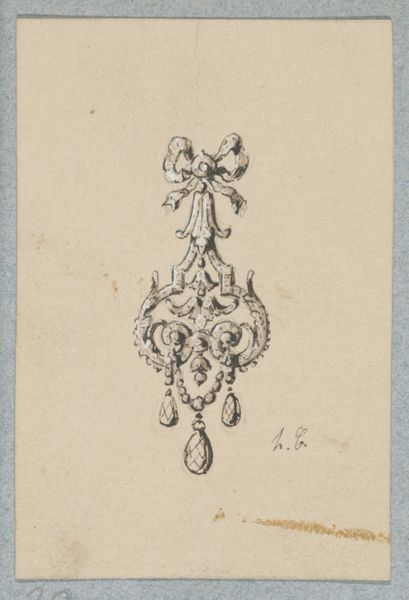
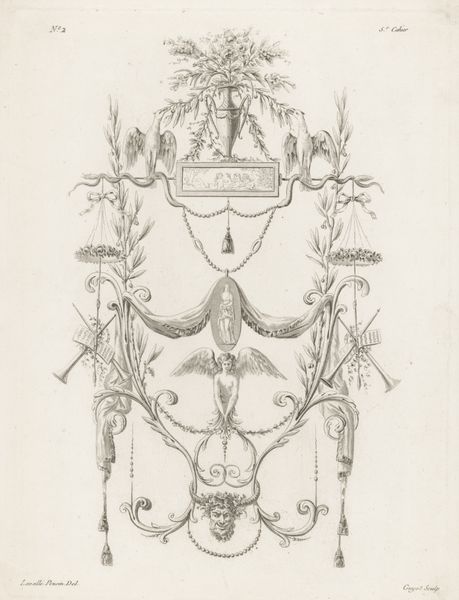
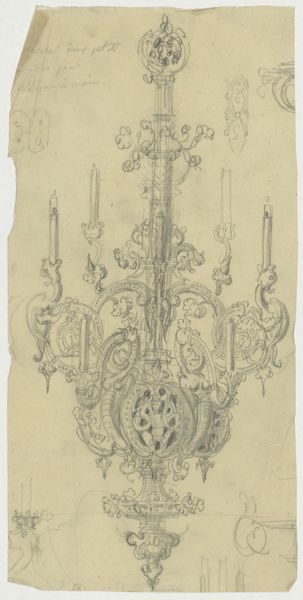
Dele af et spyd, på midten smykket af et medusahoved med slanger 1743 - 1809


drawing, ink, pencil
drawing
classical-realism
figuration
ink
pen-ink sketch
pencil
pen work
sketchbook drawing
history-painting
Dimensions: 344 mm (height) x 209 mm (width) (bladmaal)
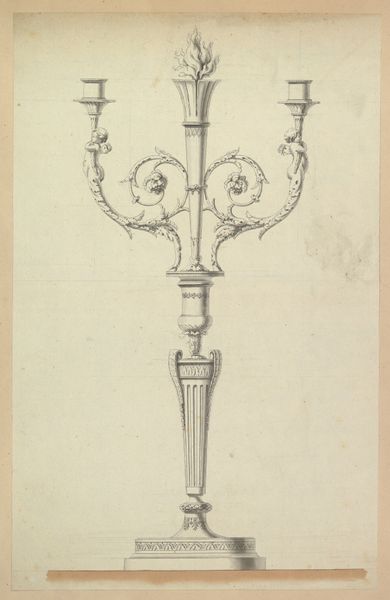
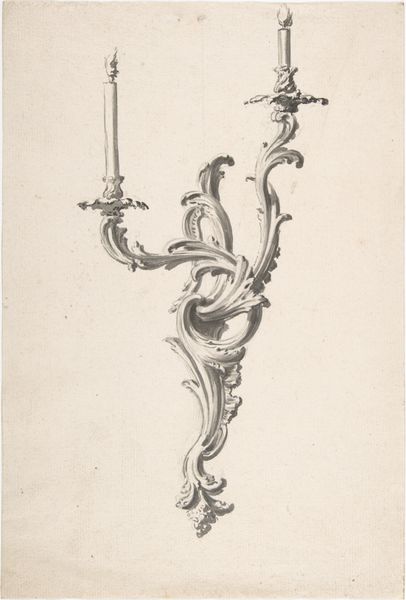
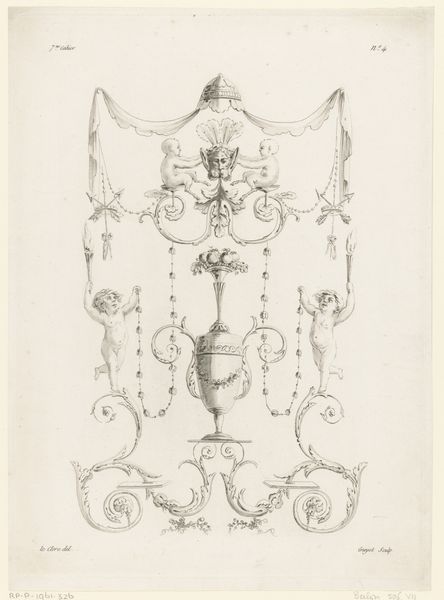
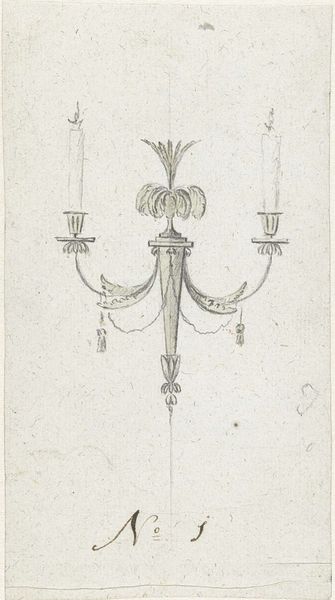
Curator: This pen and pencil drawing, titled "Dele af et spyd, på midten smykket af et medusahoved med slanger," which translates to "Parts of a spear, in the middle decorated with a Medusa head with snakes," was created by Nicolai Abildgaard between 1743 and 1809. I find it strikingly powerful. Editor: Indeed. It's visually quite stark; the monochrome rendering lends it an air of austerity, almost as if viewing an artifact recovered from an archaeological dig. There's an undeniable sense of menace emanating from that Medusa head. Curator: Precisely. Abildgaard’s careful arrangement emphasizes line and form, guiding the eye from the simple spear points to the ornate Medusa. Observe how the serpentine forms contrast with the rigid geometry of the spear shaft itself, and consider this a demonstration of neoclassical aesthetics. Editor: The choice of Medusa is quite telling when one considers the broader sociopolitical landscape. I see this drawing, in its starkness, as an allegorical reflection of power, perhaps referencing the paralyzing effect of authority figures in 18th-century Europe. The myth of Medusa has often been used to represent silenced or monstrous female figures, so the decision to place her head upon a spear could reflect anxieties about power structures. Curator: It’s intriguing to consider your interpretation. My analysis centers more upon the inherent aesthetic relationships established within this work, but there is more. This study likely speaks to a broader context of Neoclassical revival—a return to classical themes in art. Abildgaard's sharp details, combined with his subject matter, highlight this stylistic shift. Editor: Agreed. Although Neoclassicism sought to revitalize and repurpose ancient Greek and Roman motifs and narratives, it did so within particular historical circumstances. Can we extract ourselves from an acknowledgement of colonialism, elitism, and misogyny present in this context? The clean, precise lines are tools wielded in cultural narratives we should not take for granted. Curator: These points create some productive considerations. I am most appreciative of having shared time to examine line, tone, and figure—a privilege indeed. Editor: Agreed. Reflecting upon how an artwork converses across centuries through various sociohistorical frames is where genuine engagement lies.
Comments
No comments
Be the first to comment and join the conversation on the ultimate creative platform.
 React
React Comment