Dimensions: support: 268 x 476 mm
Copyright: CC-BY-NC-ND 4.0 DEED, Photo: Tate
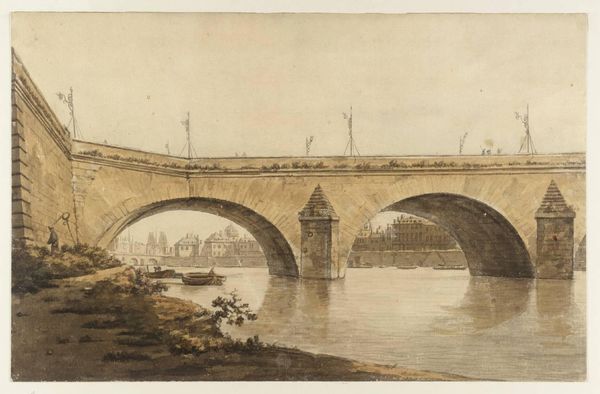
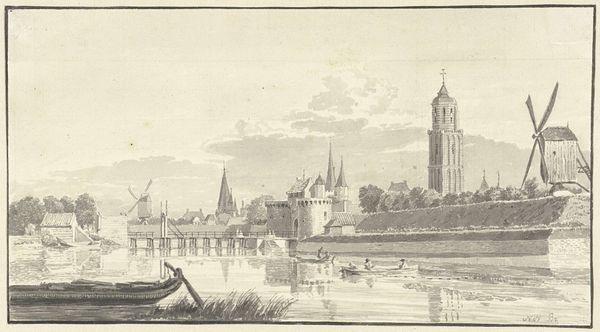
Curator: William Pars' "Schaffhausen," held at the Tate, captures a Swiss scene in delicate watercolour and ink. What catches your eye first? Editor: The sheer weight of the covered bridge pressing down on the water, and the city behind. There’s an imposing air of permanence here. Curator: Bridges have always symbolized connection, passage, but this one, constructed of stone and timber, speaks to the labor and resources required. The social impact of such an undertaking must have been immense. Editor: Absolutely. And consider the iconography. The covered bridge as a symbol of protection, a safe passage, almost womb-like, contrasting with the vastness of the water beneath and the sky above. It's a journey into the unknown, but sheltered. Curator: Indeed, and the careful depiction of the building materials—the rough-hewn stone, the timber beams—reveals an attention to craft and construction, elevating the everyday to something monumental. Editor: It’s a fascinating blend, this scene. Pars uses simple imagery to evoke the power of landscape, and the human effort to dominate it. Curator: A landscape transformed by labor, made meaningful through symbolic architecture. Editor: Leaving us to reflect on our own bridges, both physical and metaphorical.
Comments


Join the conversation
Join millions of artists and users on Artera today and experience the ultimate creative platform.

tate 12 months ago
⋮
On 31 August, some two weeks after they had travelled along the River Ticino to Pollegio (see no.46), Pars and his patron Lord Palmerston reached Schaffhausen on the river Rhine. Palmerston showed a particular interest in the bridge, 'cover'd with a Gallery as many of the Swiss and German Bridges are', and described its construction in some detail in his journal. Pars has produced a faithful record of the bridge and town, dominated by the fort of the Munot in the distance. His watercolours are often enlivened with realistically observed figures. Here he shows one seated on the river bank rolling up his breeches, perhaps preparing to immerse his ankles in the river Rhine. Gallery label, August 2004
 Collect
More like this