About this artwork
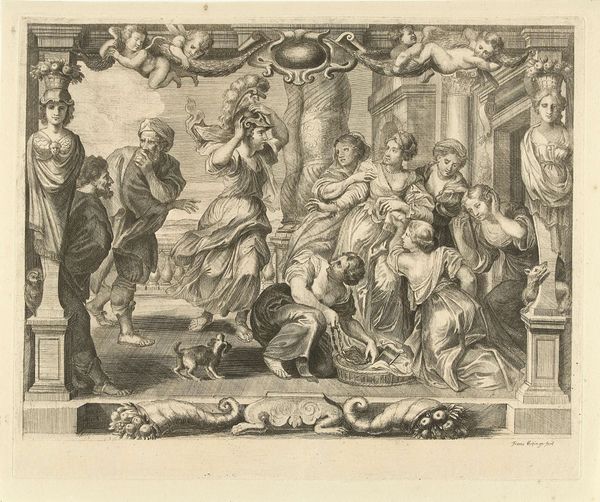
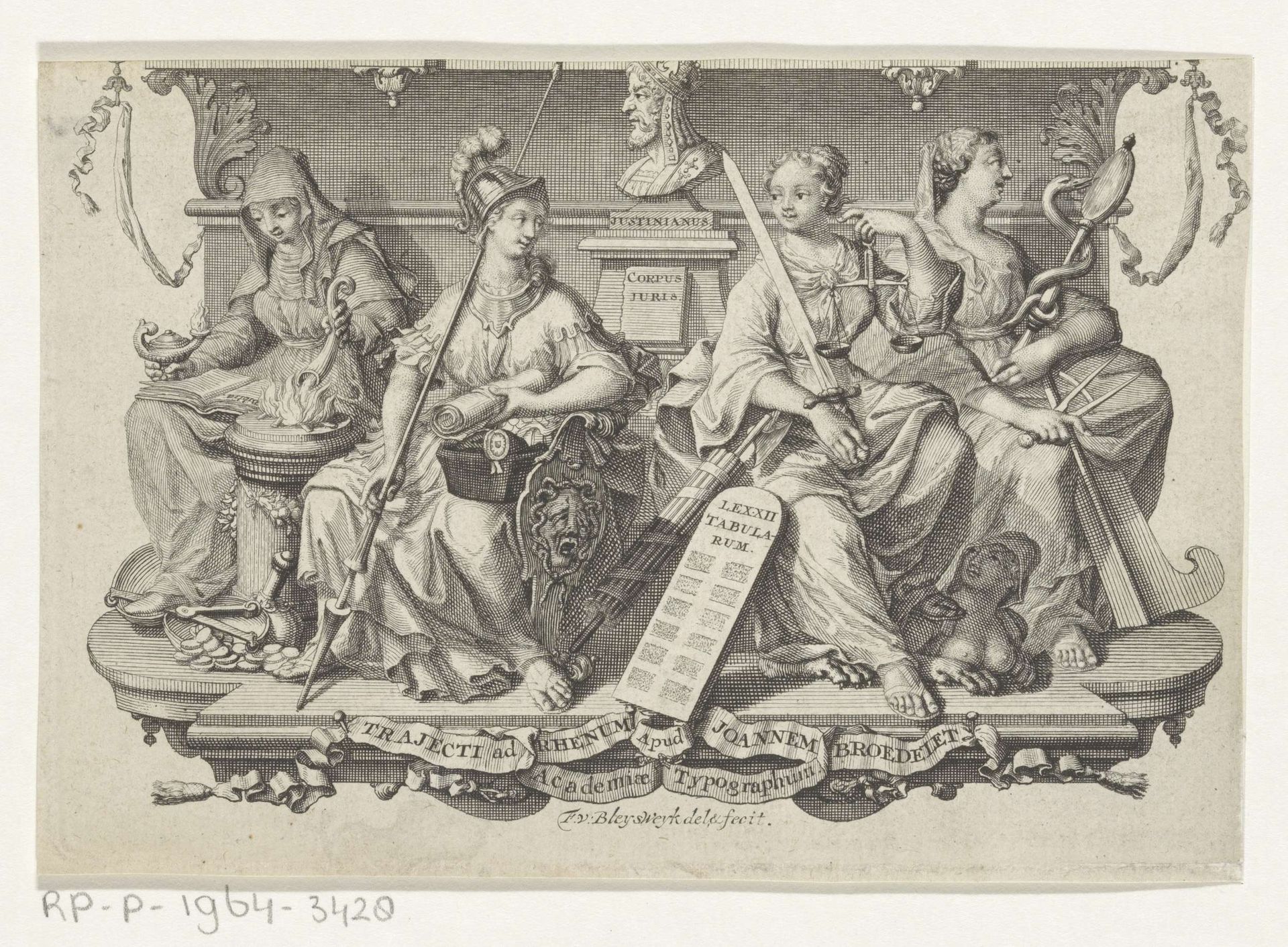
This engraving by François van Bleyswijck presents an allegory with Minerva and other virtues. The central figure of Minerva, goddess of wisdom and strategic warfare, displays a stern resolve, spear in hand, embodying the principles of reason and order. Notice the scales of justice, a symbol that stretches back to ancient Egypt, representing Maat, the principle of truth and cosmic balance. The scales reappear throughout history, adorning Roman sculptures and medieval cathedrals, each time adapted to reflect the prevailing cultural understanding of justice. Consider the figure with the mirror and serpent-entwined rod, attributes of Prudence and Health respectively. Such symbols act as conduits, linking us to a collective memory, resonating with subconscious patterns and archetypes. The emotional impact is clear: these symbols tap into a deep, shared understanding of virtue and moral order, passed down through generations. The symbols are not static, they evolve, adapt, and resurface, echoing through time in an endless dance of cultural expression.
Allegorie met Minerva en deugden
1728 - 1771

François van Bleyswijck
1671 - 1746Location
RijksmuseumArtwork details
- Medium
- drawing, engraving
- Dimensions
- height 112 mm, width 164 mm
- Location
- Rijksmuseum
- Copyright
- Rijks Museum: Open Domain
Tags
Comments
Share your thoughts
About this artwork
This engraving by François van Bleyswijck presents an allegory with Minerva and other virtues. The central figure of Minerva, goddess of wisdom and strategic warfare, displays a stern resolve, spear in hand, embodying the principles of reason and order. Notice the scales of justice, a symbol that stretches back to ancient Egypt, representing Maat, the principle of truth and cosmic balance. The scales reappear throughout history, adorning Roman sculptures and medieval cathedrals, each time adapted to reflect the prevailing cultural understanding of justice. Consider the figure with the mirror and serpent-entwined rod, attributes of Prudence and Health respectively. Such symbols act as conduits, linking us to a collective memory, resonating with subconscious patterns and archetypes. The emotional impact is clear: these symbols tap into a deep, shared understanding of virtue and moral order, passed down through generations. The symbols are not static, they evolve, adapt, and resurface, echoing through time in an endless dance of cultural expression.
Comments
Share your thoughts