

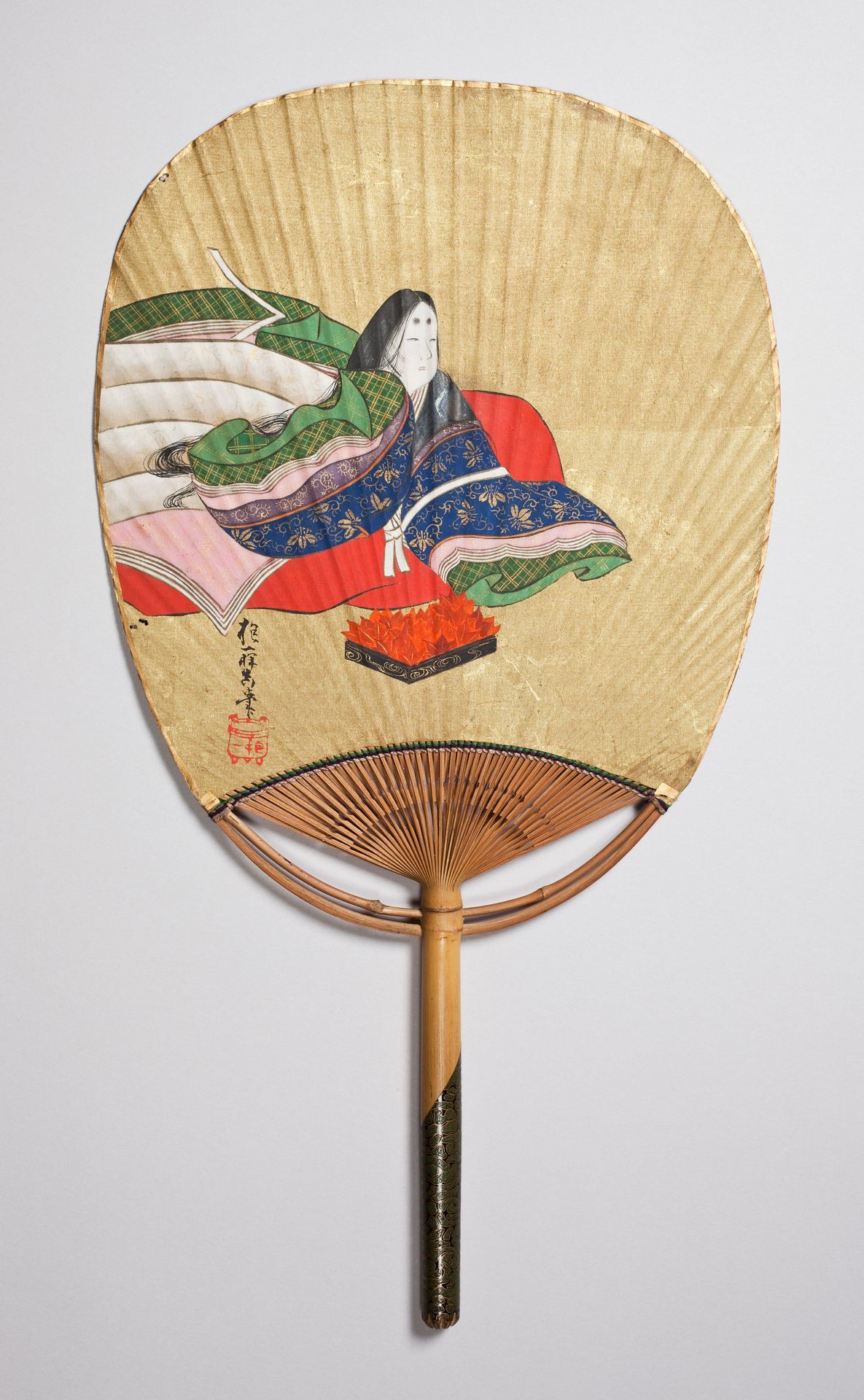
c. early 19th century
Fan with Akikonomu Chūgū from -The Maiden- Chapter of the Tale of Genji


Listen to curator's interpretation
Curatorial notes
Curator: Immediately striking is the objecthood of this piece: a functional fan adorned with such elaborate imagery. The curve of the bamboo, the texture of the paper… It presents itself as an integrated whole. Editor: This lovely piece is a fan painting with Akikonomu Chūgū from “The Maiden” chapter of The Tale of Genji, created circa the early 19th century by Sakai Hōitsu. It's a gorgeous miniature scene rendered in watercolor. Curator: Miniature indeed! Scale is everything here. The contained space dictates a necessary precision. Look at how the artist balances positive and negative space, using the golden paper to offset the figure. And the layers of color in the robes, creating depth within that small surface area... Editor: Absolutely. It also offers insight into the cultural context in which this artwork was created. Ukiyo-e, or "pictures of the floating world," were extremely popular, and the adaptation of classic literature to these accessible formats expanded the audience for courtly tales. The fan itself signifies social status, as well as the broader availability of artistic consumption. Curator: Precisely. And if we consider the form, the fan’s radiating ribs both visually emphasize the central figure and function structurally. The application of the image is not arbitrary; the form and content cohere perfectly, pointing us to questions of intention. How does the fan as a physical object modify our viewing experience? Editor: I would further argue that pieces like this blurred the lines between elite culture and popular entertainment. The Tale of Genji was a courtly text, but disseminated via these portable and relatively inexpensive objects. It offers a commentary on social stratification. Curator: It speaks volumes about the visual grammar of the time. Consider the limited palette—golds, blues, greens, and reds—and the way these choices define a specific aesthetic. There’s a clear prioritization of design. Editor: Looking closely, it's a study in art as both high craft and something embedded in daily life, shaping societal narratives and power structures. The fact that it depicts a specific scene adds another layer. Curator: A fruitful exploration of form and culture indeed. Editor: Precisely, it gives us something to *fan* about!
