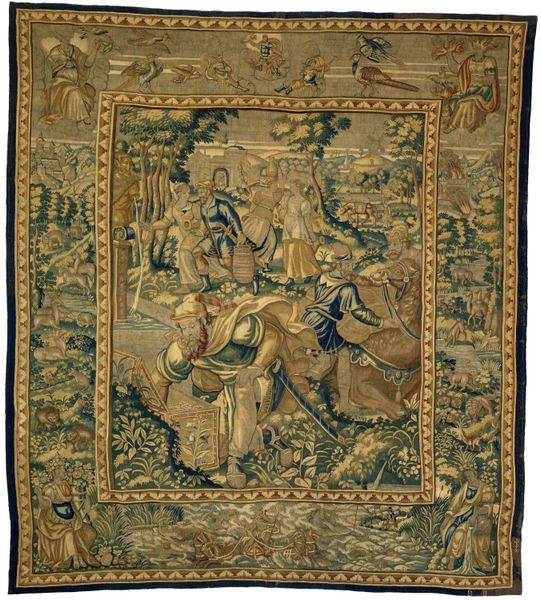
Kamerscherm, tweebladig, gestoffeerd met een weefsels met een oosterse danser en muzikant en dierenscènes uit de fabels van La Fontaine c. 1745 - 1760
0:00
0:00

weaving, textile
#
narrative-art
#
weaving
#
landscape
#
textile
#
figuration
#
genre-painting
#
rococo
Dimensions: height 142.0 cm, width 116.0 cm
Copyright: Rijks Museum: Open Domain
Editor: We're looking at a folding screen from around 1745-1760, crafted by an anonymous artist. It’s textile work, depicting scenes of an oriental dancer and musician as well as animals from La Fontaine's fables. The overall impression is playful, very ornate. What strikes you most when you look at it? Curator: Immediately, the juxtaposition of Eastern and Western imagery leaps out. The weaving suggests a desire to showcase worldly knowledge. Note how the oriental figure, juxtaposed with fables of La Fontaine, embodies a cross-cultural dialogue, presenting exoticism but filtering it through familiar moral tales. It's Rococo embracing global awareness. Editor: So, you're saying these seemingly unrelated images actually speak to the time period's understanding of different cultures? Curator: Precisely! Rococo was often about surface embellishment, but beneath this ornamentation lies a deeper engagement with other cultures, though admittedly filtered through a European lens. What do the fables featuring animals suggest to you in this context? Editor: Perhaps that human characteristics are universal, no matter what part of the world? That even within the exotic, familiar stories can be found? Curator: An insightful observation. The animals are, in a sense, a bridge, grounding the ‘foreign’ aesthetic with recognizable narratives. We are drawn to visual cultures because of our shared history of visual languages. The screen isn’t merely decorative, it's a statement. Editor: I’m starting to see how this screen is so much more than just pretty pictures! Thank you. Curator: My pleasure. Looking deeper at objects really shows us the stories they contain, consciously or unconsciously.
Comments
No comments
Be the first to comment and join the conversation on the ultimate creative platform.
 Collect
 React
React Comment
More like this