About this artwork
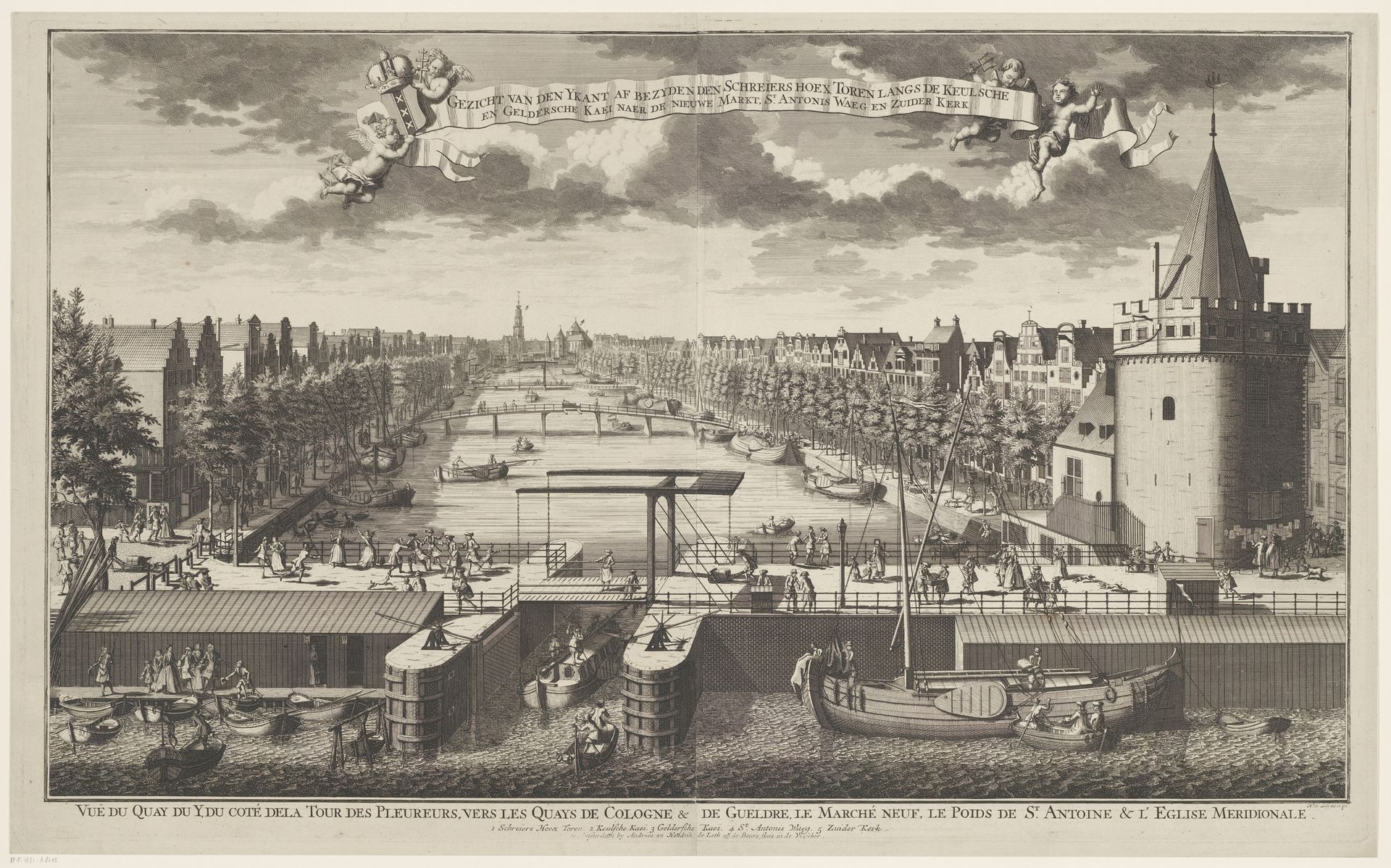
Hendrik de Leth created this print, "View of an Amsterdam Canal from the IJ Side," likely in the mid-18th century. The cityscape unfolds with a detailed, linear precision, almost architectural in its rendering. The composition is structured by the canal's perspective, receding into the distance and framed on either side by buildings and trees. De Leth constructs a visual order where each element—from the figures on the docks to the boats in the water—contributes to a larger semiotic network. The detailed rendering invites us to interpret Amsterdam society through its architectural and social structures. Notice how the linear quality of the engraving emphasizes clarity and rationality. This approach is consistent with the Enlightenment's focus on reason. Ultimately, the print encourages a structured reading of the city itself, where every detail is part of a larger, coherent, and legible whole. This reflects the era's ambition to organize and understand the world through systematic observation and representation.
Gezicht op een Amsterdamse Gracht vanaf de IJzijde
1725 - 1731

Hendrik de Leth
1703 - 1766Location
RijksmuseumArtwork details
- Medium
- print, engraving
- Dimensions
- height 579 mm, width 954 mm
- Location
- Rijksmuseum
- Copyright
- Rijks Museum: Open Domain
Tags
Comments
Share your thoughts
About this artwork
Hendrik de Leth created this print, "View of an Amsterdam Canal from the IJ Side," likely in the mid-18th century. The cityscape unfolds with a detailed, linear precision, almost architectural in its rendering. The composition is structured by the canal's perspective, receding into the distance and framed on either side by buildings and trees. De Leth constructs a visual order where each element—from the figures on the docks to the boats in the water—contributes to a larger semiotic network. The detailed rendering invites us to interpret Amsterdam society through its architectural and social structures. Notice how the linear quality of the engraving emphasizes clarity and rationality. This approach is consistent with the Enlightenment's focus on reason. Ultimately, the print encourages a structured reading of the city itself, where every detail is part of a larger, coherent, and legible whole. This reflects the era's ambition to organize and understand the world through systematic observation and representation.
Comments
Share your thoughts