weaving, wood
asian-art
weaving
japan
wood
Dimensions: 14 1/2 × 11 3/4 × 9 1/4 in. (36.83 × 29.85 × 23.5 cm)
Copyright: No Known Copyright
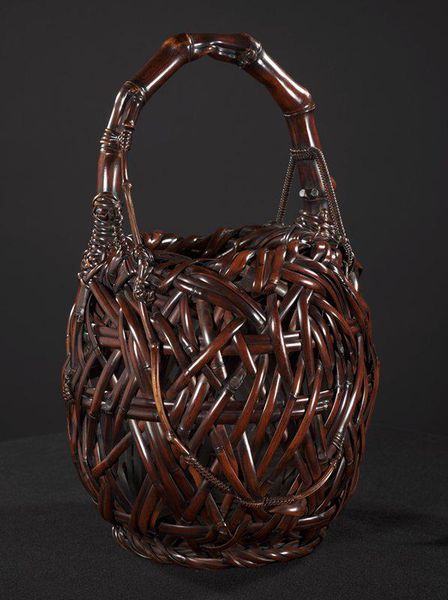
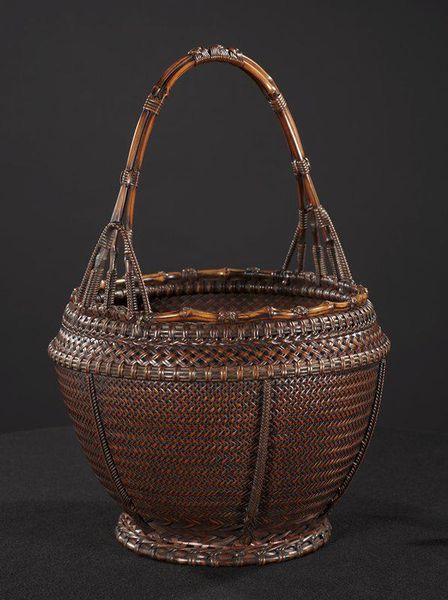
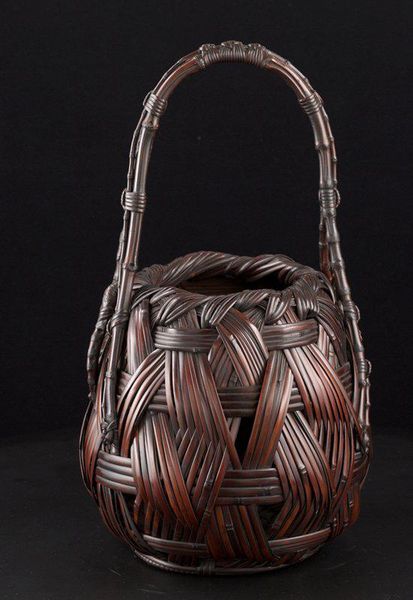
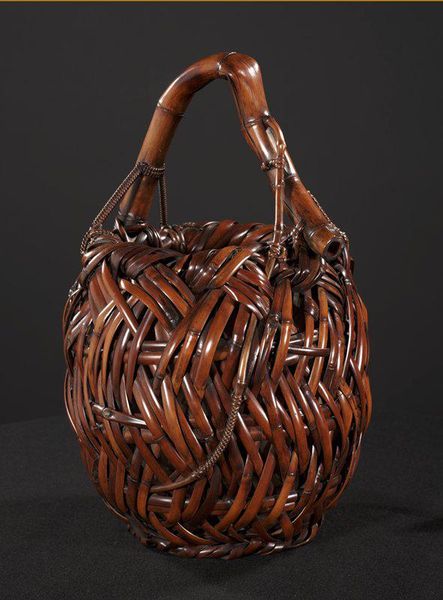
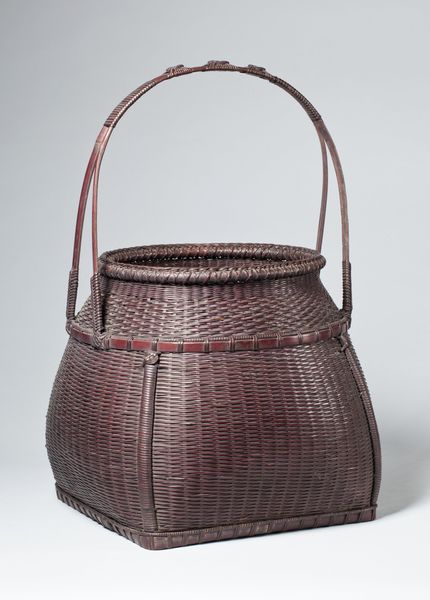
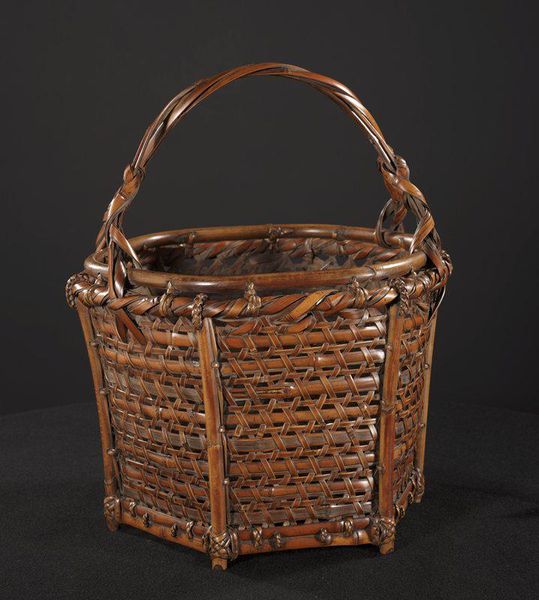
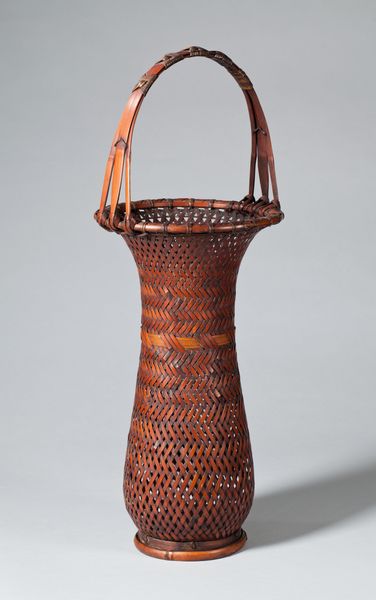
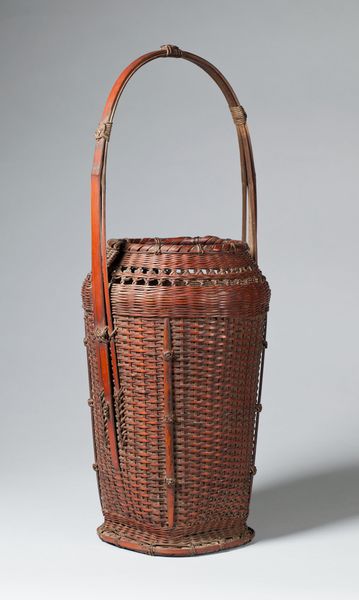
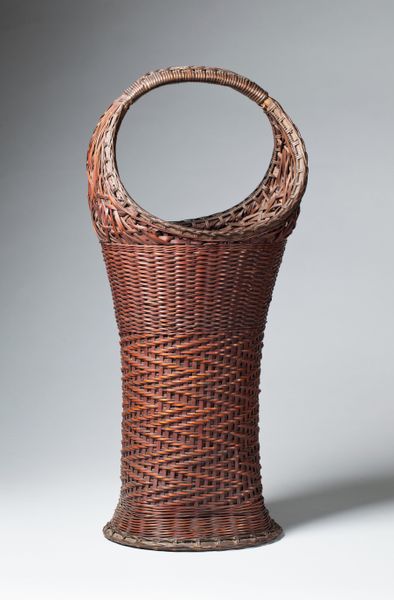
Curator: What a deceptively simple form! My first impression is that this piece evokes a sense of quiet strength. Editor: That's fitting. What we have here is a woven bamboo basket, "Passing Showers," created by Wada Waichisai II, dating to the early 20th century. Baskets, particularly in Japan, hold so much more significance than mere utility. Curator: Precisely. It’s crucial to recognize the cultural underpinnings. This basket embodies, to me, a connection to both the natural world and the rituals of daily life. Think of the labour involved, the understanding of materials... it becomes a testament to a particular way of life in early 20th-century Japan. Editor: The beauty of this object lies in its intricate structure. Look closely at the weaving technique; notice how the bamboo strips are skillfully interwoven, creating a pattern that is at once complex and harmonious. There's a delicate balance here, a play of light and shadow that adds depth and dimensionality. The maker's masterful semiotic transformation of natural into artistic material. Curator: And let’s not forget the function this basket may have served within a social framework. Who carried it? What did it carry? Food for a family, perhaps, or tools for work? These objects silently carry the stories of the women, and sometimes the men, whose lives were often obscured by historical narratives. It makes you wonder. Editor: True. While appreciating its social context, let's admire the basket's formal artistry—its elegant lines, its satisfying volume. See how the artist has paid attention to even the smallest detail, shaping and refining each element to create a visually pleasing object? Curator: A basket may appear to be “just” a basket. But it's also a symbol—of resilience, resourcefulness, of connection. These objects often hold different meaning cross-culturally and at different periods of time. What is this particular weaver trying to convey? It is through the convergence of theory, context and art history, that the significance of a work such as this truly is revealed. Editor: In closing, I think we can both agree on the artist's skillful ability to turn something ordinary into something extraordinary. The weave itself yields more meaning as light graces and penetrates the material. The end result transcends the individual components to become, dare I say, sublime.
Comments

Wada Waichisai I (1851–1901) was a pioneering bamboo artist active in the city of Osaka in the second half of the 1800s. While much remains unknown about his life and practice, the lineage of bamboo art that he established—and which continues today—is considered one of Japan’s most distinguished. The first-generation Wada Waichisai, a specialist of Chinese-style bamboo basketry, catered to a clientele made up largely of members of the literati in Osaka, who practiced a type of Chinese-style tea ceremony called sencha, requiring a variety of vessels fashioned from bamboo. In addition to Wada Waichisai II (1877–1933) and Wada Waichisai III (1899–1975), heirs to the lineage name, Wada Waichisai I’s students included Tanabe Chikuunsai, who established his own prominent lineage of bamboo artists that continues to this day.


Join the conversation
Join millions of artists and users on Artera today and experience the ultimate creative platform.