

1913
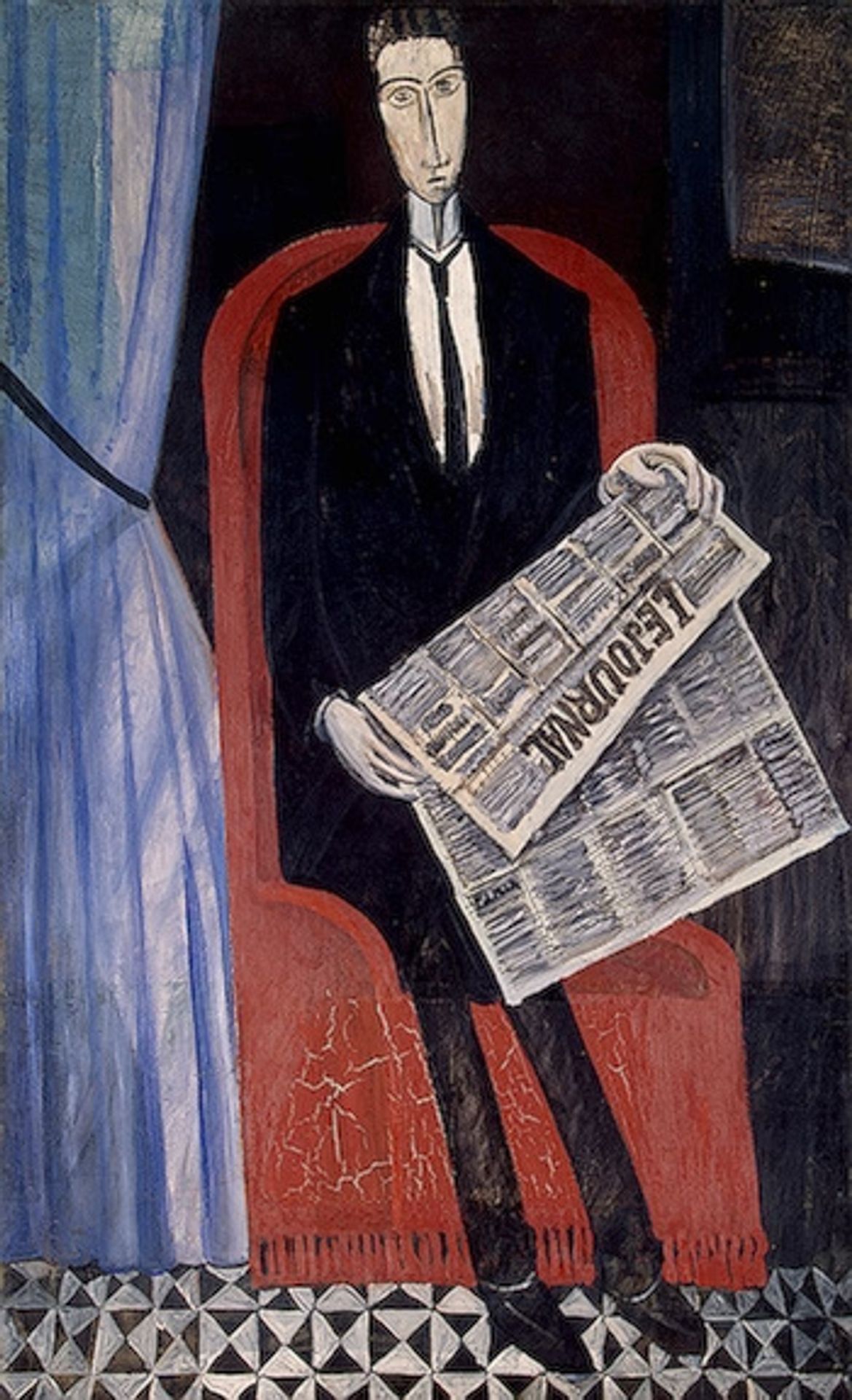
Portrait of a Man With a Newspaper


Listen to curator's interpretation
Curatorial notes
Curator: Andre Derain's "Portrait of a Man With a Newspaper," completed around 1913, is a striking oil painting currently housed in the Hermitage Museum. Editor: My first thought? Austere. There's something about the muted palette, the vertical composition and the man’s elongated features, that creates a feeling of coldness. Curator: Coldness is interesting...The subject appears confined and rigid; and the newspaper he's holding reads "Le Journal", positioning him not merely as a man but a man informed, perhaps representing a certain male bourgeois identity in early 20th century France. Editor: Note how Derain has employed bold brushstrokes; yet even with that dynamism the geometry persists: see the triangular floor tiles or how the sharp angles on the newspaper echo the chair and figure! It's a beautiful balance, where expressive marks reinforce a strict structure. Curator: Exactly. It's also hard to ignore the curtain on the left. Considering Derain's place in Fauvism, do you believe he intended to include it? Considering Fauvist interests, might that curtain not merely be an accoutrement but another representation of form, much like how identity is portrayed here? Editor: The curtain does soften an otherwise rigid painting; notice how its fluid forms act as a foil. Its addition also shows how Derain departs from strict realism while working within figuration, offering clues to the artist's broader semiotic system. Curator: Yes, that makes me wonder, how does the subject, likely wealthy, wield the knowledge disseminated by "Le Journal?" Consider the implications, particularly surrounding labor movements and early discussions of class, of how and for whom information is curated... Editor: Intriguing. What begins as a portrait morphs into a semiotic investigation of representation. It asks us to decode shapes, brushstrokes, colors to see what system generates such striking forms, with no resolution to any implied sociopolitical narratives... Curator: Precisely. Perhaps it's this tension that keeps this fauvist painting fascinating over a century later! Editor: Agreed! I came here thinking purely about visual balance but leave interested in historical power dynamics. That speaks volumes!