About this artwork
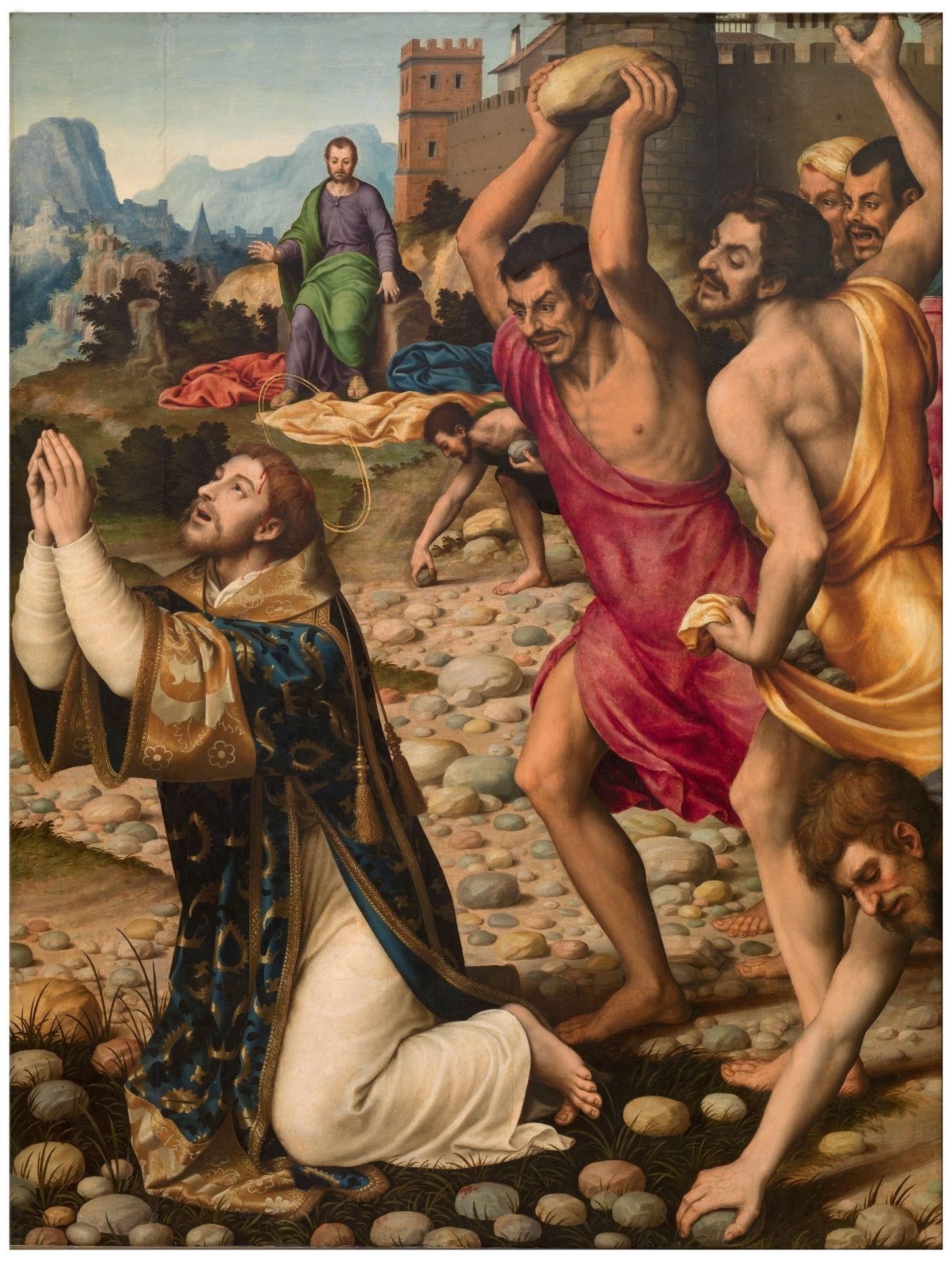
Editor: This striking oil painting, "Martyrdom of Saint Stephen" by Vicente Juan Masip, was created around 1562. I find the artist’s composition simultaneously chaotic and very deliberate, focusing on Stephen’s devout pose amidst such violent activity. What visual cues and symbols jump out at you? Curator: The stones are the immediate signifiers, aren't they? These smooth river stones become instruments of both death and religious fervour. Notice how the figure in the background is divesting himself of his outer garment; this symbolic moment suggests an abdication of worldly responsibility and adoption of a sacred duty. What do you think the painter is saying through that contrast? Editor: Perhaps it suggests that worldly concerns are unimportant in the face of what they believe is divine justice. What I don't understand is, is Stephen the only person experiencing religious ecstasy at the moment of his execution? I'm just trying to put myself into the painting, as he might feel? Curator: Consider how Masip renders Stephen’s gaze directed towards the heavens, as distinct from the downcast or averted eyes of his executioners. Stephen’s moment of transition is from the earthly to the celestial. His serenity represents his triumph over physical pain and mortal injustice. Editor: The idea of the smooth stones being used as instruments really struck me. Thanks, that context is helpful and powerful. Curator: Indeed! Thinking about symbols makes the event seem so much closer and more tangible. It underlines the complex role of memory.
Martirio De San Esteban
1562

Vicente Juan Masip
1507 - 1579Location
Museo del Prado, Madrid, SpainArtwork details
- Medium
- painting, oil-paint
- Dimensions
- 160 x 123 cm
- Location
- Museo del Prado, Madrid, Spain
- Copyright
- Public domain
Tags
Comments
Share your thoughts
About this artwork
Editor: This striking oil painting, "Martyrdom of Saint Stephen" by Vicente Juan Masip, was created around 1562. I find the artist’s composition simultaneously chaotic and very deliberate, focusing on Stephen’s devout pose amidst such violent activity. What visual cues and symbols jump out at you? Curator: The stones are the immediate signifiers, aren't they? These smooth river stones become instruments of both death and religious fervour. Notice how the figure in the background is divesting himself of his outer garment; this symbolic moment suggests an abdication of worldly responsibility and adoption of a sacred duty. What do you think the painter is saying through that contrast? Editor: Perhaps it suggests that worldly concerns are unimportant in the face of what they believe is divine justice. What I don't understand is, is Stephen the only person experiencing religious ecstasy at the moment of his execution? I'm just trying to put myself into the painting, as he might feel? Curator: Consider how Masip renders Stephen’s gaze directed towards the heavens, as distinct from the downcast or averted eyes of his executioners. Stephen’s moment of transition is from the earthly to the celestial. His serenity represents his triumph over physical pain and mortal injustice. Editor: The idea of the smooth stones being used as instruments really struck me. Thanks, that context is helpful and powerful. Curator: Indeed! Thinking about symbols makes the event seem so much closer and more tangible. It underlines the complex role of memory.
Comments
Share your thoughts