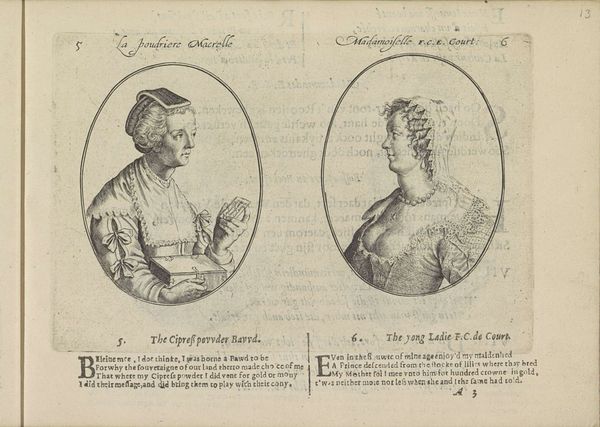
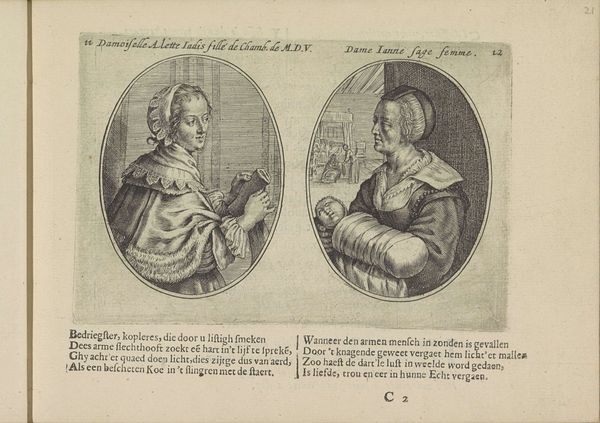
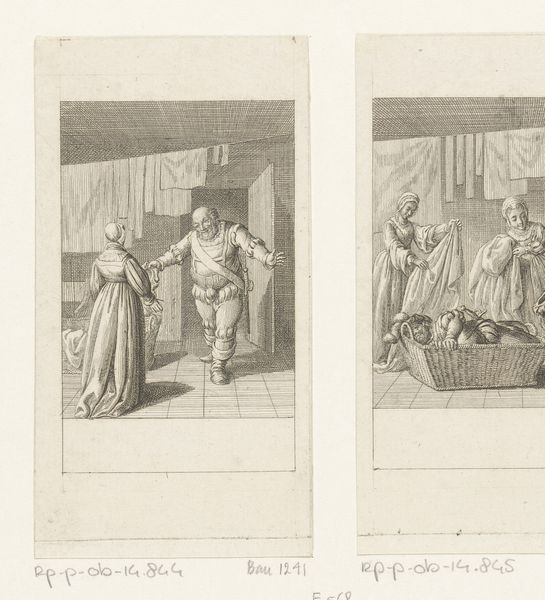
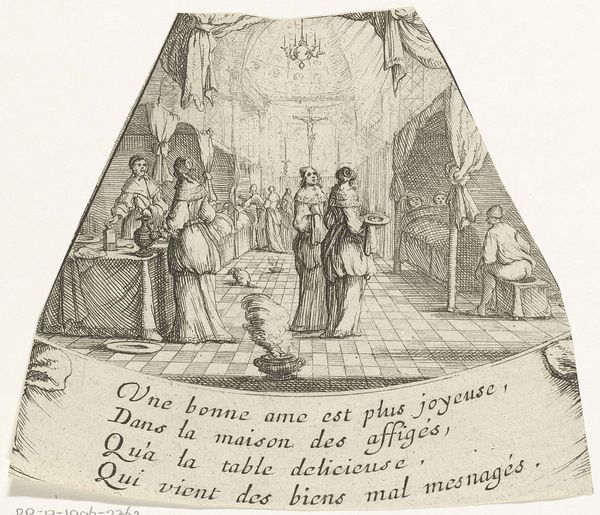
Ste. Helene, Octauie, Faustine, and Messalline, from 'The game of queens' (Le jeu des Reines renommées) 1644
0:00
0:00


drawing, print, etching, engraving
#
drawing
#
baroque
# print
#
etching
#
history-painting
#
engraving
Dimensions: Sheet: 3 1/2 x 8 11/16 in. (8.9 x 22.1 cm)
Copyright: Public Domain
Curator: Editor: So, we’re looking at "Ste. Helene, Octauie, Faustine, and Messalline, from 'The game of queens'," created by Stefano della Bella in 1644. It’s an engraving, and the starkness of the lines against the card format gives it a feeling of…cool detachment. How do you interpret this work? Curator: As a materialist, I’m drawn to the function of these prints. Think about the production – the labor of the engraver, the availability of paper, and the intended *use* of this series. It’s called "The Game of Queens," suggesting these images weren't just art, but tools for social engagement. The elite, specifically, may have seen in this series a reflection of the female role through history, to potentially legitimize the actions of women of power, no? What do you make of the medium and technique used here? Editor: Well, the engraving allows for multiple copies, right? So it makes it accessible to a wider audience. But it also, in a way, cheapens the individual value of each image. The content seems to be highlighting powerful women. Curator: Exactly. And it presents them as commodities. Think of the lines in the print – repetitive, uniform. That uniformity reflects the potential social control and classification inherent in "the game" of queens. The production is key; the method, and availability of that reproduction, shapes its consumption and therefore its value. Do you see this piece shifting the dynamic between high art and accessibility by examining its production of the many images? Editor: That's a fascinating way to see it – not just as a historical depiction, but as a manufactured representation of power itself. That really changes how I understand its historical importance. I didn't expect it to go that deep! Curator: Precisely, the material conditions of art production are deeply intertwined with how we understand power and meaning. I learned something about breaking conventional themes through understanding the social game played within.
Comments
No comments
Be the first to comment and join the conversation on the ultimate creative platform.
 Collect
 React
React Comment
More like this