

1882
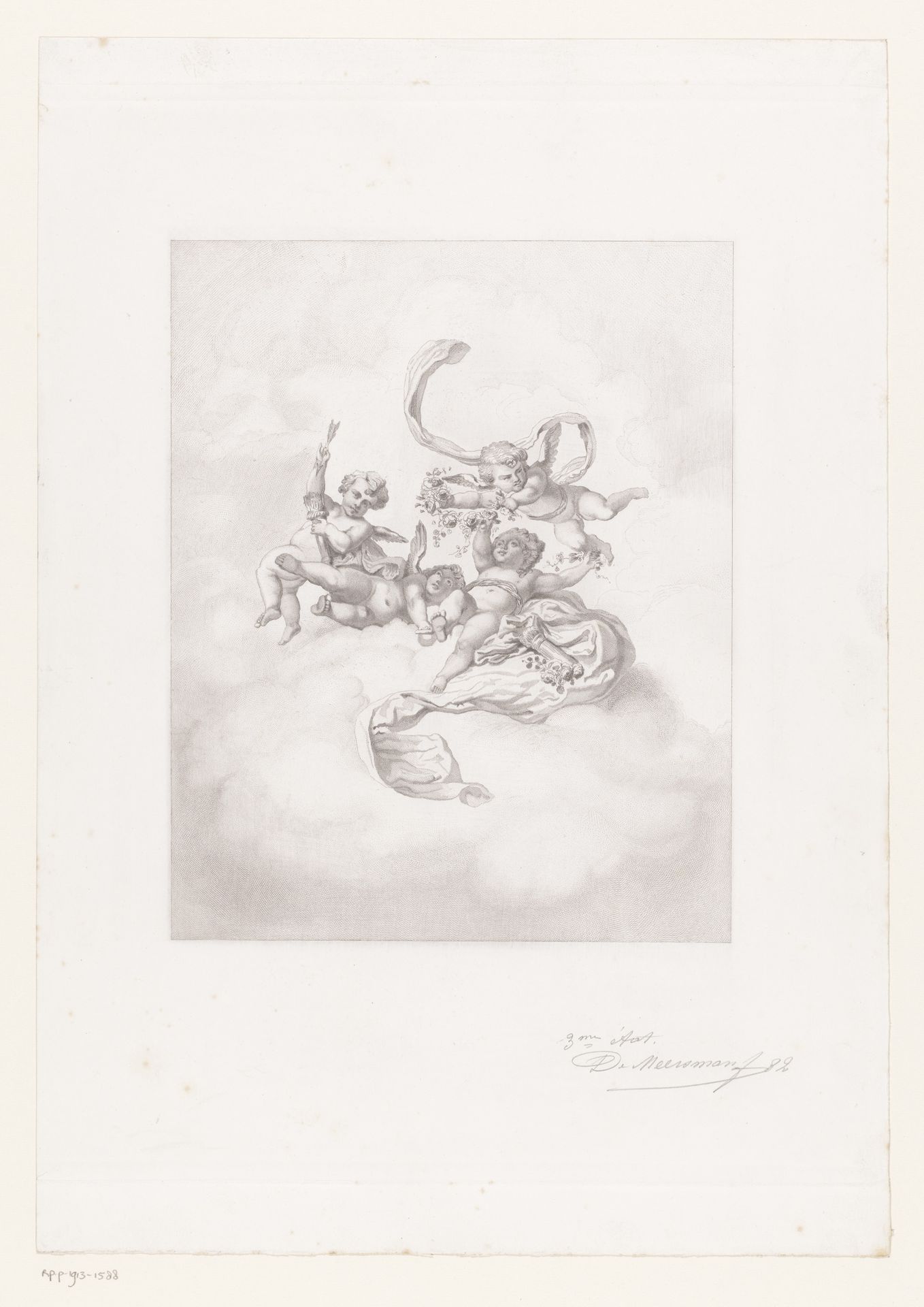
Putti op wolken met bloemen en pijlenkokers

Listen to curator's interpretation
Curatorial notes
Curator: Here we have "Putti op wolken met bloemen en pijlenkokers," or "Putti in Clouds with Flowers and Quivers," a pencil drawing created in 1882 by François de Meersman. It's a delicate rendering of cherubic figures amidst fluffy clouds. Editor: My immediate impression is lightness and grace. The softness of the pencil creates an ethereal atmosphere, almost dreamlike. It looks more like an invitation into an idealized realm than a definitive statement. Curator: Indeed. The putti themselves are traditional allegorical figures, often associated with love and innocence. Notice how they carry flowers and quivers – symbolic objects tied to Cupid, suggesting themes of affection and perhaps a playful take on matters of the heart. This artist, following academic style, revives Renaissance symbols. Editor: It’s interesting to consider the choice of pencil. Compared to the laborious nature of oil painting typical of academic art, a pencil drawing speaks to the artist’s accessibility, and speed. Pencil makes this topic immediate and light rather than a grandiose spectacle. I’d be curious to know what De Meersman was planning to do with the drawing – perhaps as preparatory work for a larger painting, or maybe intended to be an independent art piece. Curator: Perhaps intended as an independent work as you suspect, playing on themes popular at the time: innocence, beauty, the revival of classical allegories—these themes were easily consumable by the academic art world. Note, the artist leaves space around his ethereal creation; perhaps he hopes for contemplation. Editor: Looking at the wispy quality of the clouds, it’s fascinating how much atmosphere he achieved with such a simple material. The variations in pressure on the pencil create a real sense of depth and volume, turning what could have been a flat sketch into a seemingly breathable space. He also leaves space at the bottom of the piece, a suggestion of continuity, suggesting even greater depths, physically extending outside the drawing itself. Curator: Seeing such visual symbolism makes one recall our fascination with these iconic shapes; angels and putti cross time, offering a familiar language to diverse cultural perspectives. We see their enduring attraction. Editor: A drawing such as this reminds us how art production affects what we receive and interpret; how materials not only help the artists represent something but also, change how a piece enters the social space. Curator: It offers a timeless view. Editor: An example of technique turned metaphor.