Dimensions: height 95 mm, width 135 mm
Copyright: Rijks Museum: Open Domain
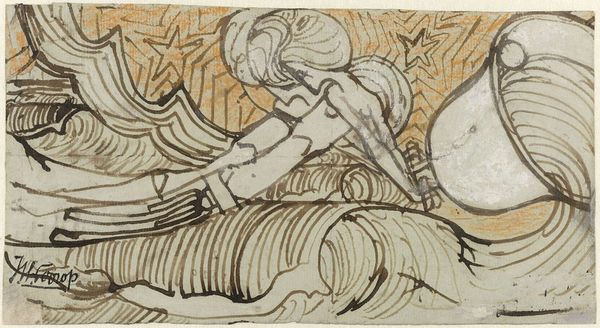
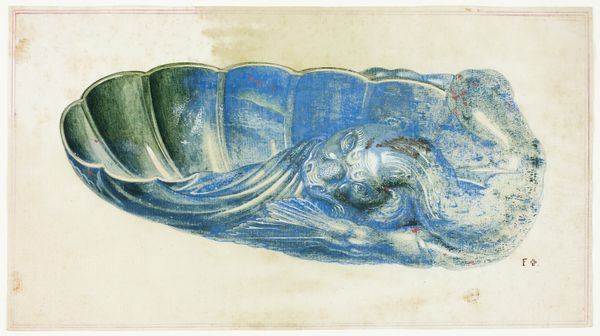
Curator: Here we have Willem Arondéus' "Op vleugelen van storm nadert de winter, november," which roughly translates to "On wings of storm winter approaches, November." This drawing is housed right here at the Rijksmuseum. Editor: My first impression is stark—the blue and ochre tones create a solemn mood, and that stylized figure looks windswept, almost overpowered by the elements. What process was involved in this linocut print, and how might that technique inform its message? Curator: I think Arondéus employs the linocut print to emphasize themes of transition and the cyclical nature of life through its visual simplicity and stark contrasts. The artwork invites us to explore concepts of vulnerability and mortality in light of changing environmental and social climates. Editor: Right, and the very act of carving into linoleum connects this image to the larger history of printmaking and working-class artistry, suggesting an intention to communicate ideas of survival through changing environments on a social level. I wonder about Arondéus's use of specific inks for their pigmentary composition. Curator: Well, from an intersectional viewpoint, you can see "November" acting as a visual elegy. Gender performance also stands out: the central figure challenges norms, appearing neither explicitly male nor female. Arondéus queers traditional symbols to suggest fluid identities, further destabilizing societal expectations surrounding power dynamics. Editor: It is as if Arondéus channeled a physical process of transformation in his image, by choosing linoleum. Its accessibility allowed the image to reach a larger demographic than painting alone. By producing multiples of his image it became an almost infinite potential to be circulated, shared, consumed and appreciated by individuals with varied societal experiences and backgrounds. Curator: Your observation reveals a very grounded social context behind Arondéus' work. Editor: In examining the materials themselves and recognizing the artist's intention, it enriches my overall experience with the artwork and how this image was produced and consumed in relationship to social narratives of his period. Thank you! Curator: Agreed, delving deeper, from an activist perspective, enriches the dialogue. Thank you, too!
Comments
No comments
Be the first to comment and join the conversation on the ultimate creative platform.
 Collect
 React
React Comment
More like this