oil-paint
#
portrait
#
figurative
#
oil-paint
#
oil painting
#
genre-painting
#
academic-art
#
portrait art
#
realism
Copyright: Public Domain: Artvee
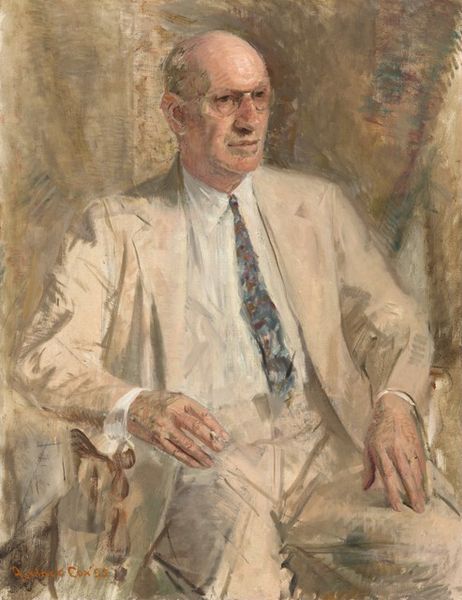
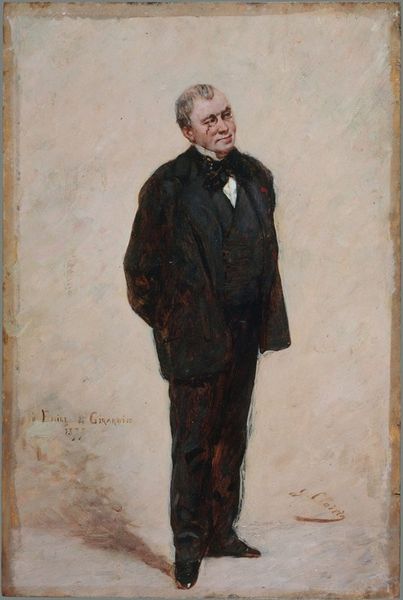
Editor: We’re looking at Thomas Eakins' oil painting, "Dr. David Hayes Agnew," possibly from 1889. The palette is very muted. I find myself wondering what a formalist lens can tell us about it, how do you interpret this work? Curator: Observe how the somber, almost monochromatic color scheme dominates the piece. Brown hues envelope much of the canvas, casting a veil over the subject. Now, consider how that palette choice interacts with the formal composition. Editor: Are you referring to how the subject is positioned off-center? Curator: Precisely. This asymmetrical placement, coupled with the direction of Dr. Agnew's gaze – averted and contemplative – injects a palpable sense of introspection into the portrait. Eakins has avoided conventional portraiture tropes. Instead of a straightforward, direct engagement, he creates visual tension. What feelings do you derive from the limited color and unbalanced composition? Editor: I see how the imbalance evokes a feeling of unsettledness. What's intriguing is how his light surgical coat stands out against the darker backdrop. Curator: It introduces an additional layer to the spatial dynamics within the painting. How do you perceive its impact in relation to Agnew’s gesture of holding a surgical tool? Editor: That's insightful. Now I'm perceiving his gaze and the surgical tool as signs that underscore his intellectual prowess. It highlights a complexity and depth beyond what is initially visible. Curator: Indeed, Eakins invites us to contemplate beyond surface representation, using formal qualities to signify more profound emotional and intellectual layers. Editor: That really alters my initial perception, thanks. Focusing on Eakins' deliberate color choices, composition, and subject placement is powerful.
Comments
No comments
Be the first to comment and join the conversation on the ultimate creative platform.
 Collect
 React
React Comment
More like this