


Curatorial notes
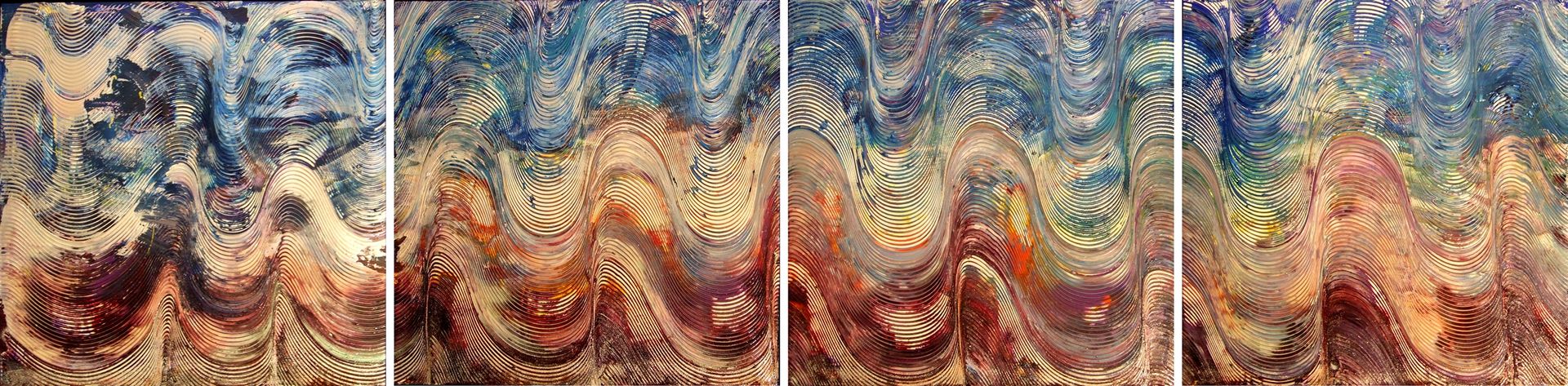
Editor: So, this is Charles Gibbons' "Vernazza" from 2007. It looks like acrylic on canvas. There's something so mesmerizing about the swirling lines and blending colours, creating almost a dreamy landscape. What do you make of this piece? Curator: Well, it strikes me as an interesting intersection of personal expression and wider societal trends in the art world at the time. Abstract expressionism, even in the 21st century, carries with it the weight of its historical moment— the post-war era, the Cold War. Does this work seem to carry a political message or reference socio-historical conditions? Editor: I don't immediately get a direct political vibe, but the abstraction kind of blurs the line. The 'landscape' seems more like an emotional space. Curator: Exactly. And think about the role of institutions, of galleries, in promoting certain styles at different times. Abstract expressionism became incredibly popular in the US, especially because it could be positioned against socialist realism, right? Do you think a piece like this, produced much later, can still be seen in relation to that historical context? Editor: Possibly. There's almost a freedom in the abstraction. But also, I wonder if the location, implied in the title "Vernazza," which is a place in Italy, contributes? Does that geographic connection provide any commentary, contrasting a specific place against a generalized 'dreamy' feel? Curator: Good question. Is this image readily recognizable as “Italy”? By titling the work with an Italian location, the artist is maybe responding to or subverting established, perhaps even romanticized, depictions. Could this abstraction serve to democratize the representation, moving away from postcard perfection to a more individual perception of place? Editor: I guess so! I never considered the political undertones of landscapes, especially in relation to their accessibility. Curator: Precisely! This goes to show that even the seemingly most apolitical artworks engage in historical and political discourse.