About this artwork
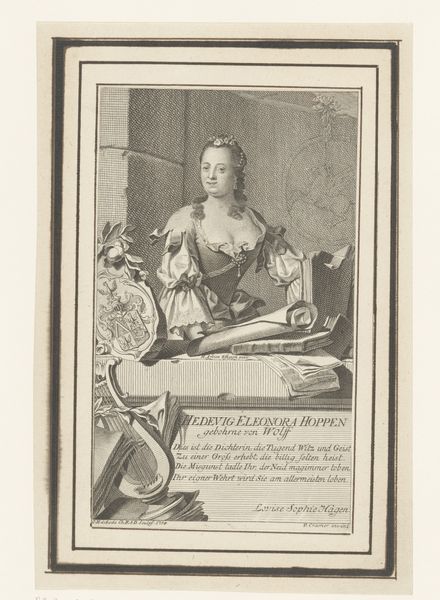
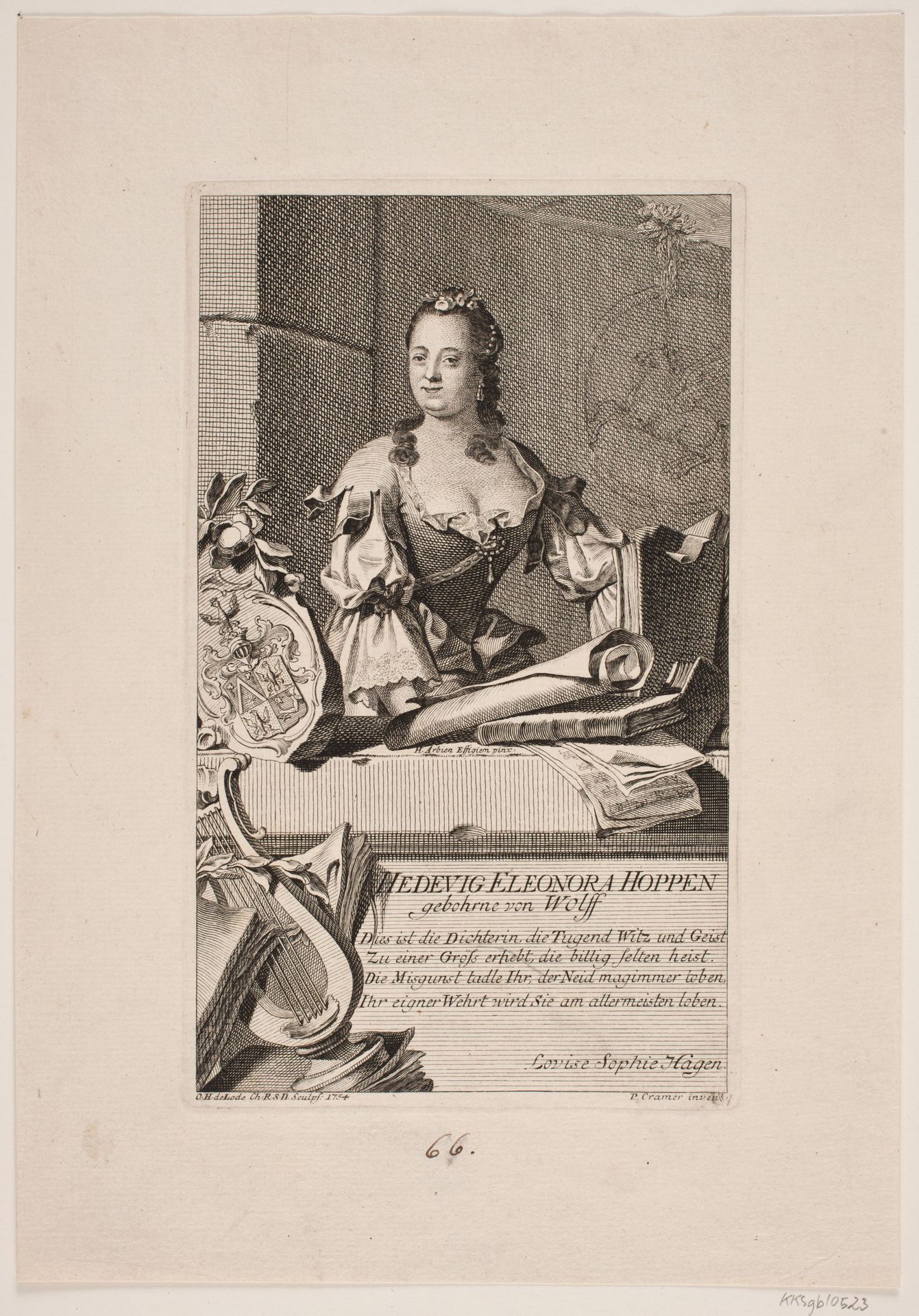
This engraving of Hedvig Eleonora Hoppe by Odvardt Helmoldt de Lode presents us with a constellation of symbols indicative of her status and intellect. The books and the harp beside the noblewoman indicate her erudition and artistic skill, hallmarks of a woman of quality in the 18th century. Consider the book, an emblem of knowledge that stretches back to antiquity. Initially, books symbolized divine wisdom, as seen in ancient Egyptian scrolls. Here, the presence of books serves to attribute intellectual prowess to Hoppe, aligning her with a lineage of learned figures. This symbolism, however, is not static. Over time, the book evolved from being a sacred object to representing individual enlightenment and social status, encapsulating centuries of collective aspirations for knowledge. These symbols are powerful vessels of cultural memory, engaging us in a deep, subconscious dialogue across time. The portrait becomes more than a mere likeness; it's a potent declaration of cultural identity. The way the symbolic language evolves is not linear. Rather, it resurfaces in art and continues to shift in meaning over time.
Hedvig Eleonora Hoppe
1754


Artwork details
- Medium
- print, paper, engraving
- Dimensions
- 181 mm (height) x 109 mm (width) (plademaal)
- Location
- SMK - Statens Museum for Kunst
Tags
Comments
Share your thoughts
About this artwork
This engraving of Hedvig Eleonora Hoppe by Odvardt Helmoldt de Lode presents us with a constellation of symbols indicative of her status and intellect. The books and the harp beside the noblewoman indicate her erudition and artistic skill, hallmarks of a woman of quality in the 18th century. Consider the book, an emblem of knowledge that stretches back to antiquity. Initially, books symbolized divine wisdom, as seen in ancient Egyptian scrolls. Here, the presence of books serves to attribute intellectual prowess to Hoppe, aligning her with a lineage of learned figures. This symbolism, however, is not static. Over time, the book evolved from being a sacred object to representing individual enlightenment and social status, encapsulating centuries of collective aspirations for knowledge. These symbols are powerful vessels of cultural memory, engaging us in a deep, subconscious dialogue across time. The portrait becomes more than a mere likeness; it's a potent declaration of cultural identity. The way the symbolic language evolves is not linear. Rather, it resurfaces in art and continues to shift in meaning over time.
Comments
Share your thoughts