photography, gelatin-silver-print
landscape
photography
orientalism
gelatin-silver-print
19th century
history-painting
academic-art
Dimensions: height 65 mm, width 102 mm
Copyright: Rijks Museum: Open Domain
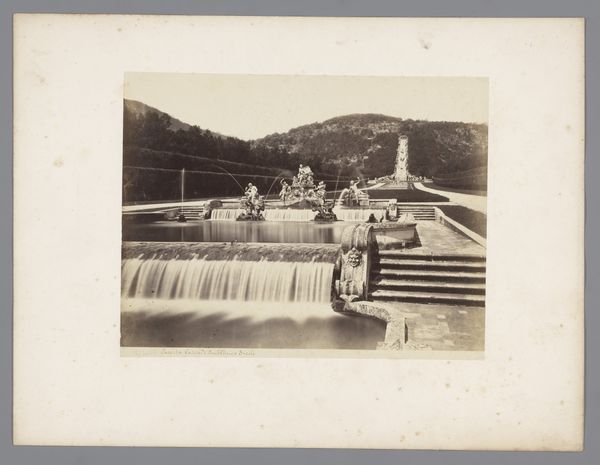
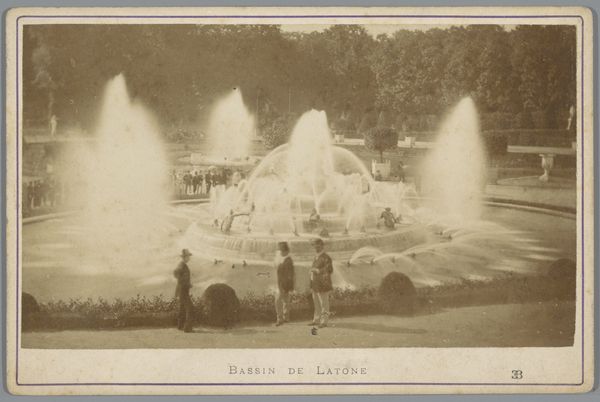
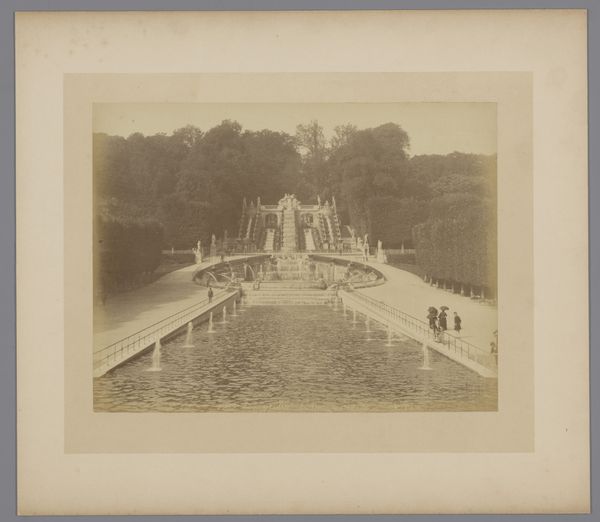
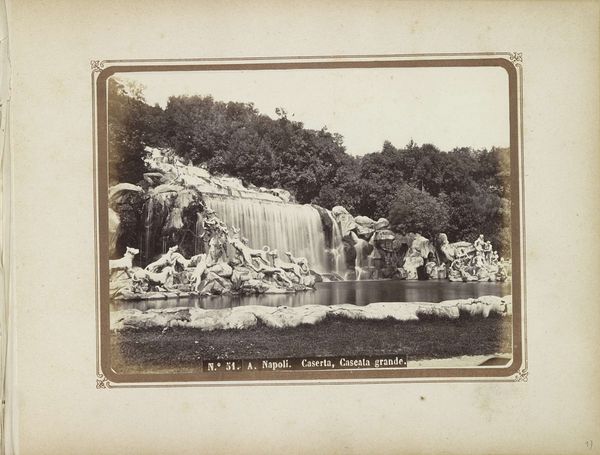
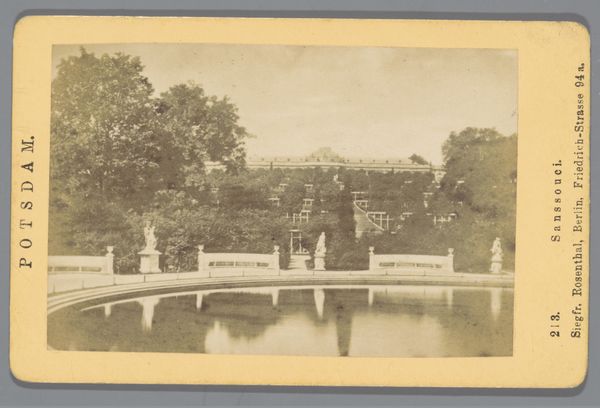
Curator: I am immediately struck by the symmetry of this photograph, almost overwhelming in its classical precision. Editor: Indeed. Here we have Giorgio Sommer's "Watervallen in de tuin van het paleis van Caserta," taken sometime between 1865 and 1888. Sommer was known for documenting southern Italy, often catering to the Grand Tour travelers. This image, a gelatin-silver print, really shows off the palace gardens. Curator: "Catering" feels too simple, doesn't it? It has an almost theatrical grandeur, those descending waterfalls… They aren't just pretty; they speak to a desire for control over nature itself. The workers must have put a monumental shift to bring this palace garden to its current state. Editor: Absolutely. The sheer scale of it screams labor and resource extraction. Think about the quarrying of the stone for those cascading pools, the engineering to divert and manage that water, the cost… it all reinforces social hierarchies. The making of a garden, like this one in the photo, is rarely ever a natural act. Curator: And that slightly hazy quality… it feels like looking into a dream of power. It's almost disquieting, that flawless, controlled perspective. The ladies seated on the stairway also reflect some of this haze: where is that fine line between the real and the imagined, in your opinion? Editor: It’s interesting you mention the figures seated on the steps; these women may be wealthy visitors consuming the gardens and Italian sunshine, but how did their wealth originate? The clean water also belies so many possible inequalities when it comes to resources. Curator: The image asks many questions, doesn’t it? And it is an image designed for the tourist's eye— a memento of perfect beauty, conveniently forgetting that "perfection" usually comes at a high cost. Even the technique itself speaks to that; the painstaking chemical process, the skill in capturing this vista...it's an illusion, beautifully crafted. Editor: Yes, thinking about photography this way helps break down assumptions around photographs as simple ‘captures’ of reality. And ultimately, how art perpetuates or subverts these socio-economic narratives becomes visible, doesn’t it? Curator: Very much so! It allows the photograph to ask different questions, to ripple into different directions of what 'beauty' means. Thanks for unveiling some more possible layers.
Comments
No comments
Be the first to comment and join the conversation on the ultimate creative platform.
 React
React Comment