1980
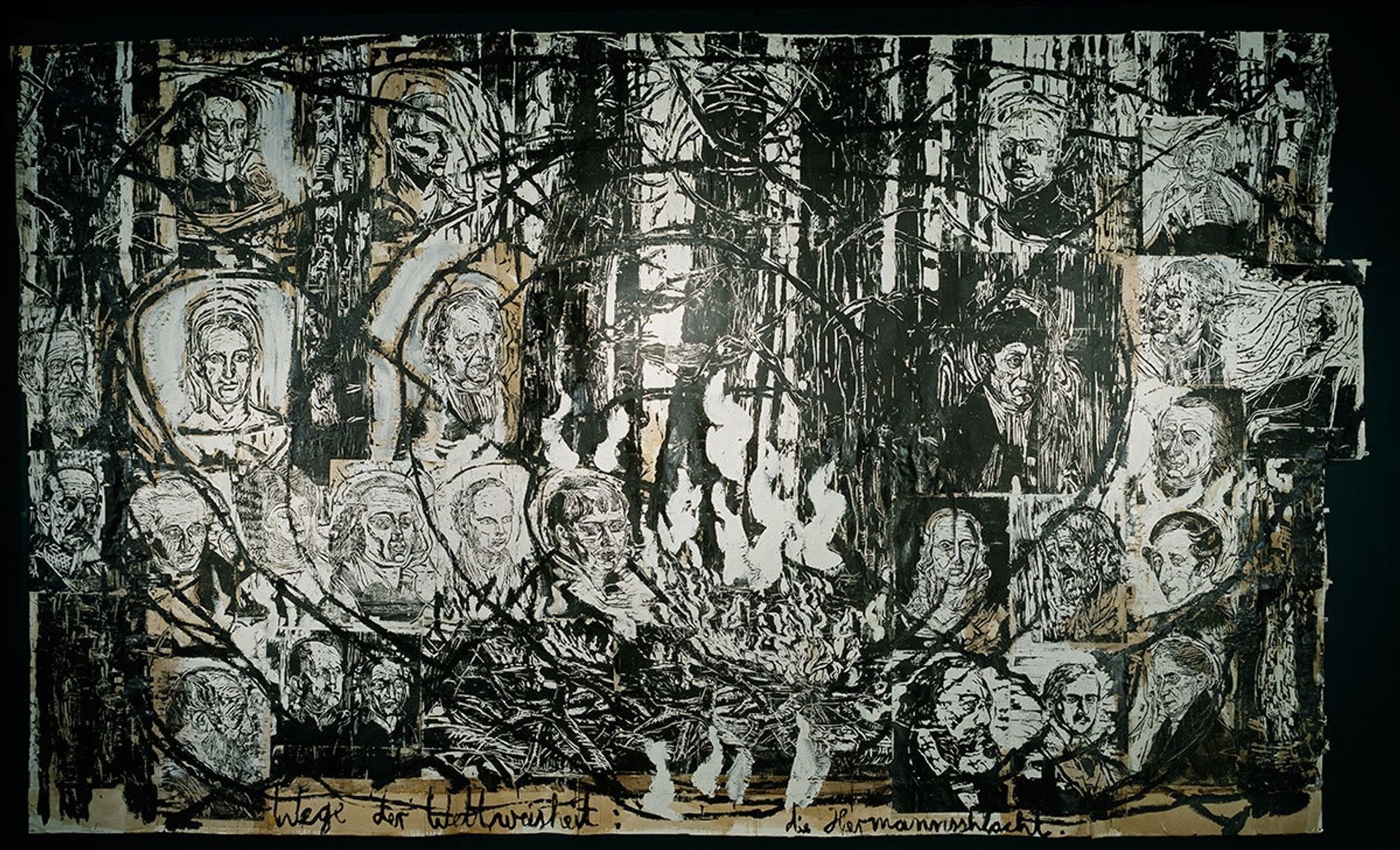
Ways of Worldly Wisdom. The Battle of Hermann,

Listen to curator's interpretation
Curatorial notes
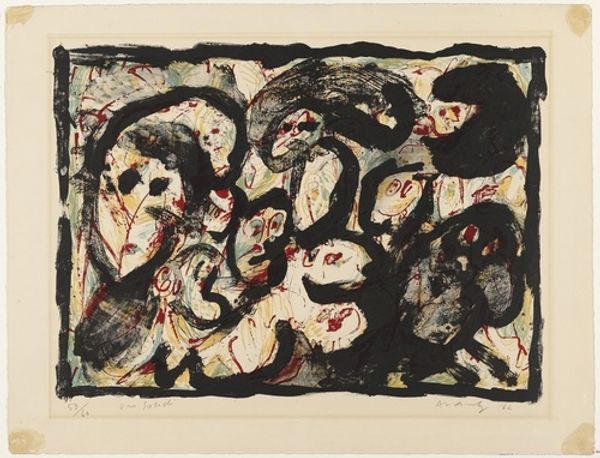
Curator: Let's discuss Anselm Kiefer's "Ways of Worldly Wisdom. The Battle of Hermann," created in 1980, employing mixed media—acrylic paint and collage. What strikes you first about it? Editor: The immediate impression is one of oppressive darkness. A cacophony of faces peers out from this dense, almost impenetrable forest of black and white. It’s heavy, brooding, even disturbing. Curator: The somber mood certainly reflects the work's subject matter. Kiefer directly confronts German history, specifically referencing the Battle of the Teutoburg Forest, a pivotal moment in German identity. This event, where Germanic tribes defeated Roman legions, became highly mythologized, particularly during periods of nationalism. Editor: So these assembled figures are representative of German intellectual and historical figures, almost like a gathering for some spectral ritual. I can't help but read the scene around them as deeply problematic. Kiefer doesn’t just present history, but critiques its construction, its often romanticized version. Curator: Precisely. Kiefer explores how national myths are formed and manipulated. The layering of paint, the collage elements, the monochrome palette—all these contribute to a sense of historical excavation, digging up uncomfortable truths. There is no glory in its history, just its unearthing. Editor: And the title itself, “Ways of Worldly Wisdom,” feels laced with irony. Whose wisdom? The figures appear disembodied and almost trapped, lost within a narrative, within this battle. It also reflects the art world during this time, where painting and expressionism, in general, took on political meaning. Curator: The '80s was a transformative era in post-war Germany with the rise of neo-expressionism. By confronting and deconstructing the weight of the past, Kiefer invites the audience to confront its legacy too, to actively question national narratives and avoid romanticizing violent history. Editor: It’s a crucial reminder that history is never a settled, objective truth but is shaped, molded, and at times, weaponized. Works like this spark that urgent conversation. Curator: Indeed, its unsettling ambiguity is perhaps its most enduring quality, prompting us to look critically at our own inherited "wisdom".