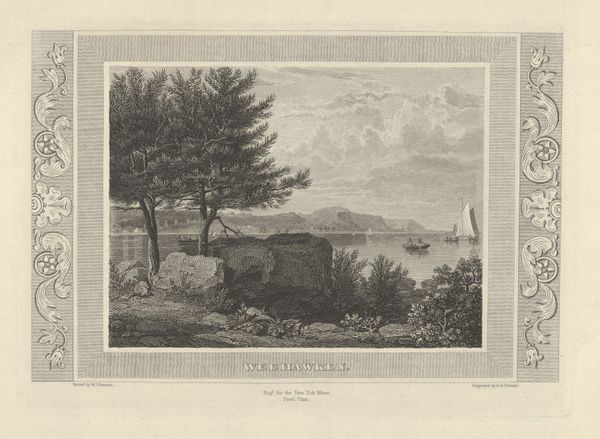
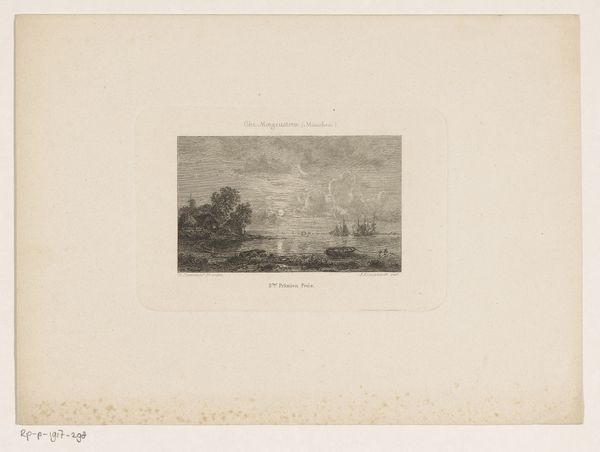
The American Landscape, No. 1, Engraved from Nature Expressly for This Work, and from Well Authenticated Pictures, With Historical and Topographical Illustrations 1830
0:00
0:00


drawing, print, etching, paper
#
drawing
# print
#
etching
#
landscape
#
paper
#
nature
#
romanticism
#
hudson-river-school
Dimensions: 13 x 10 1/16 in. (33 x 25.5 cm)
Copyright: Public Domain
Editor: This etching from 1830, "The American Landscape, No. 1," aims to capture an authentic view of the American landscape. What strikes me is how peaceful it looks, with boats gently sailing. How do you interpret this work within its historical context? Curator: That sense of peace is precisely where the political project of landscape art begins. What’s not pictured is the process of land appropriation and Indigenous removal necessary to create the idea of an untouched "American Landscape". Notice the detailed depiction of nature – trees, water, and sky are rendered with care. Do you think that meticulous detail suggests anything? Editor: Perhaps a sense of reverence, like the land is being honored or documented with precision. Curator: Exactly. But whose perspective is privileged here? This image appeared during a period of intense territorial expansion. The beauty of the landscape served to legitimize this expansion, erasing the violence inflicted upon Native populations. We need to consider how notions of "American-ness" were constructed and at whose expense. How does seeing it this way change your perspective? Editor: It makes me question the idea of a neutral landscape. I had only seen the surface beauty. The image now carries the weight of the historical context and the unspoken stories it conceals. Curator: It's crucial to understand art as a product of its time, shaped by political and social forces. Thinking about it in intersectional ways, and through different theoretical lenses allows a more critical understanding of our past. Editor: Thank you. I'll never look at landscapes the same way again!
Comments
No comments
Be the first to comment and join the conversation on the ultimate creative platform.
 Collect
 React
React Comment
More like this